
BNP leader Tarique Rahman returns: Who is Bangladesh’s potential next PM?
 25 December 2025
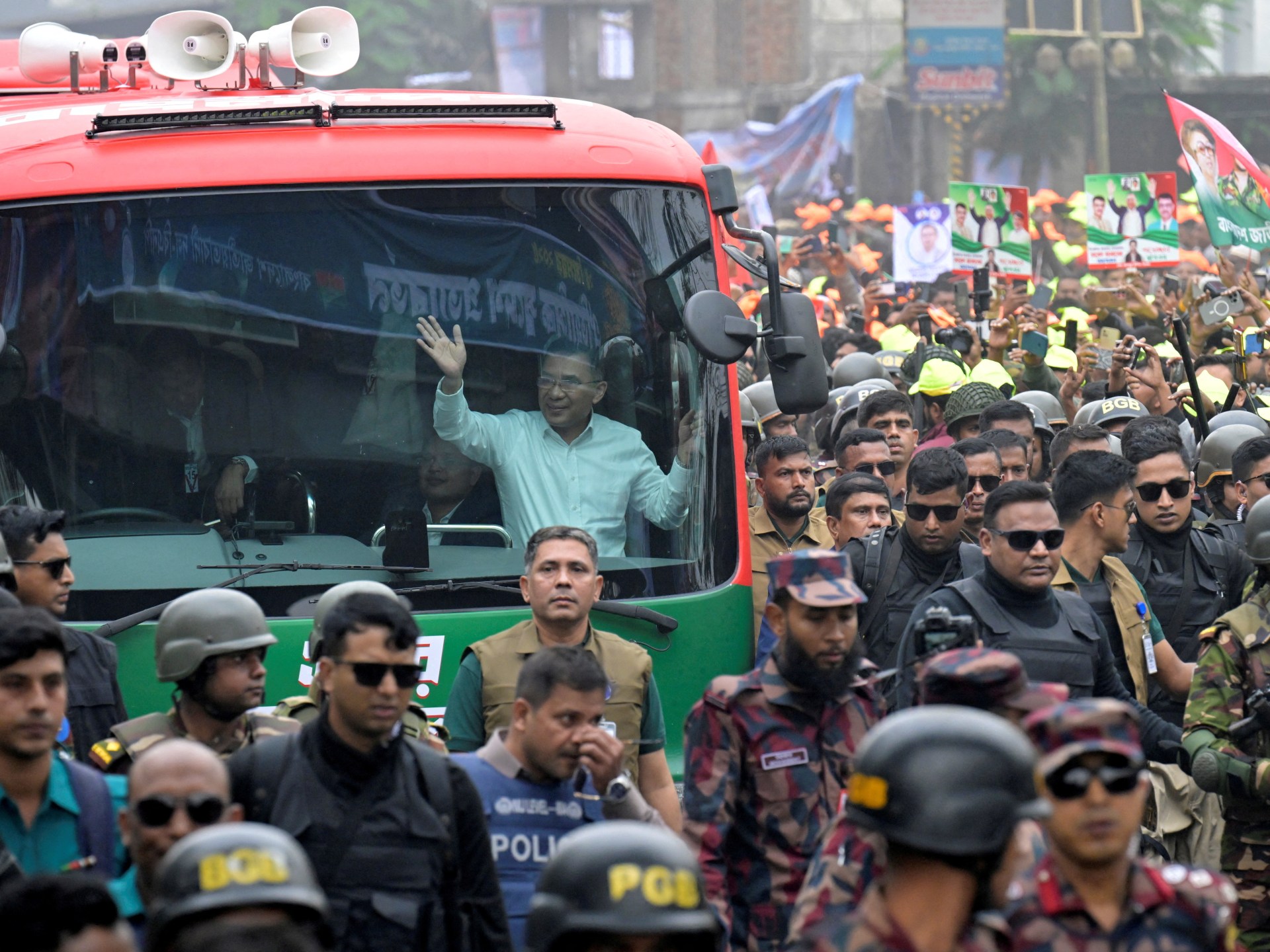

After 17 years in exile, Tarique Rahman, leader of the Bangladesh Nationalist Party (BNP) and frontrunner to be the South Asian nation’s next prime minister, returned to Dhaka on Thursday to a rousing welcome by thousands of his party’s supporters.
Rahman, long seen as a prince of Bangladeshi politics, got down at the Hazrat Shahjalal International Airport in Dhaka, alongside his wife Zubaida and daughter Zaima, and stood barefoot on Bangladeshi soil amid heavy security.
Rahman’s symbolic gestures marking his return to Bangladesh come at a crucial juncture in the country’s politics, and represent a major shot in the arm to the BNP cadre and leaders. An interim government, led by Nobel laureate Muhammad Yunus, has been in power since August 2024, following the ouster of then-Prime Minister Sheikh Hasina in a student-led uprising. The Yunus administration has announced elections on February 12, after which it is to peacefully transfer power to an elected government.
Rahman’s mother, the former Prime Minister Khaleda Zia, has been hospitalised in a critical condition since November 23. As the de facto leader of the BNP, Bangladesh’s largest political party, Rahman might be holding the nation’s reins soon.
So, here’s everything you need to know about him, his life in exile and the significance of his return for the South Asian nation.

Who is Rahman?
Rahman, 60, is the eldest son of former Bangladesh President Ziaur Rahman and Khaleda Zia, who in 1991 became the country’s first female prime minister.
Advertisement
Rahman has lived in London since 2008 and has led the BNP as acting chairman since 2018, when his ailing mother, Zia, was jailed under the rule of her political rival and then prime minister, Hasina.
He became a major public figure during his mother’s second term in power, from 2001 to 2006. But he also drew allegations of cronyism, corruption and political violence. A military-backed caretaker government that held office between 2006 and early 2009 investigated those allegations.
In March 2007, he was arrested by army units that dramatically pulled up outside his luxury Dhaka house late at night. Months later, he was released on bail and flew to the United Kingdom for medical treatment — not returning until Thursday.
Rahman and the BNP have consistently described the accusations against him as politically motivated, but his reputation for corruption extended beyond his political opponents. Rahman’s name popped up in leaked diplomatic cables, published by WikiLeaks in 2011, where American diplomat James F Moriarty described him as a symbol of “kleptocratic government and violent politics”.
Recommending blocking his entry into the United States, the American embassy in Dhaka wrote: “In short, much of what is wrong in Bangladesh can be blamed on Tarique and his cronies.”
He was subsequently convicted by the Awami League government on charges of money laundering, fraud and political violence – including a grenade attack on rival Hasina’s rally in 2004 that killed at least 20 people.
But after the August 2024 uprising against Hasina, the charges and convictions against Rahman have mostly been stayed or overturned, facilitating his return to Dhaka.
Addressing his supporters at a rally in Dhaka on Thursday, Rahman said, “Just like 1971, people from all walks of life, all together, defended the independence and sovereignty of this country in 2024,” referring to the country’s war of independence from Pakistan in 1971, and Hasina’s ouster last year.
He called for an inclusive Bangladesh, saying, “It is time for us all to build the country together. We want to build a safe Bangladesh. In Bangladesh, no matter who a woman, man, or child is, they should be able to leave their homes safely and return safely.”

Why was Rahman in exile?
Since 1991, Khaleda and Hasina – two female leaders of opposing political dynasties – have alternated power for more than three decades, barring a few transitional heads.
Advertisement
Hasina, who led the Awami League, entered politics after the assassination of her father, Sheikh Mujibur Rahman, Bangladesh’s founding president, who was killed along with most of his family in a military coup in August 1975; Khaleda rose after the assassination of her husband, Ziaur Rahman, a former army chief who became president and was killed in a failed coup in May 1981.
The parties have remained political rivals for decades, except for a brief period when they joined forces to regain power from a military leader, General Hussain Muhammad Ershad, in the late 1980s.
In 2009, after Hasina returned to power in Dhaka after eight years in opposition, Zia’s BNP found itself on the other side of the crackdown during Hasina’s long, uninterrupted years of rule.
While several BNP leaders and activists faced abuse, jail, and trials, Rahman had flown to the UK in September 2008, after he was released on bail following nearly 18 months in detention during the 2007-08 emergency rule.

After years at the helm in Dhaka, Hasina was confronted last year by a popular, student-led uprising. The protests began as a campaign against a controversial affirmative-action policy for government jobs, but amid a brutal crackdown by security forces, escalated into wider demands for an end to her rule. The United Nations says up to 1,400 people were killed.
Anger grew over her iron-fisted 15-year leadership, during which thousands of political opponents and critics were arrested, killed, tortured or forcibly disappeared. In elections widely viewed as illegitimate, Hasina won landslides in 2014, 2018 and 2024.
Ultimately, protesters overran her residence after she fled Bangladesh by helicopter on August 5, 2024, to India.
Last month, Hasina was sentenced to death by hanging after she was found guilty of crimes against humanity for ordering the deadly crackdown against the student-led uprising, by a tribunal. The Awami League, her party, has been barred from participating in the February elections.
Meanwhile, interim leader Yunus met Rahman during a visit to London in June.
Rahman has also returned at a time when his mother, Khaleda, is in hospital. Some analysts believe that the BNP is now trying to claim the political space vacated by the ban on the Awami League — with secular, liberal, centrist positions. They cite the BNP’s recent breakup with the Jamaat-e-Islami, the country’s largest Islamist force and a longtime ally of Rahman’s party.
Jon Danilowicz, a former US diplomat who spent eight years working in Bangladesh, said Rahman’s return was “the last piece of the puzzle as far as Bangladesh’s preparations for elections are concerned”.
Danilowicz told Al Jazeera that by leading the BNP campaign, “Rahman would have an opportunity to learn more about what has changed in the country over the past 17 years, and his fellow Bangladeshis will get to know how he has changed during this period.”

How is the BNP placed for the upcoming election?
The BNP is seen as the frontrunner to secure a majority vote in the upcoming elections, which would mark a return to the government after nearly two decades for the party.
Advertisement
A December poll by a United States-based nonprofit, the International Republican Institute (IRI), showed the BNP leading with 30 percent support, followed by the Jamaat-e-Islami with 26 percent. Bangladesh follows a first-past-the-post system in its elections, so in a multiparty contest, candidates do not need a majority to win.
The National Citizen Party (NCP), formed by a faction of student leaders after the uprising, has been struggling to convert street power into electoral strength due to weak organisation and limited funds. The party trails far behind the BNP, with just 6 percent support, according to the IRI poll.
With Hasina’s Awami League barred from participation in the election, Rahman’s BNP looks poised in a favourable electoral landscape for the post-Yunus period in Bangladesh.
Danilowicz, the former US diplomat, noted that the upcoming election is BNP’s to lose; “The party has demonstrated great resilience over the past 17 years; it has been out of government, with party leaders facing the full repressive force of the state,” he said.
Now, upon his return, Rahman also faces the weight of his own political legacy: “The challenge will be integrating [Rahman’s] small core of trusted lieutenants who stuck with him throughout his exile with the broader party apparatus that was assembled by his mother, and which remained in the country.”
Related News

US House passes record-breaking $901bn defence spending bill
Islamic University of Gaza resumes classes on site amid Israeli destruction

Bangladesh opposition leader Tarique Rahman returns after 17 years in exile
