US dollar: ‘Wounded hegemon’ or secure as most powerful currency on earth?
 27 January 2026

Johannesburg, South Africa – On a late November morning – two days before leaders of the world’s leading economies convened in Johannesburg for the 2025 Group of 20 summit – the governors of the South African and Chinese central banks met just 20 minutes away to inaugurate a system that many hope can help move international trade out of the shadow of dollar dominance.
At a ceremony at the South African Reserve Bank in Pretoria that day, Standard Bank – Africa’s largest by assets – became the first on the continent to link directly into China’s Cross-Border Interbank Payment System (CIPS). This integration means African businesses can now settle payments with China directly in renminbi without the use of any intermediary currency – notably the United States dollar (USD).
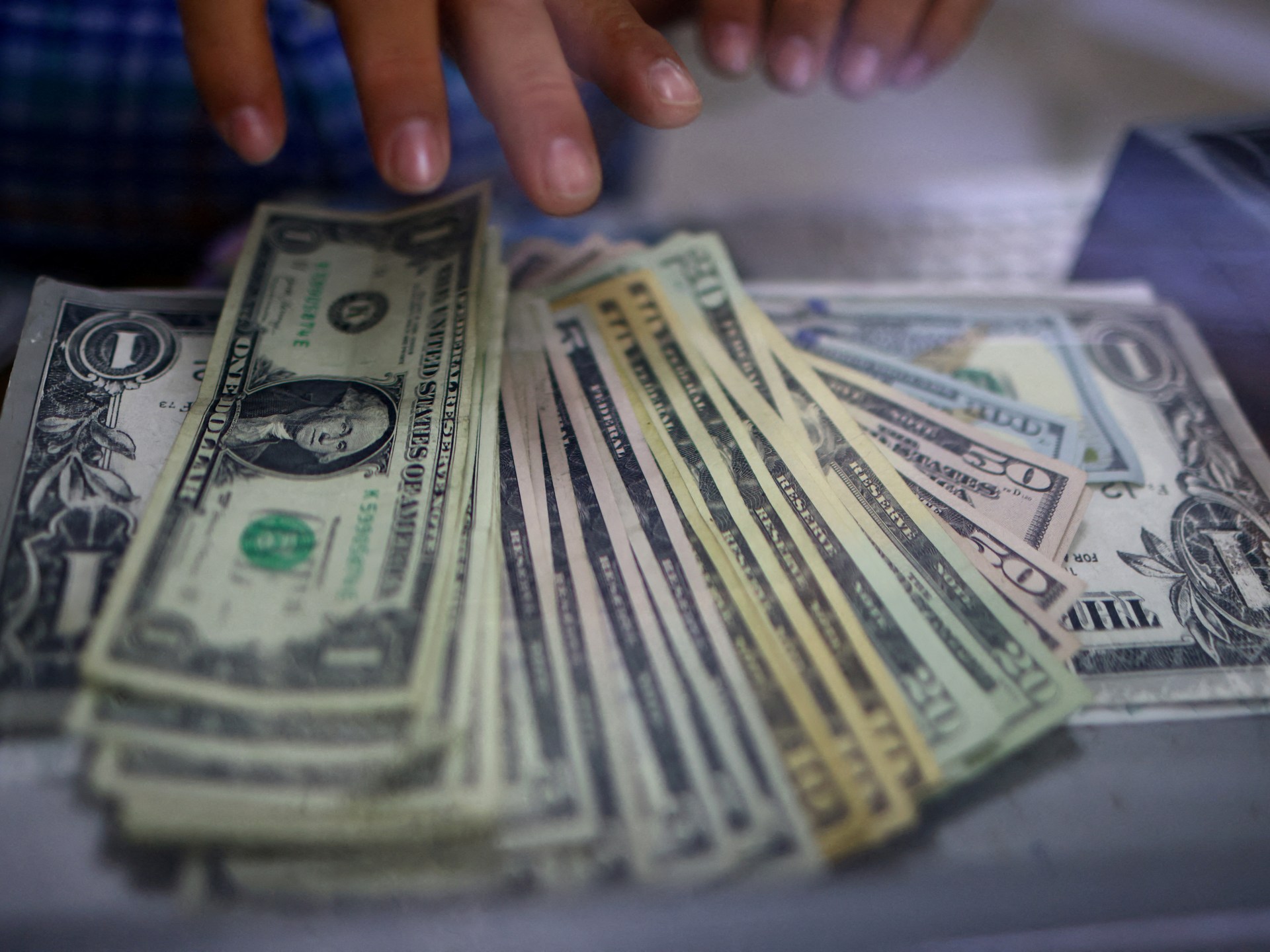
The USD has been the world’s principal reserve currency since the end of World War II, and is used in more than 80 percent of international trade today.
But in recent years, talk of alternatives to the greenback has been gaining traction, particularly in the Global South, and spearheaded by the BRICS group of developing economies, of which South Africa is a part, along with Brazil, Russia, India and China as the founding members. Egypt, Ethiopia, Indonesia, Iran and the United Arab Emirates have also joined in recent years.
Like South Africa, Brazil has also integrated into CIPS. At the same time, it has increasingly been using the real and the yuan to settle bilateral trade with China, such as in the sale of soya beans, bypassing the USD.
Advertisement
Other countries have also been leaning into the use of local currencies. India and the UAE have traded in rupee and dirham, while China and the UAE have settled liquefied natural gas (LNG) trade in yuan. China has traded with others, including Argentina, Iraq and Saudi Arabia, using the yuan. And China and Russia have sharply shifted their bilateral trade settlement into local currencies, partly as a workaround to bypass Western sanctions. China’s oil trade with Iran and Russia has mainly been settled in renminbi. India and Russia have increased the use of roubles and rupees for their bilateral trade.
As a group, BRICS is also pushing ahead with its Bridge digital currency that, if successful, would allow them to trade bypassing both the USD and the Society for Worldwide Interbank Financial Telecommunication (SWIFT) – a messaging network banks use to facilitate international payments, which is heavily influenced by US and European Union regulations. Although the Bridge system is not yet active, a working model is expected to be presented during this year’s BRICS summit in India.
For analysts, bilateral trade allowing countries to set their own terms has always been part of international economics. So such endeavours are not new or unexpected.
However, they are increasing in frequency as there is more incentive to move away from sole dependence on the USD, say analysts.

While the US, as the world’s leading economy, has historically dominated global trade, that influence has waned over the last decade, with China taking the lead, especially in the Global South, which accounts for 85 percent of the world’s population and about 50 percent of global gross domestic product (GDP).
In Africa, for example, China was the source of most of the continent’s imports in 2024, followed by the EU, India and the US, according to the United Nations Comtrade database. For that reason, bilateral trade in local currencies, or integrating CIPS, makes economic sense, analysts say.
“For every time you do a transaction in the dollar, there is a hidden cost that goes back to the US,” notes Sanusha Naidu, a foreign policy analyst at South African think tank, the Institute for Global Dialogue.
Now, according to the analyst, countries around the world have rightly started asking: “Why must we pay the US that cost?”
Instead of the buyer’s local currency getting converted into USD before being converted into the seller’s currency, with both parties risking losing some revenue in the process, money can now flow directly.
Advertisement
But for Danny Bradlow, a professor with the Centre for Advancement of Scholarship at the University of Pretoria, local currency trade faces challenges; and these are less about what is possible and more about what is practical.
Although two countries can trade in whatever currency they choose, whether each party would want stores of the other’s currency is unclear, he said.
For example, if two countries with not many transactions between them – like Botswana and Mexico – want to trade goods, it would be more practical for them to convert pulas and pesos into dollars to trade with the in-demand USD than to keep large amounts of one another’s tender.
Another challenge in bypassing the USD is that the “infrastructure that supports trade settlement in local currencies must first be in place to ensure the wide adoption of local currency transactions”, said Shirley Yu, managing director of ACME Macro Advisory and director of the China-Africa Initiative at the London School of Economics.
As well as CIPS, she pointed to BRICS Pay (a decentralised financial messaging and payment system designed for BRICS nations) and Project mBridge (a multi-central bank digital currency platform), which are enabled by blockchain technology. “The technology infrastructure itself enables countries to trade in local currencies without going through SWIFT or using the dollar as the medium of exchange”, but these need to be built up, she said.
Although the number of local currency transactions is increasing, it is still a fraction of what goes through SWIFT and the USD. The Chinese currency is still involved in less than 10 percent of global trade, for instance. While other currencies, like the European tender, are also in use globally, Yu noted that “the renminbi is a bigger trade settlement currency than the euro”.
‘Incentives’ to change
But what has shifted and grown dramatically are “the incentives to change and develop alternatives”, said Bradlow of Pretoria University, “and one of the ways you see that is that the price of gold is going up so much”.
Countries are no longer treating the USD as a fully stable reserve currency; instead, they are managing and hedging their risk against it, says Naidu. The rise in gold and silver prices signals this declining trust in the dollar, she adds.
Chris Weafer, an investment analyst with Macro-Advisory, a strategic consultancy that focuses on Eurasia, says political changes in the US have led to this distrust.
“President [Donald] Trump’s lack of predictability and the huge US debt mean that the US dollar is not as safe or as predictable as it used to be.” The US national debt is currently more than $38 trillion.
“But even without Trump, many people around the world – even in the West – would say that the role of the dollar is a problem,” Bradlow argued.
“Having a system that’s so heavily dependent on the dollar means … vulnerability to US monetary and economic policies. Shifting to a system that is more diversified or more internationalised in some way but not subject to one country’s control would be more acceptable to everyone,” he says.
Advertisement
But does that mean the end – or even the beginning of the end – for the US dollar?
Most analysts still say no.
“The US dollar will remain the global reference currency, for example, pricing oil or materials, and would be the world central banks’ main reserve currency,” Weafer said.
There are currently “no alternatives to the US dollar in terms of currency”, he said.
But experts also say a replacement for the USD is not necessarily what the Global South and BRICS countries are seeking. What they want is diversification and alternative or additional trade settlement systems – ways to get around SWIFT or a Western hegemonic system through which the US asserts its dominance.
However, even these alternatives “will still rely on the US dollar as a reference currency”, Weafer noted.
Meanwhile, the US will also do all it can to protect the dominance of the dollar, Yu said.
“President Trump wants to ensure the dollar’s global dominance, through the Genius Act,” she notes, referring to the US law that creates a framework for issuing and supervising US‑dollar stablecoins. A stablecoin is a cryptocurrency designed to maintain a stable value by being pegged to a reserve asset, like the USD.
“The dollar is fundamental to the US national power, therefore, national security. The global dominance of the dollar will be protected at all costs.”
USD in a ‘slow burn’ decline
Although the USD faces no real competition and will maintain its position, for international relations expert Naidu, the debate playing out is about more than just the “hard currency” value of the dollar. It is about the rise and fall of nations and how hegemonic power tends to peak and unravel after 70-80 years.
The USD, like the US empire itself, is a “wounded hegemon”, she said.
When a hegemon becomes wounded and feels its dominance challenged, “it becomes very dangerous and unpredictable”.
Naidu said the four pillars of US structural power – security, finance, knowledge and production – have all been anchored in the dollar. As more countries become risk-averse to the dollar, and as alternative payment systems emerge, these pillars weaken.
So while the USD is not about to be suddenly replaced, it is undergoing a “slow burn” decline, she said, arguing that this is more dangerous and consequential than if it were a rapid collapse.
Although the world is a long way away from having another currency to rival the dollar, if one were to emerge in the “very long term”, many experts say it might be China that is next in line.
If countries lose confidence in the US economy, political leadership and dollar, “eventually, it will be the rise and greater use of the Chinese yuan that will break the global dominance of the US dollar,” Weafer said, especially in the Global South.
Yu said “the scale of dedollarisation will certainly expand among Global South countries”, especially in the light of recent geopolitical events in Venezuela, and US tensions with Iran.
But “the quantum shift for the global currency architecture will happen when the petroyuan replaces the petrodollar”, she added, referring to a scenario where the yuan becomes the currency used for global oil pricing and settlement – a function currently performed by the USD.
“This event, if it does happen, will signal the end of the US dollar as the global central reserve currency,” Yu said, noting how China’s oil trade with Iran and Russia over the past few years has already largely been conducted in renminbi.
The bottom line, according to analysts, is that there is no imminent or even medium-term threat to the USD, but that is less because of anything the greenback is doing right, and more because international trade, for the most part, has few other options at the moment.
Related News

Europol busts Europe-wide drug ring in ‘largest-ever’ operation

Trump names Tony Blair, Jared Kushner to Gaza ‘Board of Peace’

Russia-Ukraine war: List of key events, day 1,419