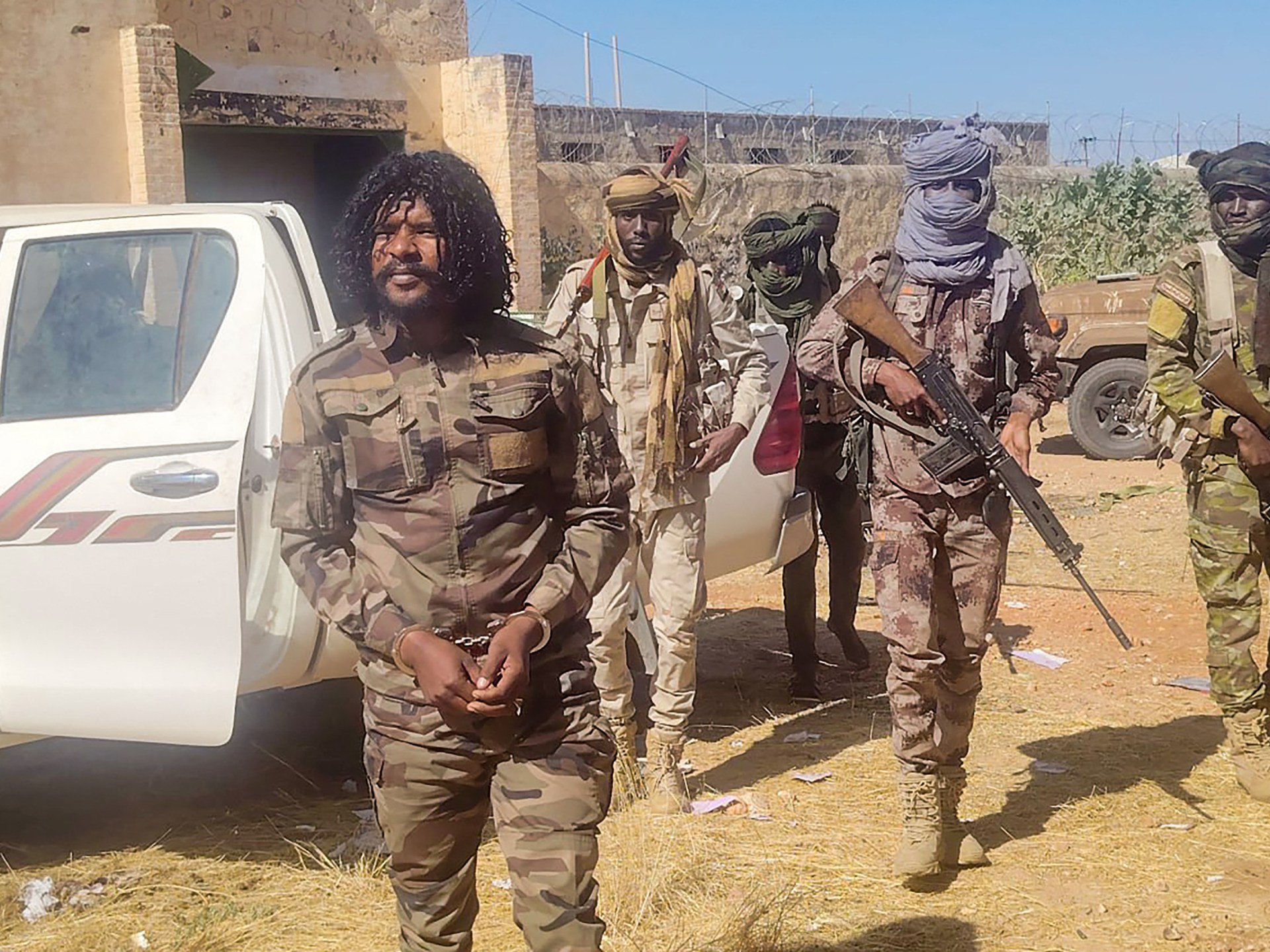

Mohamed Ibrahim, a Sudanese doctor, feared he would not live to see the sun go down.
“All around we saw people running and falling to the ground in front of us,” the 28-year-old physician said, according to a report by The Associated Press news agency on Saturday.
- list 1 of 4Dozens killed in RSF drone attack in war-torn Sudan’s South Kordofan
- list 2 of 4Sudan’s war displaced crisis peaks as millions eye return to ruined homes
- list 3 of 4Sudan army says two-year RSF siege of key town broken
- list 4 of 4Sudan’s women break ‘traditional rules’ to survive
end of list
Ibrahim was recounting the assault on el-Fasher, the capital of Sudan’s North Darfur, by the paramilitary Rapid Support Forces (RSF) that began on October 26 and lasted three days, ending an 18-month siege of the Sudanese army’s last stronghold in the province.
The RSF and the Sudanese army have been waging a brutal civil war for control of Sudan since April 2023, killing thousands of people and displacing millions. The conflict has created what the United Nations describes as the world’s largest displacement and hunger crisis
“We moved from house to house, from wall to wall under nonstop bombardment. Bullets were flying from all directions,” Ibrahim said as he recounted fleeing el-Fasher’s last functioning medical facility.
What followed was a systematic campaign of mass killings and ethnic cleansing, according to the United Nations and human rights groups, triggering war crimes investigations and international sanctions.
Speaking with the AP from the town of Tawila, about 70km (43 miles) from el-Fasher, Ibrahim provided a rare, detailed first-person account.
As RSF fighters swarmed in, they opened fire on civilians scrambling over walls and hiding in trenches in a vain effort to escape, while mowing down others with vehicles, Ibrahim said. He said seeing so many killed felt like he was running towards his own death.
Advertisement
“It was a despicable feeling,” he said. “How can el-Fasher fall? Is it over? I saw people running in terror. … It was like judgement day.”
Within hours, RSF fighters were storming homes, demanding phones at gunpoint and looting property.
Satellite imagery analysed by Yale University’s Humanitarian Research Lab, which has been monitoring the war in Sudan, identified at least 150 clusters of objects consistent with human remains between October 26 and November 1.
Researchers documented systematic efforts to destroy evidence through burning and burial, with RSF vehicles present near the sites.
Sarra Majdoub, a former UN Security Council expert on Sudan, said in a post on X that a “machinery of disappearance” had been operating in the aftermath of the fall of the city, with thousands unaccounted for.
Ibrahim, the doctor, was also held by RSF fighters after being captured, with the fighters demanding a ransom. “I didn’t want to tell them I was a doctor, because they exploited doctors,” he said.
After negotiating his ransom down from a $20,000 initial demand, his family paid $8,000 for his release, the AP report said.
The International Organization for Migration reported that more than 26,000 people fled el-Fasher in just two days following the October 26 takeover, with at least 106,387 people displaced by late November.
The United States, United Kingdom and European Union have imposed sanctions on RSF commanders in recent months.
Nazhat Shameem Khan, deputy prosecutor of the International Criminal Court, said war crimes and crimes against humanity were committed in el-Fasher “as a culmination of the city’s siege by the Rapid Support Forces”.
“The picture that’s emerging is appalling,” she told the UN Security Council last week, adding that “organised, widespread mass criminality” has been used “to assert control”.
Related News

Trump claim on NATO role in Afghanistan draws UK condemnation
Sudan’s people endure ‘horror and hell’ in war, says UN rights chief
Anti-ICE protesters chase anti-Islam ‘influencer’ Jake Lang in Minneapolis