Why was El Paso airspace shut down? Drones, security fears and confusion
 12 February 2026
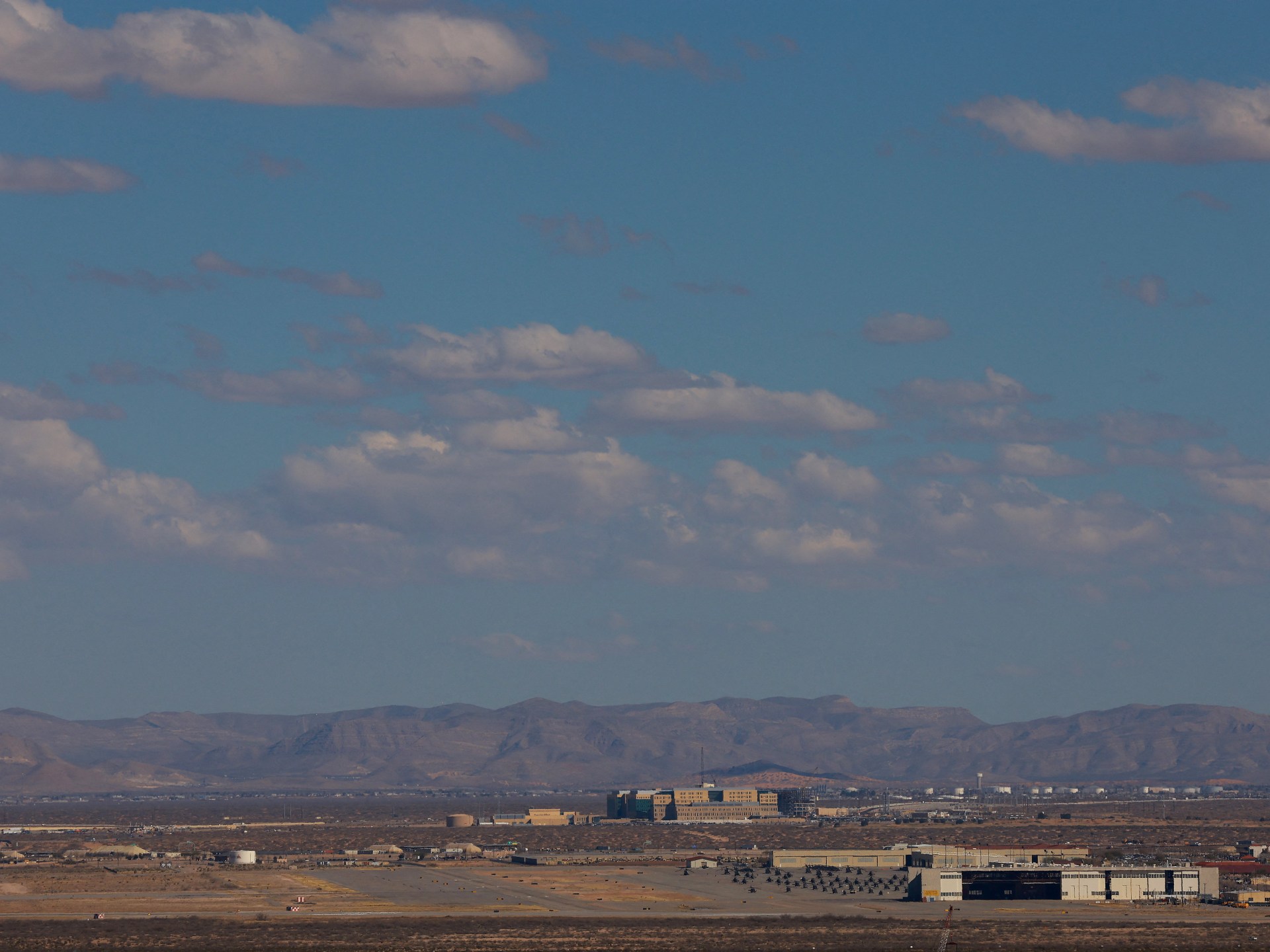

A new United States military laser-based anti-drone system led authorities to halt air traffic in and out of El Paso, Texas, after aviation officials raised serious concerns about risks to commercial aircraft.
The Federal Aviation Administration (FAA) initially announced a 10-day airspace closure on Wednesday but removed the restriction less than eight hours later, a decision reports said stemmed from miscommunication between the Pentagon and aviation regulators.
- list 1 of 4US reopens airspace over El Paso after claim of cartel drone infiltration
- list 2 of 4Five employees of Canadian mine found dead in Mexico, authorities say
- list 3 of 4Mexico sends 37 more drug cartel suspects to US amid Trump attack threats
- list 4 of 4US air authority warns of ‘military activities’ over Mexico, South America
end of list
Officials, speaking on condition of anonymity, said the FAA acted over concerns that a military counter-drone laser system could pose risks to aircraft, according to the Reuters news agency. The FAA and the military had planned to discuss the issue at a February 20 meeting, but the army moved ahead without final FAA approval, prompting the agency to halt flights in El Paso, sources said.
Here is what we know:
What happened when El Paso’s airspace was shut down?
On February 10, at about 11:30pm (05:30GMT) local time, the FAA stopped all flights to and from El Paso international airport, citing “special security reasons”.
The restriction was initially expected to last for 10 days.
The order covered an area of about 16km (almost 10 miles) around El Paso, including the nearby community of Santa Teresa, and was originally set to remain in place until the night of February 20.
Restrictions applied to all aircraft flying below roughly 5,500 metres (18,000 feet), while planes flying above that altitude were not expected to be affected.
Advertisement
US Transportation Secretary Sean Duffy said that the airspace was closed due to the Department of Defense and the FAA dealing with an incursion by Mexican drug cartel drones, and “the threat has been neutralized”.
According to local media reports, the FAA also warned that pilots who failed to follow the order “may be intercepted, detained and interviewed by law enforcement/security personnel”.
The agency added that authorities could use deadly force if it was “determined that the aircraft poses an imminent security threat”.
The airspace closure risked disrupting activity in one of the largest cities in the US, as El Paso is home to nearly 700,000 residents and is among the country’s 25 most populous cities.
A restriction of this scale has only been applied once before in El Paso, after the September 11, 2001, attacks, when US airspace was closed nationwide following the coordinated airliner hijackings that led to the destruction of the World Trade Center towers in New York and damage to the Pentagon.
Why did the FAA close El Paso’s airspace?
The agency initially cited “special security reasons”.
Transport Secretary Duffy said that a cartel drone had breached US airspace, an explanation that was echoed by officials at the White House and the Pentagon.
However, according to media reports, people briefed on the situation said the shutdown was linked to the Defense Department’s use of new high-energy laser technology designed to counter unmanned aircraft.
Bloomberg News, citing a source familiar with the matter, reported that the Pentagon was also flying drones as part of the tests, with some operating outside normal flight paths.
The activity occurred in airspace near El Paso international airport, prompting FAA concerns about potential interference with commercial flights.
Representative Veronica Escobar, a Democrat whose district includes El Paso, pushed back on the drone incursion explanation.
“I believe the FAA owes the community and the country an explanation as to why this happened so suddenly and abruptly and was lifted so suddenly and abruptly,” Escobar said during a morning news conference.
There was “nothing extraordinary about any drone incursion into the US that I’m aware of”, she said.
“The information coming from the federal government does not add up,” Escobar added later.
The airspace closure also drew backlash from other leaders, who said they were not properly consulted.
“This unnecessary decision has caused chaos and confusion in the El Paso community,” Renard Johnson, the mayor of El Paso, said at a news conference.
Advertisement
“I want to be very, very clear that this should have never happened. You cannot restrict airspace over a major city without coordinating with the city, the airport, the hospitals, the community leadership. That failure to communicate is unacceptable,” Johnson added.
Mexico’s President Claudia Sheinbaum denied the US claims that Mexican drones had entered US airspace.
“There is no information about the use of drones at the border,” she said.
Security experts say drone incursions near sensitive sites are not uncommon, but the scale of the response in this case was unusual.
“It is not unusual that unidentified drones will wander over an airport or military base, causing short term disruption,” Mark Cancian, a retired Marine Corps colonel and senior adviser with the Washington-based Center for Strategic and International Studies think tank, told Al Jazeera.
“However, it is unprecedented that the FAA would seek to shut down a large piece of airspace for days,” Cancian said.
“It is hard to believe that they had thought through the economic and social costs of such an action,” he added.
Close to 3.5 million passengers travelled through El Paso international airport between January and November 2025, according to data on the airport’s website.
How common are Mexican cartel drone incursions along the US border?
The administration of US President Donald Trump has long warned that Mexican cartels are using drones along the border for drug smuggling activities.
Mexican officials have expressed less alarm, at times minimising the security threat posed by drone activity in the region.
Steven Willoughby, deputy director of the counter-drone programme at the Department of Homeland Security (DHS), told Congress in July that cartels are using drones nearly every day across the border.
According to DHS data, in the last six months of 2024, more than 27,000 drones were detected within 500 metres (1,640 feet) of the US southern border, mainly at night. He said that across the US-Mexico border, 326 flights a day were detected.
“There’s been a substantial amount of incursion by Mexican criminal groups’ drones into US airspace, and they pose [a] great risk of colliding with civilian aircraft,” Vanda Felbab-Brown, an expert on non-state armed groups at the Brookings Institution, told Al Jazeera.
“In the case of El Paso, the risks were likely considered higher than in more remote desert areas,” Felbab-Brown said.
“But outside of the airports, there is a significant amount of drones belonging to Mexican criminal groups that have been penetrating US systems, both to gather reconnaissance on where law enforcement agents are present and on the route, but also to carry drug payloads,” she said.

Are drones being used in conflicts inside Mexico?
Experts say drone technology is also being used inside Mexico, particularly in conflicts between rival criminal groups fighting for territory.
Advertisement
One of the most prominent is the Jalisco Nueva Generacion cartel (CJNG), one of Mexico’s most powerful criminal organisations, known for its rapid expansion and use of military-style tactics and new technologies.
CJNG has clashed with Carteles Unidos, a loose alliance of smaller groups formed largely to resist CJNG’s advance in the western state of Michoacan.
In rural parts of Michoacan, which include farming communities known as ejidos, drones have increasingly been used not only for surveillance but also to drop explosives during territorial disputes.
“In the deployment of drones in Mexico, we have seen other activities by the cartels, such as carpet bombing of rural Eiridas in Michoacan, with the purpose of driving populations out of an ejido,” Felbab-Brown, of Brookings Institution, explained.
“The Jalisco Nueva Generacion cartel has used these tactics to counter the local advantage of Carteles Unidos and their deep social roots in those communities. Unable to overcome that, they have tried to force people out,” she said.
“At various times, reporting from Michoacan has suggested that tens of thousands, and in some cases possibly hundreds of thousands, of people have been displaced from ejidos as a result of these scorched-earth tactics carried out using drones,” she added.

Related News
Thousands gather in Libya for funeral of Saif al-Islam Gaddafi
Iran says it will ‘respond like never before’ after Trump’s threats

Top Iranian security official heads to Oman following nuclear talks with US