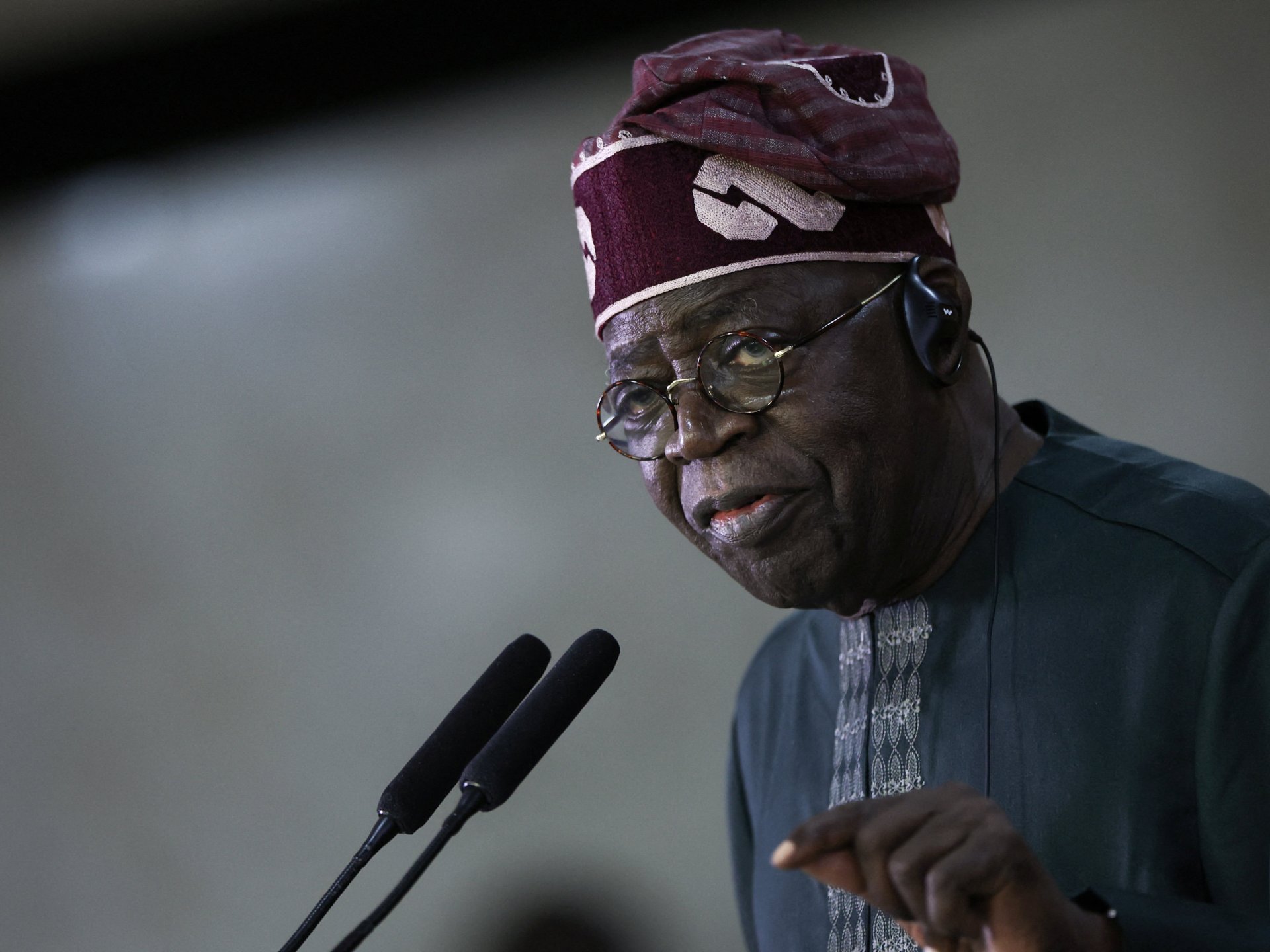

London, United Kingdom – When Nigerian President Bola Tinubu arrives in the UK this week, the visit will carry more than ceremonial significance. It will be the first state visit by a Nigerian leader to Britain in 37 years.
King Charles III and Queen Camilla are to host Tinubu and first lady Oluremi Tinubu at Windsor Castle from Wednesday to Thursday.
- list 1 of 4As Khamenei’s son steps in, Nigerian Shias mourn Iran’s old supreme leader
- list 2 of 4Is Nigeria’s security situation worsening, or is there progress?
- list 3 of 4‘Holding hands’: How Nigeria turned Trump’s threats to military partnership
- list 4 of 4Nigeria: ‘Renewed Hope’ or ‘Hopelessness’? | Mehdi Hasan and Daniel Bwala
end of list
The last Nigerian state visit, considered one of Britain’s most important diplomatic tools, took place in 1989 when then-military ruler Ibrahim Babangida met Queen Elizabeth II.
“It’s the first time since Nigeria returned to democracy [in 1999] that a democratically elected Nigerian head of state is being afforded this honour by the British monarchy,” said Ikenna Okonkwo, data integrity lead at the Nigerian intelligence consultancy SBM Intelligence.
The visit comes at a time when both countries are trying to deepen economic cooperation.
Nigeria is one of Britain’s most important partners in Africa. Trade between the pair was worth more than 8 billion pounds ($10.6bn) in the year to October.
In 2024, they signed a trade and investment partnership aimed at expanding business opportunities.
Among members of the UK’s Nigerian community, there are mixed feelings about the visit.
London-based business owner Monica, who requested Al Jazeera withholds her surname, expressed scepticism about whether it will bring tangible change.
“What is he [Tinubu] coming here for? He needs to sort out the issues at home,” she told Al Jazeera, pointing to economic difficulties and violence in parts of the country. “Look at the state of the economy in Nigeria.”
Advertisement
A country under pressure
Tinubu, a trained accountant and former Mobil oil executive who is in his 70s, took office in May 2023 after a tightly contested election.
Early in his presidency, he implemented sweeping economic reforms intended to bring stability and attract foreign investment. But they also triggered a sharp rise in the cost of living.
“The country has been dealing with a lot – from security concerns to economic pressures,” Okonkwo said. “Ending the fuel subsidy and changing the currency regime created significant hardship for many Nigerians because it pushed inflation very high.”
Security is another key issue. Armed groups and banditry affect several regions while instability across the Sahel has increased pressure on West African states.
“There are perennial issues around power supply, the cost of living and security,” Okonkwo said.
What leaders hope to achieve
Policymakers view the visit as an opportunity to advance strategic interests.
Kabir Adamu, managing director of Beacon Security and Intelligence Ltd in Abuja, said some may see the visit as a chance to reset relations after Britain’s departure from the European Union.
Discussions are likely to focus on expanding the trade and investment partnership and cooperating on security, migration policy and climate financing, he told Al Jazeera.
“The UK secures deeper commercial access to Africa’s largest market,” he said. “At the same time, Nigeria gains essential foreign direct investment and security backing to stabilise its domestic economy.”

Tinubu is also expected to use the visit to promote his government’s economic agenda.
“The president will actively pitch his administration’s macroeconomic reforms to attract British investment into sectors like mining, energy and Nigeria’s creative industries,” Adamu said.
But he warned that negotiations could also touch on sensitive areas, including UK immigration rules affecting Nigerian students and workers as well as debates over human rights and the repatriation of historical artefacts.
“A successful visit would produce tangible outcomes,” Adamu said, “such as trade agreements, commitments from British companies to invest in Nigerian infrastructure and stronger security cooperation.”
Oil, investment and global politics
Energy may also feature in the discussions.
Advertisement
Nigeria is Africa’s largest oil producer although output has fluctuated in recent years due to pipeline theft and security issues in the Niger Delta. The government has been trying to increase production to meet demand.
Okonkwo said that as a major hydrocarbon producer, Nigeria could become more significant in a volatile global energy market.
“Nigeria is trying to ramp its production back up,” he said. “Given the geopolitical tensions around energy supply globally, West African producers like Nigeria become increasingly relevant.”
Beyond oil, Nigeria is seeking investment in manufacturing, infrastructure and power generation as it tries to diversify its economy.
“One of the biggest obstacles to investment has been insecurity,” he said. “There are also ongoing questions around governance and corruption that international partners will be paying attention to.”
The ‘foundational’ diaspora factor
The Nigerian diaspora, estimated to be among the largest African communities in Britain, is an important bridge. According to official figures, more than 270,000 people in the UK were born in Nigeria.
Adamu described the diaspora as “foundational” to the bilateral relationship.
“They drive economic remittances, act as a source of soft power and serve as a cultural bridge between the two nations,” he said.
Remittances play a significant role in supporting families back home. For many migrants, those financial ties mean they closely follow political and economic developments in Nigeria.
Okonkwo noted that some members of the diaspora have become increasingly critical of the government.
“A large number of Nigerians have moved to the UK in recent years because of the deteriorating situation at home,” he said.
For some in the diaspora, the visit represents an opportunity for dialogue. Okonkwo said engagement between the government and Nigerians abroad could be crucial.
“I would hope that there are interactions not just with elites but with diaspora organisations,” he said.
Diplomacy and expectations
Ultimately, the ceremonies at Windsor Castle will showcase the UK’s traditional pageantry while signalling the importance London places on relations with Africa’s largest economy. And it will be watched closely by Nigerians both at home and abroad.
For analysts like Adamu, success will be measured in concrete results.
“If the trip produces real investment commitments and stronger security cooperation,” he said, “then it will have achieved something meaningful.”
For Nigerians in the UK, the test lies beyond photo opportunities.
Tinbu is “just here to drink tea with the king. They’ll sit down, take a few pictures and then go back,” said Goodwin, the business owner. “For him [Tinubu], it’s about saying, ‘While I was president, I dined with the king.’ That’s all that matters to him. Nigerians don’t matter.”
Related News
Eight Arab, Islamic countries condemn Israeli closure of Al-Aqsa Mosque
US senators demand probe into ‘appalling’ attack on girls’s school in Iran
‘We were just praying’: Pakistani students recount escape from war-hit Iran