
A ceasefire offered hope after weeks of intensified Israeli strikes on Lebanon, but renewed Israeli attacks and the creation of a military boundary similar to the “Yellow Line” in Gaza are casting doubt on the agreement.
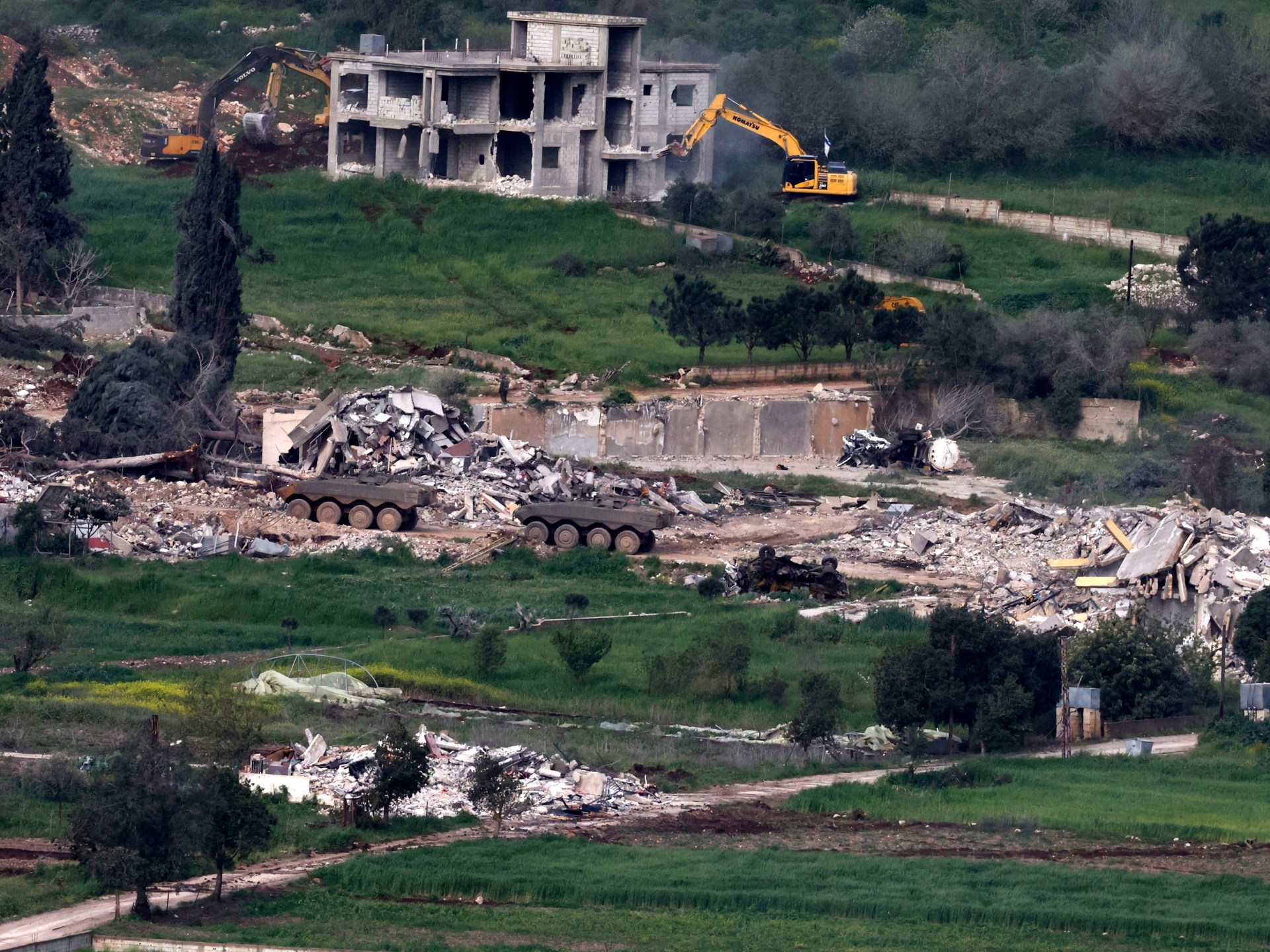
The 10-day ceasefire started on Thursday night after 46 days of Israeli bombardment and a ground invasion in southern Lebanon. Within hours, Israeli forces were reported to be carrying out demolitions, artillery shelling and land-clearing operations in several border areas in violation of the ceasefire.
- list 1 of 4Iran, US still ‘far’ from breakthrough amid Strait of Hormuz impasse
- list 2 of 4How the Israeli military targets the people who save lives
- list 3 of 4Iran war day 51: What is happening in Lebanon and the Strait of Hormuz?
- list 4 of 4Fire razes 200 homes in Sabah, leaving hundreds homeless
end of list
At the centre of the dispute is what Israel calls a “Yellow Line” – a military zone stretching roughly 10km (6 miles) north of the border inside southern Lebanon. Israeli officials say they intend to keep the zone under military control, while reserving the right to strike the area in what they describe as efforts to root out Hezbollah.
Lebanon and Hezbollah have rejected the move as an occupation of sovereign territory that they say violates the very premise of a ceasefire.
What is the ‘Yellow Line’?
Prime Minister Benjamin Netanyahu said Israeli forces “are remaining in Lebanon in a reinforced security buffer zone”.
“This is a security strip ten kilometres deep, which is much stronger, more intense, more continuous and more solid than what we had previously. That is where we are and we are not leaving.”
The line has drawn comparisons with Gaza, where Israel has partitioned Palestinian territory into separate zones, with an eastern area totalling 60 percent of the enclave controlled by the Israeli military. Palestinians, most of whom are displaced, have been crammed into the remaining territory to the west.
Advertisement
In Gaza, Israeli troops routinely fire on anyone approaching the line and have demolished hundreds of homes in the effective buffer zone. Israeli attacks have killed more than 700 people and wounded around 2,000 since the US-brokered “ceasefire” was agreed last October.
Senior Israeli military officials told reporters during a briefing on Saturday that “the ‘Yellow Line’ model implemented in Gaza will be replicated in Lebanon; the IDF [Israeli military] has already established a ‘Yellow Line’ and its forces are currently working towards it”.
The military officials added that residents will not be allowed to return to 55 Lebanese towns and villages within that area.
Israeli Defence Minister Israel Katz announced on Friday that the Israeli military “will continue to hold and control all the positions it has cleared and secured”.
Does the ceasefire allow Israel to keep attacking?
The wording of the ceasefire has prompted immediate disagreement, with the text saying Israel and Lebanon “will implement a cessation of hostilities”, while later saying that Israel “shall preserve its right to take all necessary measures in self-defence, at any time, against planned, imminent, or ongoing attacks”.
Analysts say those clauses are riddled with contradictions and leave wide room for interpretation. Reporting from Beirut, Al Jazeera’s Heidi Pett said terms released by the US State Department appeared to allow Israel to act in what it defines as self-defence.
“And Israel defines that fairly broadly, so not just imminent and ongoing threats, but even planned ones,” she said.
She said Israeli forces had continued demolitions in Lebanese villages, artillery fire and machinegun attacks targeting communities on or near the front line – or the “Yellow Line”.
It comes as Israel also announced the launch of air strikes after the ceasefire began. The first, it said, targeted fighters approaching Israeli troops near the “Yellow Line”. The second, it claimed, targeted men entering a tunnel inside the same zone.
“So Israel seems to be enforcing this in the same way as the “Yellow Line” in Gaza, through gunfire or indeed air strikes,” Pett said.
“And Israel is arguing that these do not violate the terms of the ceasefire.”
Al Jazeera correspondents on the ground reported that Israeli forces blew up homes in the town of Haneen on Saturday, while artillery shells were fired towards Beit Lif, al-Qantara and Toul. They also reported Israeli bulldozers continuing demolition and land-clearing operations in several areas of southern Lebanon.
Advertisement
Hezbollah has faced accusations over an ambush on UN peacekeepers in Lebanon on Saturday in which a French soldier was killed and three others wounded. French President Emmanuel Macron blamed the group for the attack, Hezbollah denies responsibility.
How has Hezbollah responded?
Hezbollah has condemned the ceasefire agreement as “an insult to our country” and “a slippery slope with no end in sight”.
“A ceasefire means a complete cessation of all hostilities”, the group said. “Because we do not trust this enemy, the resistance fighters will remain in the field, ready to respond to any violations of the aggression. A ceasefire cannot be unilateral; it must be mutual”.
Hezbollah later said its fighters would remain deployed and would respond to Israeli violations, while insisting that Israeli forces must withdraw from occupied Lebanese territory up to the border.
The comments suggest Hezbollah does not view the ceasefire as binding if Israeli attacks continue or troops remain inside Lebanon. However, both Israel and Hezbollah’s official line is that the ceasefire is still in place – despite the continuous violations.
Hezbollah has linked the ceasefire to broader regional diplomacy involving Iran, with talks between the US and Iran expected in Islamabad in the coming days.
Iranian officials have made clear that a ceasefire in Lebanon is a prerequisite for any meaningful progress in their negotiations with the US, warning that continued Israeli attacks there would jeopardise peace between the two countries.
The Lebanese government is holding parallel talks with Israel, which Hezbollah has condemned as a “humiliation” and a “shameful spectacle”. Beirut’s decision to engage in negotiations with Israel risks deepening tensions between the government and the group.
Israeli and Lebanese officials have both called for Hezbollah to disarm, but it says its weapons are necessary to defend Lebanon and communities in the south. It has also insisted it will not disarm without agreement on a national defence strategy. Hezbollah insists that Israel needs to first withdraw from Lebanese territory.
Israeli forces never fully left southern Lebanon following the November 2024 ceasefire between Israel and Hezbollah, continuing to carry out attacks inside Lebanon in violation of the ceasefire. Hezbollah did not fire back at Israel as part of the 2024 agreement.
Why are fears of permanent occupation growing?
Some analysts say Israel is seeking leverage ahead of future negotiations. Political commentator Abed Abou Shhadeh told Al Jazeera there appeared to be a new Israeli strategy, not only in Lebanon but also in Syria, aimed at consolidating power through territorial expansion.
“In any future negotiation, Israel would seek to hold on to this land and use it as leverage as much as possible,” he said.
Israel occupied southern Lebanon for years before withdrawing in 2000, while continuing to hold the Shebaa Farms area. It also continues to occupy the Syrian Golan Heights and Palestinian land in the occupied West Bank.
Advertisement
For many Lebanese, the “Yellow Line” raises fears that a temporary military zone could become a longer-term occupation under the cover of a ceasefire. As Israeli troops remain inside Lebanon and military operations continue, critics say the truce is a mechanism for legitimising occupation.
Related News
FIFA faces pressure to call on Trump to stop ICE raids at 2026 World Cup

Hegseth touts US ‘victory’ over Iran as Tehran hails its own ‘historic’ win
‘Endless grief’: Turkiye mourns victims of second school shooting in a week