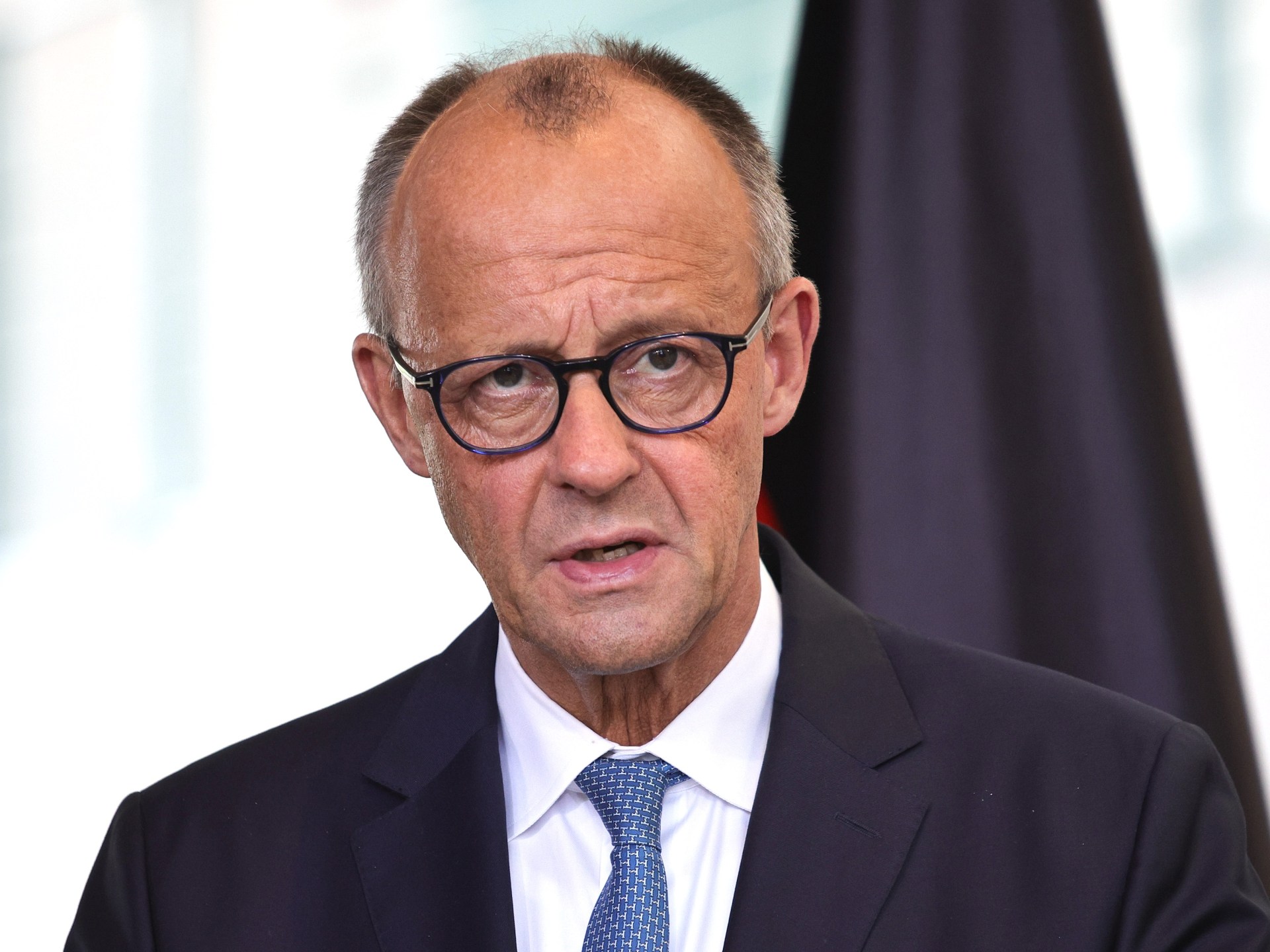

German Chancellor Friedrich Merz has defended his country’s NATO defence spending, shortly after US President Donald Trump re-upped his criticism of alliance members.
The statement on Friday came as NATO leaders were set to meet next week in Ankara. Trump has decried defence spending by members of the bloc throughout his political career, calling the balance of spending “ridiculous” and “one-sided” in his latest Truth Social posts on the issue earlier this week.
- list 1 of 3France-Germany jet plans crash: Can Europe end reliance on US for security?
- list 2 of 3Top European leaders vow ‘strong’ support for Ukraine ahead of NATO summit
- list 3 of 3Trump slams NATO over lax participation in Iran war in talk with Mark Rutte
end of list
In one post, Trump said Germany’s spending was “MUCH LOWER” between 2014 and 2025 than the US or other NATO allies, which he again called “Ridiculous!”
When asked about the comment, Merz said Germany would double its defence budget within four years.
“This is the greatest effort we have ever made to strengthen our defence capabilities. In this respect, we have no reason to shy away from anyone,” Merz said.
“We will state this, with all due modesty, and we are doing so as the European Union’s largest member state, bearing a responsibility within Europe,” he said.
US and European ties have been strained throughout Trump’s first term from 2017 to 2021 and his current term, which began in January 2025.
However, while largely dismissive of the president during his first four years in office, several European leaders have sought a more amenable approach to the president this time around.
At the behest of the US, NATO leaders agreed to spend 3.5 percent of their countries’ GDP on core defence items, such as weapons and troops, by 2035, an increase of the previous goal set by the bloc of 2 percent of its GDP.
Advertisement
However, relations have since frayed over several issues, including Trump’s pledges to take control of the autonomous Danish territory of Greenland. Denmark is a member of NATO.
The US-Israeli war in Iran has also proven to be a major wedge, with Trump launching the conflict without consulting European allies who have dealt with the fallout of the closure of the Strait of Hormuz.
Trump had repeatedly condemned European allies for not joining the war effort.
Merz, meanwhile, roiled the president by saying in April the US had been “humiliated” by Iran. Trump, in turn, said the US would withdraw 5,000 troops currently stationed in Germany.
Speaking on Friday, Merz said Germany was ahead of schedule to reach its NATO commitments.
“We will reach the 3.5 percent benchmark set in The Hague as early as 2029,” he told reporters, “well ahead of the agreed deadline”.