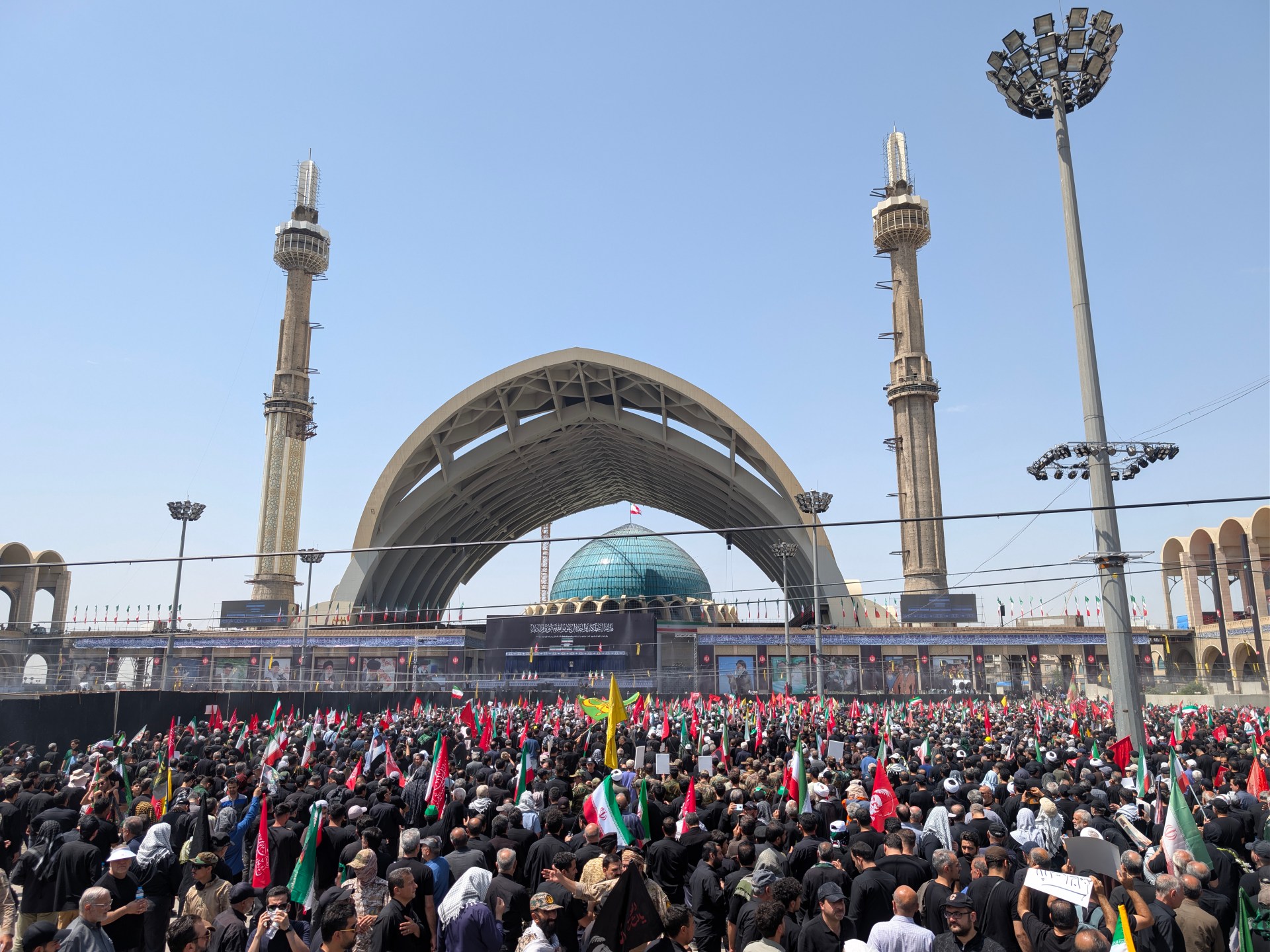

Tehran, Iran – Large-scale public commemorations for former Iranian Supreme Leader Ayatollah Ali Khamenei have commenced in the capital, with authorities promoting a message of continuity for the Islamic Republic and vengeance for his killing.
Khamenei, 86, was targeted in an airstrike at the start of the war with the United States and Israel on February 28, after ruling Iran with absolute power for nearly 37 years.
Red flags, commonly associated with martyrdom but also viewed as a symbol of revenge in Shia Islam, were seen throughout the Grand Mosalla commemoration site in Tehran and other mass gatherings.
“We must rise,” was the official slogan used for the ceremonies, accompanied by an image of Khamenei’s clenched fist on a red and black background.
Thousands gathered inside the huge religious complex used for the funeral from the early hours of Saturday morning to pay their respects to the assassinated supreme leader.
Khamenei’s coffin, carried to the funeral site by a lorry, was displayed at the centre of the stage and draped in flags. Positioned on an elevated platform in the central court, surrounded by glass and guarded by Islamic Revolutionary Guard Corps (IRGC) personnel, authorities were ready to deal with crowds attempting to reach his coffin.
Visiting men and women were separated by a large barrier to observe Islamic values. Religious chanting and slogans blasted from loudspeakers around the complex.
Videos circulated by state media showed crowds chanting “Death to America” and “Death to Israel” at a number of metro stations.
Advertisement
“We are all here to seek blood vengeance for our leader,” Fatemeh, a 55-year-old woman travelling in a group of women clad in black chadors, told Al Jazeera while waiting to enter through a northern gate of the complex.
“We will all listen to his son. He will guide the revolution forward,” she said, in reference to Mojtaba Khamenei, who was quickly selected as supreme leader by a clerical body in March following his father’s killing.
![The commemoration has attracted thousands of people from across Tehran to mourn Khamenei [Maziar Motamedi/Al Jazeera]](https://www.aljazeera.com/wp-content/uploads/2026/07/9-1783177414.jpg?w=770&resize=770%2C580&quality=80)
Tight security
A heavy security presence continues in the capital, with armoured vehicles, heavy machine guns and snipers visible throughout the areas surrounding the farewell ceremonies.
Men were body searched as they entered the Mosalla, while electronic devices – such as power banks, earphones and lighters – were confiscated from the mourners by security.
Mojtaba Khamenei, who has not been seen publicly since he took office, will not attend the funeral due to security concerns.
State-affiliated newspapers and television reported that the supreme leader’s killing had rallied supporters of the Islamic Republic government, which has been in power since the 1979 revolution overthrew Iran’s last shah, Mohammad Reza Shah Pahlavi.
Authorities are expecting similar huge numbers as attended the 1989 funeral of Ruhollah Khomeini, the founder of the Islamic Republic. At least eight mourners died in the crowds, forcing the military to evacuate his body by helicopter.
Thousands of “mokebs”, or temporary religious service stations, were set up across Tehran, blasting out Islamic Shia chants and rhythmic eulogies to Khamenei.
![Government messages and images of Khamenei were plastered across Tehran during the commemoration [Maziar Motamedi/Al Jazeera]](https://www.aljazeera.com/wp-content/uploads/2026/07/3-1783178247.jpg?w=770&resize=770%2C580&quality=80)
Some volunteers handed out flags, banners and images to the crowd. As temperatures rose to 36 degrees Celsius (97 degrees Fahrenheit), other mokebs were equipped with giant cooling fans and volunteers distributed free drinks to the thousands of mourners.
Emergency services were stationed across the area to assist with any health problems due to the crowds or the heat, but so far authorities have reported no security incidents or medical emergencies.
Large parts of Tehran have been cordoned off with barriers and non-official vehicles are barred from entering or exiting.
The whole of Iran has been effectively shut down until the end of Monday, in an apparent effort to encourage public participation, with 10 million Iranians expected to take part in the proceedings across the country.
Advertisement
Funeral procession
Khamenei’s remains are expected to be moved through Tehran during the funeral procession on Monday. It is then expected to pass through some of Shia’s holiest sites, including Qom, Najaf and Karbala, before burial in his hometown of Mashhad in northeastern Iran on Thursday.
Some Iranians have used the public holiday to escape the crowds and the heat of Tehran for the cooler northern provinces by the Caspian Sea, as they regularly do on multi-day public events in the capital. Long lines of traffic were seen on the Tehran-Shomal Freeway leading to the provinces, with travellers stuck for hours in jams.
IRGC commander-in-chief Ahmad Vahidi, who made his first appearance since the start of the war, told state TV during an event on Friday to grieve Khamenei so that “enemies will take their wish for our surrender to the grave”.
“The enemies must know that the pure blood of our martyred imam was another turning point in the victories of dear Islam against the global infidel front,” he said.
![Red flags, associated with martyrdom in Shia Islam and carrying religious messages, were carried by mourners [Maziar Motamedi/Al Jazeera]](https://www.aljazeera.com/wp-content/uploads/2026/07/1-1783178093.jpg?w=770&resize=770%2C580&quality=80)
IRGC aerospace chief Majid Mousavi, responsible for launching ballistic missiles and drones across the region during the war, also made a public appearance.
The central headquarters of armed forces issued a statement to warn against any military action during the ceremonies, after Israel’s Defence Minister, Israel Katz, said Mojtaba Khamenei was “marked for death”.
Representatives from dozens of countries were in Tehran on Friday to pay their respects to Khamenei and speak with Iranian officials during televised state ceremonies.
Pakistan’s Prime Minister, Shehbaz Sharif, who helped mediate talks between Iran and the US, was among the most senior officials present. Other countries sent lower-level dignitaries, while European countries were reportedly not invited.
Among the most prominent attendees on Friday were members of the IRGC-backed “Axis of Resistance”, including members of Hamas, the Houthis in Yemen and Hezbollah in Lebanon.
The Hezbollah delegation included members of Hassan Nasrallah’s family, the long-time head of the armed group killed by Israel in 2024, and relatives of Imad Mughniyeh, the commander killed by a car bomb in Syria in 2008.
Related News
Iranians cautiously optimistic about thorny deal with US
Israel fetes Somaliland’s leader as it seeks to expand Red Sea influence
Israeli attacks kill four men and a boy in Gaza and a teenager in West Bank