
Berlin, Germany – Music is a major part of Rayhan Butt’s life. The 18-year-old from the west German city of Bielefeld discovered his passion for the piano a few years ago, and now plays daily, sometimes for 12 hours a day. Picking up singing along the way, he performs regularly across the country.
Butt has now found a way to combine his love of music with his love for Germany. Next month, he will travel to Berlin for an internship with the German Armed Forces, and in autumn he will be joining full-time as part of the army’s marching band.
- list 1 of 4Europe reimagines rearmament at sea, learning from Russia’s war on Ukraine
- list 2 of 4‘A stress test’: US-Germany rift widens as Iran war drags on
- list 3 of 4Why is Germany trying to build ‘Europe’s strongest conventional army’?
- list 4 of 4NATO pledges 70 billion euros for Ukraine as Trump praises peace ‘progress’
end of list
“Music, especially piano and singing, is not a hobby – it’s my whole life, and I want to build my future around it,” Butt tells Al Jazeera. “The Bundeswehr [German Armed Forces] has an excellent reputation, and there are a lot of opportunities to perform at a very high professional level, for example, in front of the German chancellor.
“I have decided to enrol because I can continue receiving musical training alongside learning valuable skills within the army such as teamwork and discipline.”
As he looks ahead to joining, Butt says that he supports voluntary military and civic duty and believes all young people should pursue one of these paths. “If tomorrow I’m called away from the marching band to fight, I would not hesitate in stepping up as a soldier. I’m a child of immigrants, and I’ve had a lot of opportunities growing up here, such as freedom and a great education. I would definitely defend this country with my life,” adds Butt, who Al Jazeera met through his participation with Generation Global, an initiative by the Liz Mohn Foundation that aims to prepare young people for future leadership roles.
Advertisement
That’s a sentiment the German government is desperately counting on, as it seeks to ramp up its military recruitment.
![Rayham Butt playing the piano [Photo courtesy Rayham Butt]](https://www.aljazeera.com/wp-content/uploads/2026/07/IMG-20260716-WA0000-1784876666.jpg?w=770&resize=770%2C550&quality=80)
Germany’s expanded military ambitions
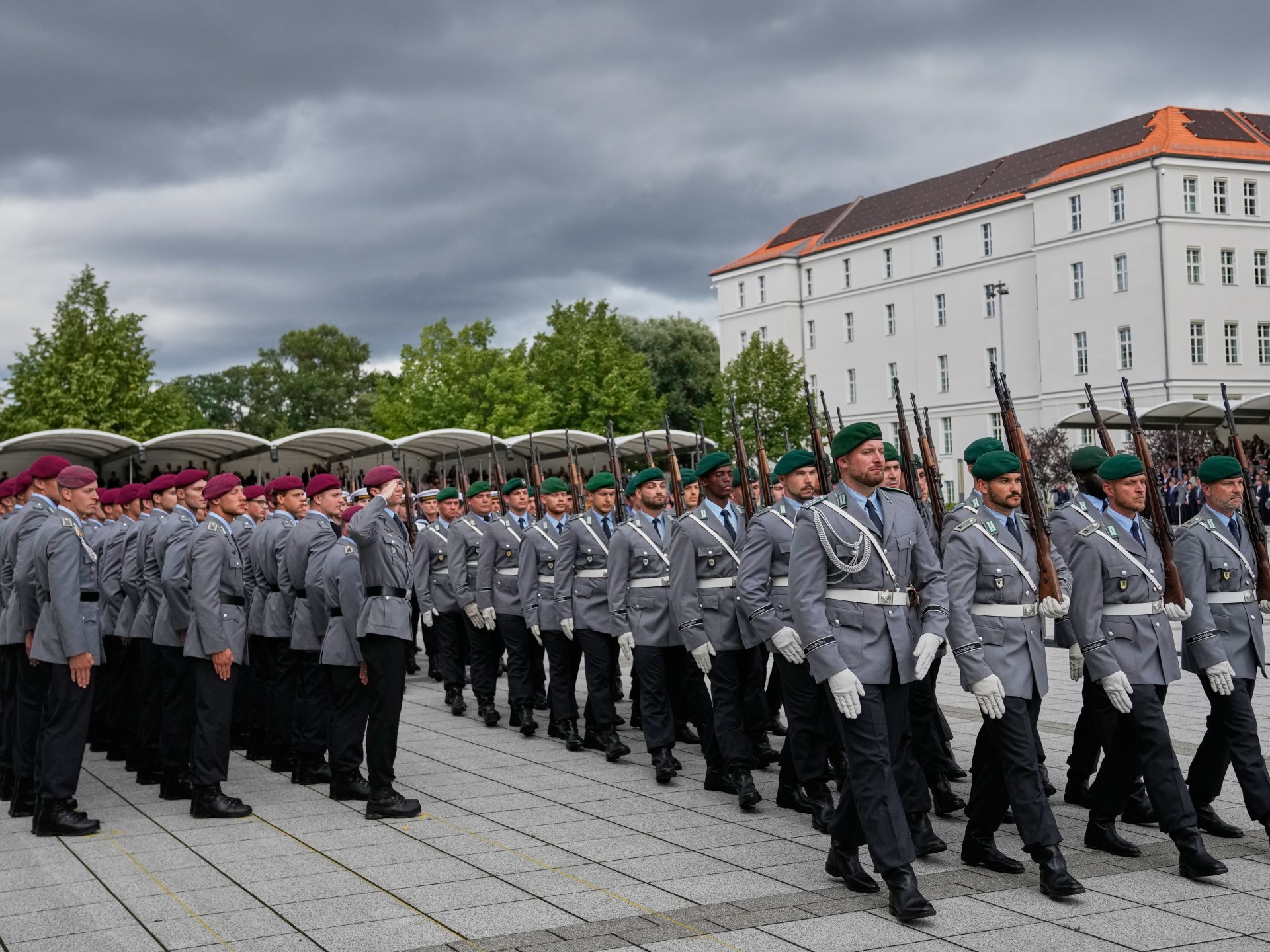
The Bundeswehr wants to increase its active-duty force by 80,000 men and women to 260,000, through a voluntary recruitment drive. In addition, it wants 200,000 men and women in the reserves.
The drive forms part of the Military Service Modernisation Act, which came into effect on January 1 and lays out a new set of requirements for young Germans. Since January, more than 300,000 letters have been sent to 18-year-olds to gauge their willingness to join the armed forces, as well as requesting information on their physical fitness and education. Women have also been sent the letter but, unlike young men, are not legally required to respond.
It’s one strand within Germany’s broader military expansion plans, initiated in 2022 after Russia’s full-scale invasion of Ukraine. In one of his first major speeches as chancellor last year, Friedrich Merz pledged to build the “strongest conventional army in Europe”.
Most recently, a new military concept outlining how Germany intends to fight and a capability profile were published three months ago.
Moritz Graefrath, an assistant professor of international security at the University of Oklahoma’s School of International Studies, said that more than this new document, the timing of its publication is what’s significant.
“One of the most plausible explanations is that it’s part of an effort to show, particularly to Washington as well as potentially other European allies within NATO, how serious the German government now is about ‘Europeanising’ European security and taking on more of the burden of continental defence,” he told Al Jazeera. “In many ways, this is a relatively costless signal of commitment to that idea of burden shifting within NATO, to that idea of taking on more responsibility.”
![Bela Breitner, a member of a students group that’s campaigning against conscription [Photo courtesy Bela Breitner]](https://www.aljazeera.com/wp-content/uploads/2026/07/Bela-Breitner-1784900189.jpeg?w=770&resize=770%2C840&quality=80)
Opposed to conscription
Yet the latest measures on conscription are not being welcomed by all.
Official figures published on July 14 showed that so far this year, 6,000 young men have applied to remain out of the military service on “religious” and “moral” grounds, more than the number throughout the whole of last year.
A clause in the new law that required young men between the ages of 17 and 45 years old to seek prior approval for long stays abroad was repealed following a backlash by opposition voices, including student activists who have arranged three large-scale demonstrations attended by a reported 50,000 young people across 90 German cities since December.
Advertisement
Bela Breitner is a 22-year-old computer science student living in Bochum in western Germany. He is part of the Schulstreik Gegen Wehrpflicht (School Strike Against Conscription) campaign group, which formed late last year in response to what they see as the “militarisation” of German society.
“Our main focus point is conscription,” he tells Al Jazeera. “Many students are in opposition to these measures because within the last few years, we feel like we haven’t received anything positive from the state.
“Many young people lost opportunities during the COVID pandemic, the school system in Germany is criminally underfinanced, and now they want to implement conscription to force us to be trained in combat. Many of us feel like our voices are not being listened to.”
History of conscription in Germany
Conscription was first introduced in Germany in the mid-1950s, and suspended only in 2011. Graefrath says the suspension was driven by societal factors as well as government calculations around things such as budgets.
“On the one hand, there was a sense of post-Cold War peace where it seemed inconceivable for another war in Europe to take place, let alone one that would involve Germany, so the conscription framework was seen as a relic of the past,” he said. “On the other hand, it became apparent, especially to young Germans at the time, that if the model was abandoned, they could study, start apprenticeships and enter the workforce, rather than having at least one year of compulsory service. So there was that societal element there.”
While the Bundeswehr says it is optimistic about achieving its targets, only about 500 recruits have been enrolled so far this year. The figures prompted one senior politician earlier this month to say that Germany will have to decide by next July at the latest whether to reintroduce compulsory military service.
Analyst Graefrath said that Germany would need to decide the future of conscription based on its reading of wider geopolitical challenges. “This would be how unreliable the United States is right now and in the foreseeable future, and how big a threat Russia actually poses.”
Meanwhile, the clause for young men to seek permission before shifting abroad remains repealed but only as long as conscription remains voluntary.
Student activist Breitner says the issue doesn’t just affect students, but people from across society, and the campaign group will continue efforts to mobilise wider support.
“I don’t know any Russians, but I believe there are many people in Russia and around the world who have dreams and want to achieve something else with their life other than fighting a war,” he said. “I believe that there are more people who share values such as peace, freedom and the right to choose over what may separate us.”
Related News

Guyana ferry with 116 people on board capsizes; more than 50 rescued

DR Congo says 1,307 Ebola cases confirmed, including 377 deaths
What is the religious and political messaging behind Khamenei’s funeral?