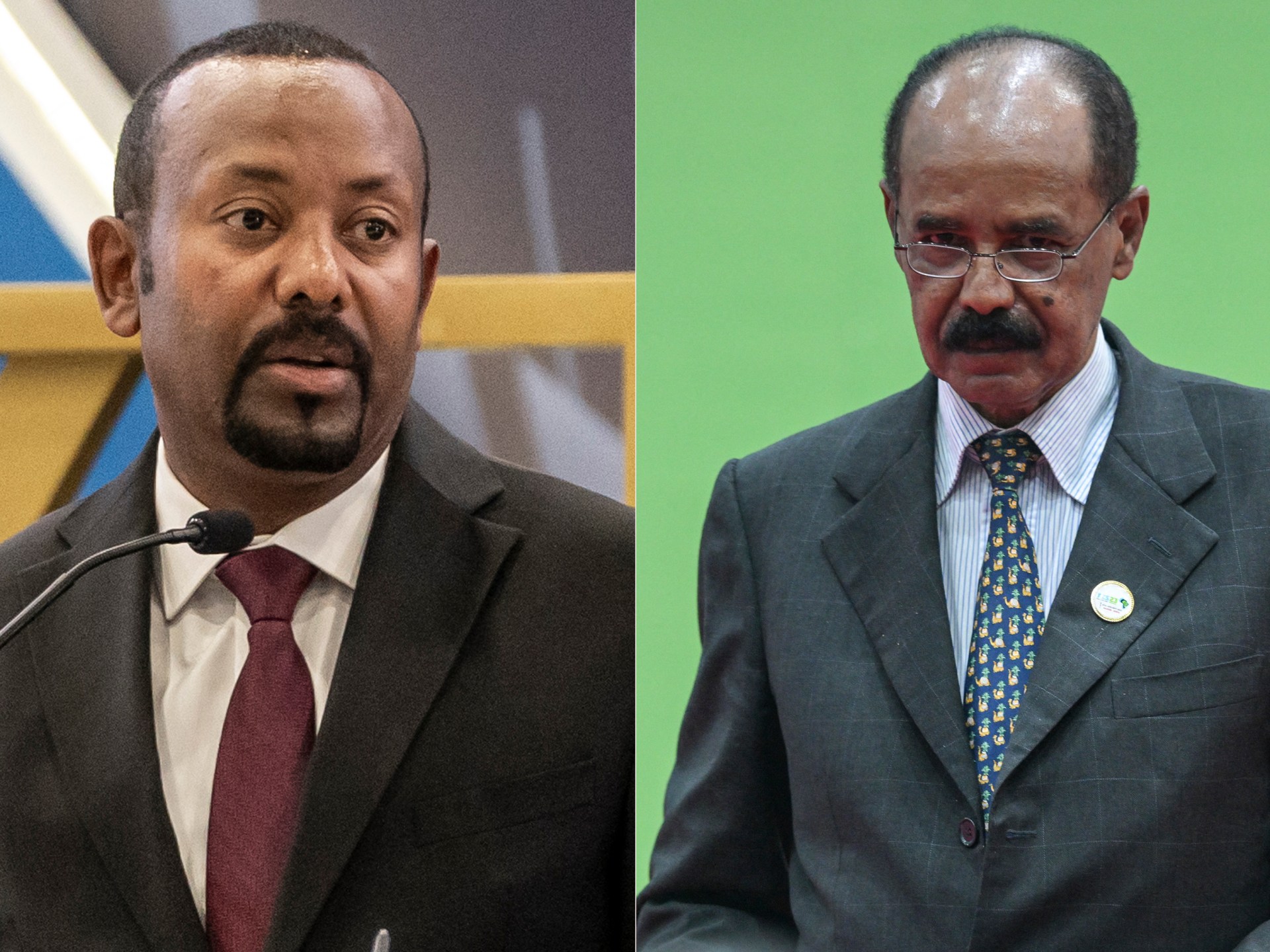

Ethiopia and Eritrea have exchanged accusations of aggression at the United Nations, raising fears of a new conflict in the Horn of Africa region as fighting intensifies in Ethiopia’s northern Tigray region.
The diplomatic spat comes as Ethiopian troops and allied armed groups advanced across Tigray, where forces from Asmara have allegedly crossed the border to support rebels fighting the government forces.
The two neighbours, which fought a deadly border war between 1998 and 2000, were allies during Ethiopia’s devastating 2020-2022 Tigray war.
However, they have since been at loggerheads over the 2022 peace agreement that ended a two-year civil war between the government in Addis Ababa and Tigray rebels, and over Ethiopia’s demands for access to the Red Sea.
So, what did Eritrea and Ethiopia accuse each other of, and are they inching towards war?
What did Eritrea and Ethiopia say at the UN?
Eritrean troops had advanced as far as 60km (37 miles) into Tigray, Ethiopia told the UN Security Council on Friday, accusing its neighbour of violating its sovereignty.
In a letter, Ethiopian Foreign Minister Gedion Timothewos described the alleged incursion as “a blatant act of aggression that engages Ethiopia’s inherent right to self-defence”.
He invoked Article 51 of the UN Charter, which recognises a country’s right to self-defence, but did not specify what measures Ethiopia was taking.
Eritrea, which won independence from Ethiopia in 1993, rejected the accusations of incursions into Ethiopia, calling them a pretext for an Addis Ababa offensive.
![Members of the Ethiopian National Defense Force (ENDF) gather in front of Mekelle Alula Aba Nega International Airport after federal forces retook control of the facility in Mekelle, Ethiopia, October 6, 2026 [AFP]](https://www.aljazeera.com/wp-content/uploads/2026/10/AFP__20261006__D2CC4C4__v1__HighRes__EthiopiaTigrayConflictUnrest-1791393629.jpg?w=770&resize=770%2C513&quality=80)
Eritrean Foreign Minister Osman Saleh, in his own letter to the UN Security Council on Saturday, urged the body to condemn Ethiopia’s “deplorable declaration of war” and take “deterrent measures”.
Advertisement
He warned that an Ethiopian offensive would cause “huge devastation to the peoples of both countries and destabilise the whole region”.
The accusations come amid a broader dispute over access to the Red Sea.
Landlocked Ethiopia has repeatedly argued that securing direct sea access is essential, while Eritrea fears Addis Ababa intends to seize its port of Assab.
Ethiopian Prime Minister Abiy Ahmed reiterated on Monday that Ethiopia must have access to the Red Sea.
Hossamaldeen Ibrahim, an analyst at Bloomsbury Intelligence and Security Institute (BISI), said the narratives of both countries contain “verifiable elements”.
“The danger lies in the fact that each side now treats the other’s narrative as existential,” he told Al Jazeera.
Eritrea and Ethiopia fought a deadly border war from 1998 to 2000. Relations improved after Abiy came to power in 2018, but have soured again in recent years.
Professor Matthias Rompel from the Institute of Sociology at the Justus-Liebig-University Giessen in Germany, said that both sides have legitimate security concerns, but their accusations need to be distinguished from independently verified facts.
“Ethiopia’s allegations of Eritrean military incursions into Tigray… and …the scale of Eritrean involvement, and particularly allegations that Asmara is orchestrating the rebellion against Addis Ababa, remain difficult to substantiate independently,” he told Al Jazeera.
He added that the latest developments suggest that the confrontation is no longer merely about Tigray. “Ethiopia’s quest for Red Sea access, Eritrea’s concerns about sovereignty, and Egypt’s strategic rivalry with Ethiopia over the Nile are interconnected,” he said.
“The conflict, therefore, has the potential to destabilise the wider Horn of Africa, with repercussions for Sudan, Somalia and Red Sea security.”
Fighting escalated on September 23 when a rebel alliance, including the Tigray People’s Liberation Front (TPLF), launched attacks against Ethiopian government forces across Tigray, Amhara and Afar regions.
The rebels captured Tigray’s capital, Mekelle, and its airport before announcing their withdrawal on October 3. Government-allied forces subsequently entered the city.
In the latest on the battlefront, government and allied forces took Idaga Hamus early Friday and Abiy-Adi, in the Tembien area, on Thursday afternoon, according to Ermiyas Ababu, a commander of the government-allied Tigray Peace Force.
Advertisement
Residents, according to Reuters news agency, also reported the takeover of Idaga Hamus. Gebremedhin Kihishen, a business owner in Tembien, said government-allied forces controlled Abiy-Adi.
It was unclear from those accounts who held the towns immediately before the reported government advance or whether Eritrean troops were involved in the fighting.
Ermiyas previously reported Eritrean personnel entering Adigrat on Tuesday and Idaga Hamus on Wednesday, citing reports from his personnel. Al Jazeera was unable to independently verify the claims.
The Armed Conflict Location and Event Data Project (ACLED), a United States-based conflict monitor, reported that Eritrean troops crossed into Ethiopia near Zalambessa and came under Ethiopian drone attack while advancing towards Idaga Hamus. Eritrea has yet to comment on the development.
Addis Ababa accuses Asmara of financing, arming and directing armed groups, as well as deploying troops inside Tigray. Eritrea denies the allegations, which have not been independently verified.
The renewed fighting threatens to unravel the 2022 peace agreement.
That conflict began in November 2020 after months of tensions between Prime Minister Abiy Ahmed’s government and the TPLF, which had dominated Ethiopian politics for nearly three decades before Abiy took office in 2018.
Eritrea fought alongside Ethiopian federal forces against the TPLF, its longtime adversary. The war killed hundreds of thousands of people and was marked by allegations of massacres, sexual violence and widespread hunger.
The November 2022 Pretoria agreement ended major hostilities, but Eritrea was not a party to the deal. Relations between Addis Ababa and Asmara subsequently deteriorated.
Has Ethiopia sent troops north towards Eritrea?
Multiple media reports say Ethiopian government troops and allied militias entered Adigrat, a strategic city roughly 30km (19 miles) from the Eritrean border, on Saturday.
Three residents confirmed their presence to Reuters, while verified footage showed government-allied militia members walking through the city.
Associated Press news agency footage also showed Ethiopian military vehicles entering Adigrat as some residents welcomed the troops.
Government-allied forces have reported capturing Idaga Hamus and Abiy-Adi, while explosions and alleged drone strikes have been reported near Adigrat.
Are Ethiopia and Eritrea inching towards war?
Analysts warn that Ethiopia and Eritrea may already have moved beyond threats and into a dangerous phase of possible military confrontation.
BISI’s Ibrahim said the two countries have moved beyond “inching” towards war, noting that “The situation has entered a high-risk phase of limited but direct military confrontation with a real possibility of rapid escalation into interstate war.”
He warned that the severing of diplomatic ties removed the “last formal mechanism for crisis management”, while Ethiopian military advances towards the Eritrean border increased the risk of “miscalculation”.
Advertisement
Tom Gardner, a correspondent for The Economist, said the current tensions should be understood in the context of decades of hostility between the neighbours.
Their brief alliance during the 2020-2022 Tigray war was an exception and was driven by a shared hostility towards the TPLF, Gardner told Al Jazeera.
“The Ethiopian government’s strategic goal number one is access to the Red Sea, but also removing Eritrea’s government from the picture,” he noted.
“It’s very much looking like the most dangerous moment for the region since that 1998 to 2000 war.”
Rompel from Justus-Liebig-University Giessen said that the current situation is evolving. “The danger of a wider interstate conflict is real, and the situation has already moved beyond a purely diplomatic confrontation,” he said.
“The central danger is not necessarily that either government has decided to launch a full-scale war, but that military miscalculations, mutual distrust and domestic political pressures could trigger a further escalation neither side can easily control.
“A wider conflict is not inevitable, but the space for diplomatic de-escalation is rapidly narrowing,” he said.
Related News
At least 81 US aircraft worth up to $3.3bn lost or damaged in Iran war
Saudi-led coalition dismisses ‘misleading’ Houthi claim of Riyadh attack
As major powers act unilaterally, experts say UN faces crisis in New York