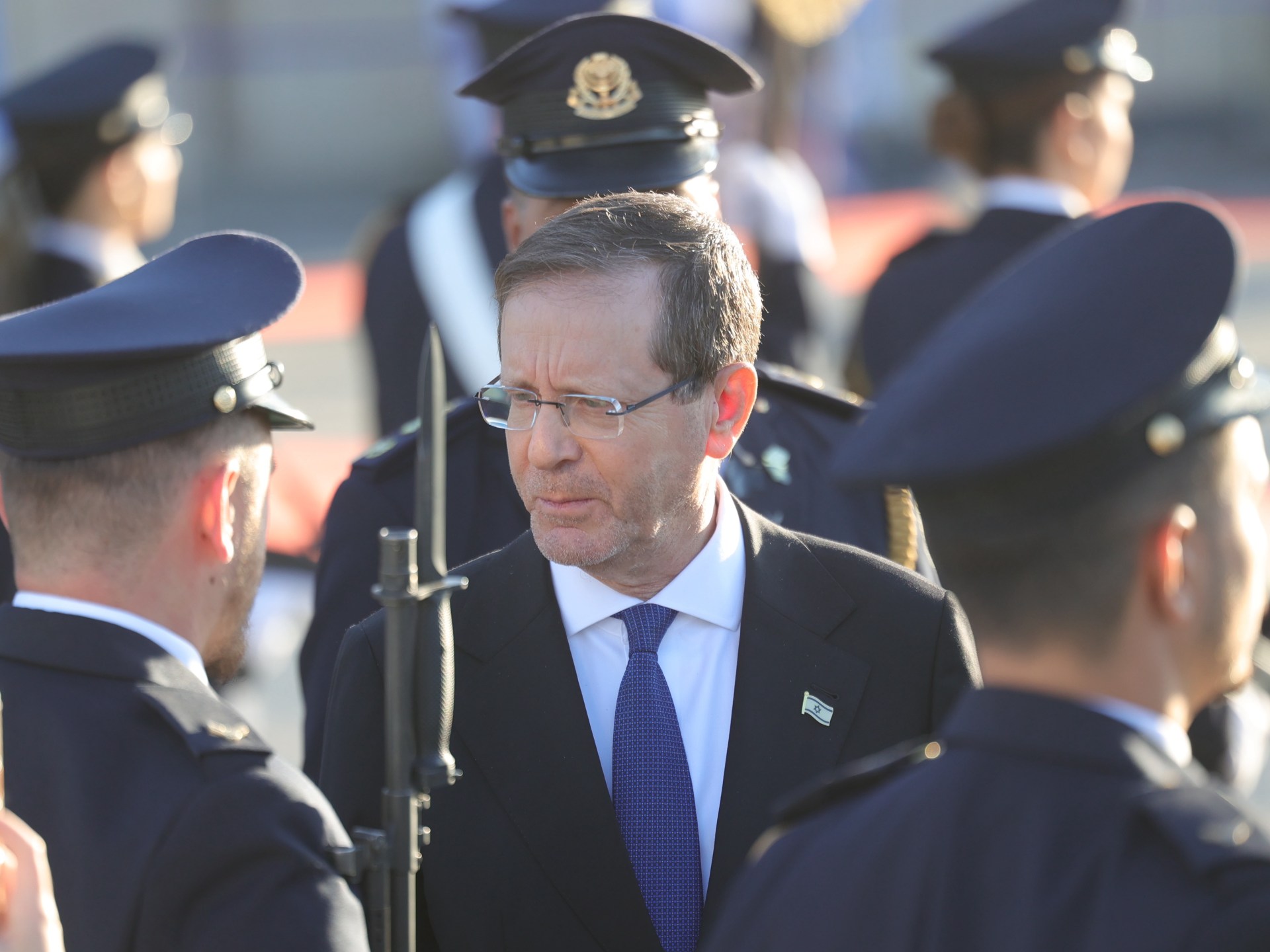

Israeli President Isaac Herzog has urged lawmakers to “leave no stone unturned” and launch an investigation into the October 7 attacks by Hamas in a speech opening the new parliamentary session, after the election left Prime Minister Benjamin Netanyahu’s bloc short of a majority.
Herzog called on party leaders to “make concessions” and do “everything possible to avoid a repeat election” at the swearing-in of newly elected members in the 26th Knesset on Tuesday.
- list 1 of 4Trump says Israel, Gulf allies must repay Iran war cost: What does it mean?
- list 2 of 4Israeli forces kill 14-year-old Palestinian boy in occupied West Bank
- list 3 of 4What is next for Israel?
- list 4 of 4Eisenkot open to Netanyahu joining Israel’s next government
end of list
The Israeli president tasked opposition leader Gadi Eisenkot with forming the country’s next government on Sunday, starting the clock for him to cobble together a coalition within 28 days, with a possible 14-day extension.
While also short of a parliamentary majority, Eisenkot and his allies hope to use their newfound legislative power to move rapidly to establish an independent inquiry into the October 7 attacks.
“I am committed in this complex situation to form a national emergency government as quickly as possible,” Eisenkot said, ahead of the Knesset session.
Netanyahu has previously refused to form a commission to investigate the attacks, arguing that a panel appointed by the Israeli Supreme Court would be biased against the government.
On Iran, Herzog said in his speech that Tehran “does not stop even for a moment in its plots and threats, whether directly or through its partners”, repeating the notion from his speech officially delegating Eisenkot to form the new government.
The president said Israel “must fortify the alliance” with the United States amid increasing disapproval of Israel among the US public due to the genocidal war on Gaza and the US-Israel war on Iran.
Advertisement
“Alongside the stubborn and determined war against those who seek to harm us, we must build a stable political horizon in the region with our neighbours,” he said, adding that Israel must “strengthen and even add to the peace agreements with Egypt, Jordan, Morocco, the United Arab Emirates, and Bahrain”.
Political gridlock
The speaker of the Knesset, a member of Netanyahu’s Likud Party, will remain in the caretaker position until a new vote is held.
“Yashar, Eisenkot’s party, has already submitted 61 signatures of new parliamentarians demanding that the vote take place as soon as possible,” said Al Jazeera’s Nour Odeh, reporting from the occupied West Bank.
Netanyahu and his bloc continue to protest the result of the October 27 elections, claiming foreign interference after Palestinian-Israeli parties secured a 19-seat bloc.
“Those protests have gone unanswered because the results have been certified and every relevant authority has dismissed the allegations that there were widespread violations,” Odeh said.
Eisenkot has yet to strike deals with parties that could bring him to the 61-seat majority needed to form a government. If neither Eisenkot nor Netanyahu forms a coalition, another round of elections could follow.
Related News
One person killed in suspected ‘Islamophobic’ shooting near Paris
‘Call me senator’: How Abdul El-Sayed beat Trump’s hate to create history
China steps up Middle East diplomacy with Iran and Oman meetings