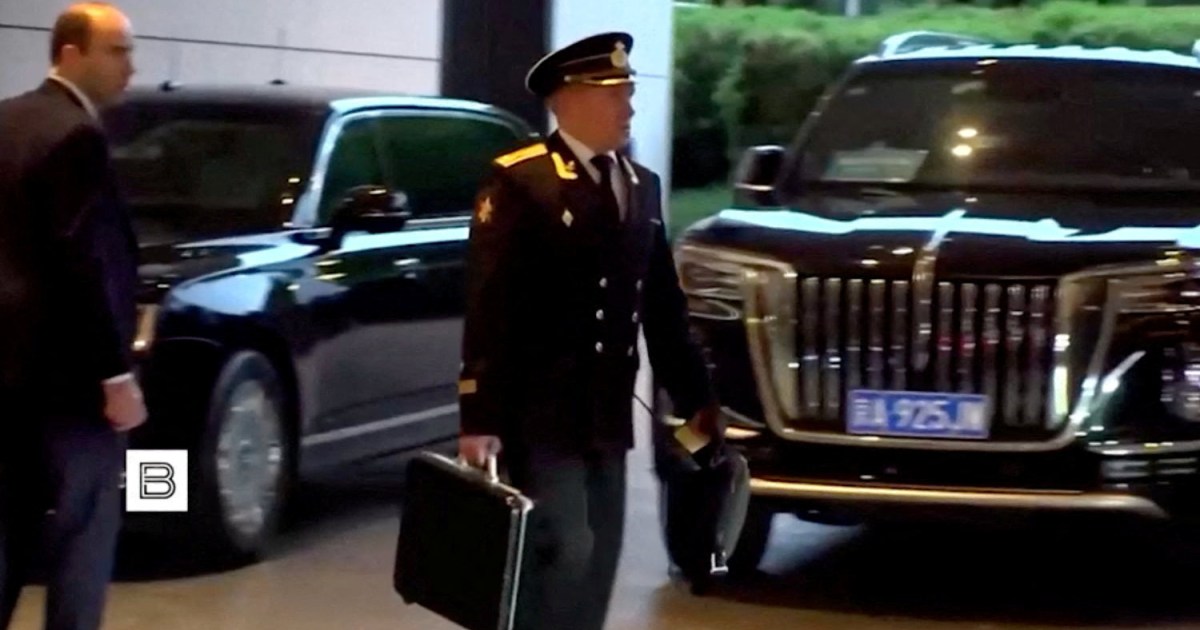

As the leaders of the United States, China and Russia arrived in the southern Chinese city of Shenzhen for trilateral talks on the sidelines of the Asia-Pacific Economic Cooperation (APEC) summit on Thursday, one man in Russian military uniform was spotted carrying a mysterious black briefcase.
As a Russian state television camera zoomed in on the naval officer travelling with President Vladimir Putin, reporter Yevgeny Popov gestured towards the case, telling viewers, “this is the nuclear briefcase”. The officer smiled and confirmed it was indeed the bag carrying the Russian president’s direct access to his country’s nuclear arsenal – known as the “Cheget”.
Recommended Stories
list of 4 items
- list 1 of 4Charting the world’s biggest IPOs as Anthropic overtakes SpaceX
- list 2 of 4Gaza Syndrome: Why Israeli soldiers’ trauma erases Palestinian victims
- list 3 of 4Why is Pete Hegseth strengthening US military ties with Venezuela?
- list 4 of 4Kenya’s world marathon champion Jepchirchir gets three-year ban for doping
end of list
“Unbelievable,” Popov said.
The US president has an equivalent satchel, known as the “nuclear football”, which routinely travels with him, though it has yet to be spotted in Shenzhen. Whether Chinese President Xi Jinping travels with a similar case is unclear.
So are these briefcases simply symbols to project power, or do they really give leaders the ability to order a nuclear strike at a moment’s notice?
Here’s what we know:
What is a nuclear briefcase?
It is a specially kitted-out briefcase that connects to the military command system, through which a leader can order a nuclear attack.
The US and Russian (then-Soviet) systems emerged during the Cold War, when the leaders of both powers faced the prospect of having to make decisions about nuclear strikes with little warning.
However, the image of a finger hovering over a red button is somewhat far-fetched. Military personnel and a much larger communications system are required to carry out a leader’s order.
Advertisement
How do the US ‘football’ and Russia’s Cheget differ?
The origins of the nuclear briefcase in the US, known as the “nuclear football”, predate the 1962 Cuban missile crisis. Historians trace it to Dwight Eisenhower’s administration, and a declassified memo indicating that Eisenhower briefed John F Kennedy on the device the day before Kennedy took office in January 1961.
The US president also carries a card nicknamed the “biscuit”, which contains codes used to verify the president’s identity when issuing a nuclear order. The vice president has access to a “backup football” and authentication codes in case he or she needs to assume presidential authority.
The Congressional Research Service states that the US president alone can authorise the use of nuclear weapons but can seek advice from senior military leaders.
Russia’s version of the briefcase, the Cheget, takes its name from a mountain in the Caucasus. It entered Soviet service in 1983 and a naval officer traditionally carries the president’s case for him. In 2015, the Yeltsin Center in Yekaterinburg put the briefcase used by Boris Yeltsin, Russia’s first post-Soviet president, on display.
Today’s Cheget links the president to the Russian military’s central command, and it can transmit an order to use nuclear weapons, but it cannot launch them. Russia is believed to have three such briefcases, assigned to the president, the defence minister and the chief of the General Staff.
Under Russia’s published nuclear doctrine, the president decides whether to use nuclear weapons. The Cheget communicates through Russia’s “Kazbek” command-and-control network, which supports a separate communications system called “Kavkaz”. Public accounts differ on how many of the briefcases would be needed to authenticate a presidential order.

Why do leaders travel with them?
In theory, a nuclear attack could begin while a president is on a plane, at a summit or asleep in a hotel.
Nuclear briefcases, therefore, allow attacks or counterattacks to be launched at any time, regardless of the leader’s location. That matters in terms of deterrence: the idea that an adversary may decide against attacking if they believe the other side could still retaliate.
As the economist and strategist Thomas Schelling wrote in his 1966 book Arms and Influence: “The power to hurt is bargaining power.”
Advertisement
Russian media also showed Putin accompanied by naval officers carrying briefcases on a visit to Beijing in 2023. At a summit, the sight of the Cheget can serve as a visible reminder of Russia’s nuclear arsenal. The Shenzhen footage establishes that the case is there, which also acts as a strong reminder that Russia possesses nuclear weapons.
“The fact that Kremlin-backed TV channels showed this tells us a lot,” Simon Mabon, a professor of international politics at Lancaster University, told Al Jazeera. “This is pure political theatre and a symbolic performance of a man that is conscious his country’s standing in the world is not what it once was.”
“Compared to the United States or China, Russia does not have the military or economic capacity it once did – this is an attempt to performatively demonstrate that Russia belongs at that grand table.”
Do other countries have nuclear briefcases?
The Stockholm International Peace Research Institute counts nine nuclear-armed states. The US and Russian briefcases are the best documented. Elsewhere, governments have generally revealed more about who can authorise the use of nuclear weapons than about what equipment travels with their leaders.
In the United Kingdom, only the prime minister can authorise the use of nuclear weapons, according to the House of Commons Library. Each new prime minister also writes four handwritten “letters of last resort” – one for the commander of each nuclear-armed submarine – setting out what to do if a nuclear attack destroys the government.
Meanwhile in France, that authority rests with the president. French newspaper Le Monde reported that Nicolas Sarkozy handed over the nuclear codes to Francois Hollande when he left office in 2012.
China maintains a “no first use” policy, meaning Beijing says it would deploy nuclear weapons only in response to a nuclear attack from another country. Whether President Xi Jinping travels with a dedicated nuclear briefcase remains unclear.
The government in India says only the Political Council of its Nuclear Command Authority, chaired by the prime minister, can authorise the use of nuclear weapons, while it remains unclear whether it carries equipment.
Pakistan and North Korea also have nuclear weapons, while Israel is widely believed to hold them, but there is not enough reliable public information to know whether their leaders travel with comparable cases.