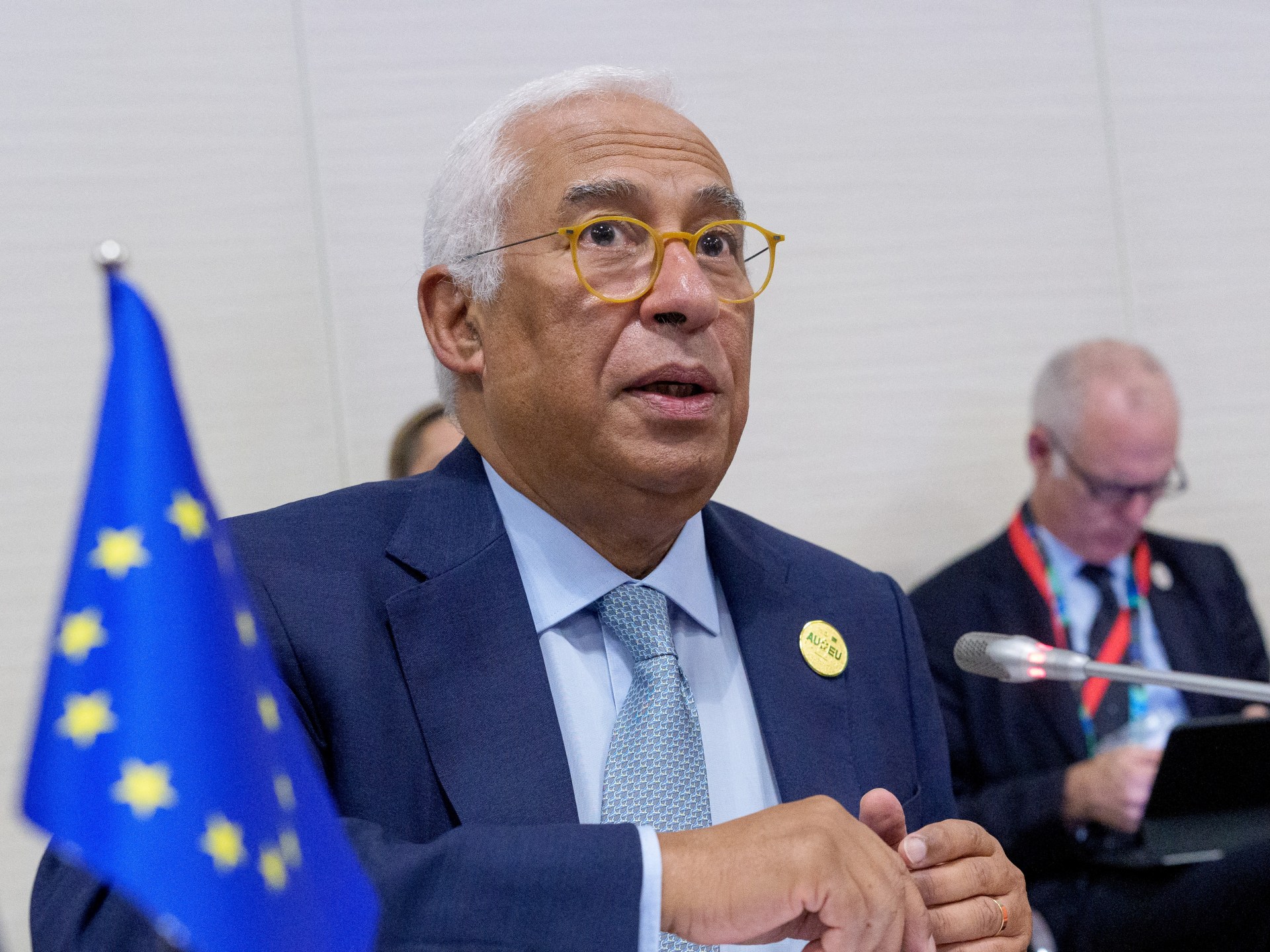

European Council President Antonio Costa and the German government have lambasted a new US national security strategy that paints Europe as a troubled, declining power that may one day lose its usefulness as an ally to Washington.
The remarks on Monday from the European Union’s leading economy and one of its top officials delivered a stinging rebuke to the National Security Strategy released on Friday by the administration of US President Donald Trump.
- list 1 of 4EU’s Kallas says Washington ‘biggest ally’ despite US security downgrade
- list 2 of 4Russia welcomes Trump’s revised US security strategy
- list 3 of 4Ukraine’s Zelenskyy to meet European allies as US pushes revised peace plan
- list 4 of 4Will Trump’s new security doctrine boost the rise of far right in Europe?
end of list
The 33-page document contains scathing criticism of the continent, claiming it is facing the “prospect of civilisational erasure” due to migration, scorning it for “censorship of free speech” and suppression of anti-immigration movements, and suggesting that the US may withdraw the security umbrella it has long held over it.
The stoush over the strategy, playing out as Washington ramps up pressure on Ukraine to agree to a plan to end the war with Russia, reflects what EU leader Costa said was a “changed” relationship between the US and Europe.
“We need to focus on building a Europe that must understand that the relationships between allies and the post-World War II alliances have changed,” Costa said at the Jacques Delors Institute, a think tank in Paris.
In response to the strategy document’s comments on free speech, Costa warned, “There will never be free speech if the freedom of information of citizens is sacrificed for the aims of the tech oligarchs in the United States.”
Costa strongly criticised allegations that free speech is being censored in Europe and said only European citizens can decide which parties should govern them.
Advertisement
“What we cannot accept is this threat of interference in Europe’s political life. The United States cannot replace European citizens in deciding which are the right parties and the wrong parties,” Costa said.
“The United States cannot replace Europe in its vision of freedom of speech,” he noted, adding, “Our history has taught us that there is no freedom of speech without freedom of information.”
In Berlin, Sebastian Hille, a deputy spokesperson for the German government, said some of the criticisms in the document were “ideology rather than strategy”.
“Political freedoms, including the right to freedom of expression, are among the fundamental values of the EU,” he said.
He said Berlin also disagreed with the document’s failure to classify Russia, which in February 2022 launched a full-scale invasion of neighbouring Ukraine, as a threat.
“We stand by NATO’s joint analysis, according to which Russia is a danger and a threat to trans-Atlantic security,” he added.
Divisions over Russia
The US strategy document makes clear that Washington wants to improve its relationship with Moscow, saying that it has a “core interest” in ending the conflict with Ukraine to “reestablish strategic stability with Russia”, while hitting out at European officials’ “unrealistic expectations” for a solution to the war.
An initial US plan for ending the war, which would have allowed Russia to hold on to large territories in eastern Ukraine, sparked criticism from European leaders amid concerns that Washington is trying to force Kyiv to accept unfavourable terms.
The plan has since been altered, first with input from Ukraine alongside its European allies and then in meetings between Ukrainian and US officials. The full details of the proposal as it stands have not been disclosed.
By contrast, Moscow has welcomed Trump’s strategy document.
Costa said that given the strategy document’s position on Ukraine, “we can understand why Moscow shares [its] vision.”
“The objective in this strategy is not a fair and durable peace. It’s only [about] the end of hostilities, and the stability of relations with Russia,” he said.
“Everyone wants stable relations with Russia,” Costa said, but “we can’t have stable relations with Russia when Russia remains a threat to our security”.
Related News
Tens of thousands march in Europe denouncing Israel’s genocide in Gaza
‘Putin perfectly understands that Ukraine is running out of time’
Was ex-Honduras leader Hernandez victim of Biden ‘set-up’, as Trump claims?