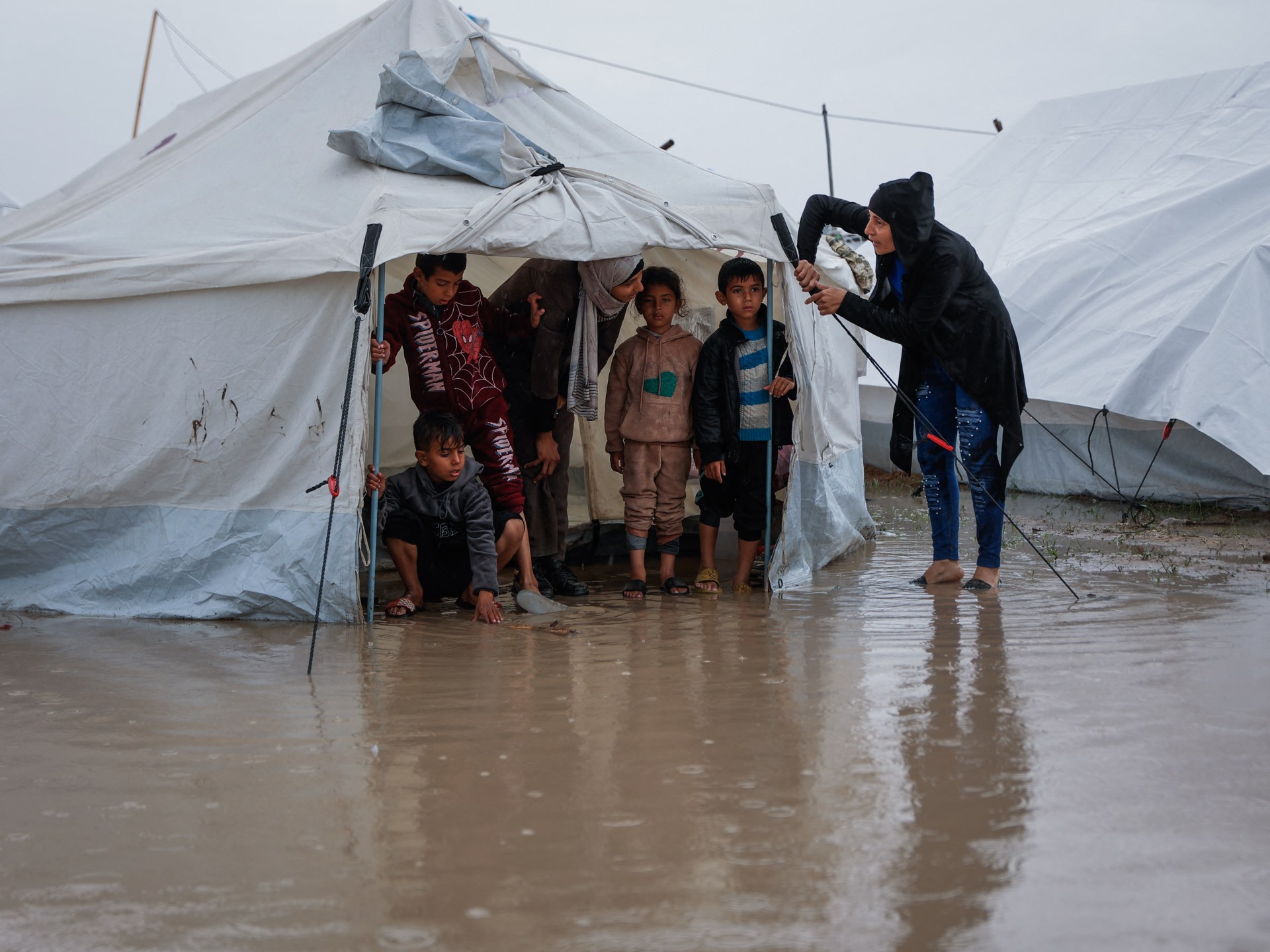

In the large displacement camps of Gaza, rows upon rows of makeshift tents blanket debris, empty lots and what remains of flattened neighbourhoods. With Storm Byron descending upon the enclave, a sense of terror has seized a population already exhausted from two years of Israel’s genocidal war with its unrelenting bombardment, starvation and chaos.
For the 1.5 million Palestinians living under plastic sheets and tattered tarps, the storm means something more than just bad weather. It’s another danger piled on top of the current battle for survival.
- list 1 of 4Are Israel, Hamas entering the second phase of Gaza ceasefire?
- list 2 of 4Displaced Gaza families struggle as winter storm hits
- list 3 of 4Gaza storms mean Palestinians brace for “very tragic situation”
- list 4 of 4Winter storm devastates Gaza tents amid deepening humanitarian crisis
end of list
For several days, meteorologists have warned that heavy rainfall and strong winds could hit the strip today, tomorrow and over the weekend, risking flash flooding and significant wind damage. What is certain, though, is that Gaza is not facing this storm with ready infrastructure, stocked shelters or functioning drainage systems.
It faces it with tents propped up with pieces of scrap metal, paths that become mud rivers after only one night of rain and families who have nothing left to protect.
Solidarity a survival strategy
In the camps of Gaza City, the scenes of vulnerability are everywhere. Most tents are constructed from aid tarpaulins, pieces of plastic salvaged from rubble and blankets tied to recycled wooden poles. Many sag visibly in the middle; others are erected inadequately, so much so that they quiver and flap violently under the slightest breeze.
“When the wind starts, we all hold the poles to keep the tent from falling,” said Hani Ziara, a father sheltering in western Gaza City after his home was destroyed months ago.
Advertisement
His tent was flooded last night in the heavy rain, and his children had to stay outside in the cold. Hani wonders painfully what else he can do to protect his children from the rain and strong winds.

In many camps, the ground was already soft from previous rainfall. Wet sand and mud stick to shoes, blankets and cooking pots as people shuffle through. Trenches dug by volunteers to divert water often collapse within hours. With nowhere else to go, families who live in low-lying areas are preparing for the worst: that floodwaters will be pushed directly into their tents.
Stocking up on food, storing clean water and securing shelter are the most basic steps when people prepare for a storm, but that is considered a luxury for the displaced of Gaza.
Most families receive scant water deliveries, going sometimes days without enough to cook or wash. Food supplies are equally strained, and while irregular aid distributions provide basics like rice or canned beans, the quantities seldom last more than a few days. Preparing for a storm by cooking ahead, gathering dry goods or storing fuel is simply not possible.

“We could not sleep last night. Our tent was flooded with rainwater. Everything we had was flushed out by water. We want to prepare, but how?” asked Mervit, a mother of five children displaced near the Gaza port. She added, “We barely have enough food for tonight. We can’t save what we don’t have.”
Despite poverty, solidarity has become Gaza’s strongest survival strategy. Neighbours, with whatever they have, help secure the tents. Young men go through the rubble and scavenge for metal and wood remains to serve as temporary posts. The women organise collective cooking so that hot meals can be distributed to families in need, particularly those with young children or elderly family members, whenever possible.
These unofficial networks become more active the closer a storm gets. Volunteers trudge from tent to tent, helping families raise sleeping areas off the ground, patch holes in canopies with plastic sheets, and dig drainage channels. Crowds try to move those who are in precarious, extremely exposed areas to other locations, sharing information about safer places.
‘We are exhausted’
Beyond physical danger, the psychological impact is deep. After months of displacement, loss and deprivation, another crisis – this time, not war, but forces of nature – feels overwhelming.
Advertisement
“Our tents were destroyed. We are exhausted,” said Wissam Naser. “We have no strength left. Every day there is a new fear: hunger, cold, disease, now the storm.”

Many residents describe the feeling of being sandwiched between the sky and the ground, exposed on both ends and unable to protect their families from either.
As clouds mass along Gaza’s shore, families prepare to take a hit. Some weigh down tent walls against the wind with rocks and sandbags. Others push children’s blankets to the driest corner, hoping a roof will last. Most don’t have a plan. They just wait.
The storm will not be another single-night affair for the displaced in Gaza. It would be a further reminder of how fragile life has become, how survival depends not on preparedness but rather on endurance.
They wait because they have no alternative. They prepare with what little they have. They pray that this time, the winds will be merciful.
Related News
Guinea-Bissau’s new military ruler moves to consolidate power after coup

Netanyahu writes to Israeli president requesting pardon in corruption cases

Ukraine seeks to shore up support in Brussels, Paris