How does the cutoff of Starlink terminals affect Russia’s moves in Ukraine?
 10 February 2026

Kyiv, Ukraine – A heavy Russian Geran drone struck a fast-moving train in northern Ukraine on January 27, killing five, wounding two and starting a fire that disfigured the railway carriage.
Such an attack was impossible back in 2022, when Russia started dispatching roaring swarms of Shaheds, the Geran-2’s Iranian prototypes.
- list 1 of 4Ukraine pulls plug on Russian Starlink, beefs up drone defence
- list 2 of 4US has given Ukraine and Russia June deadline to end war: Zelenskyy
- list 3 of 4Russia says second suspect in general’s shooting arrested in Dubai
- list 4 of 4Child among 4 killed in latest Russian missile and drone barrage: Ukraine
end of list
Ukrainian servicemen ridiculed them for their slow speed and low effectiveness – and shot them down with their assault rifles and machineguns.
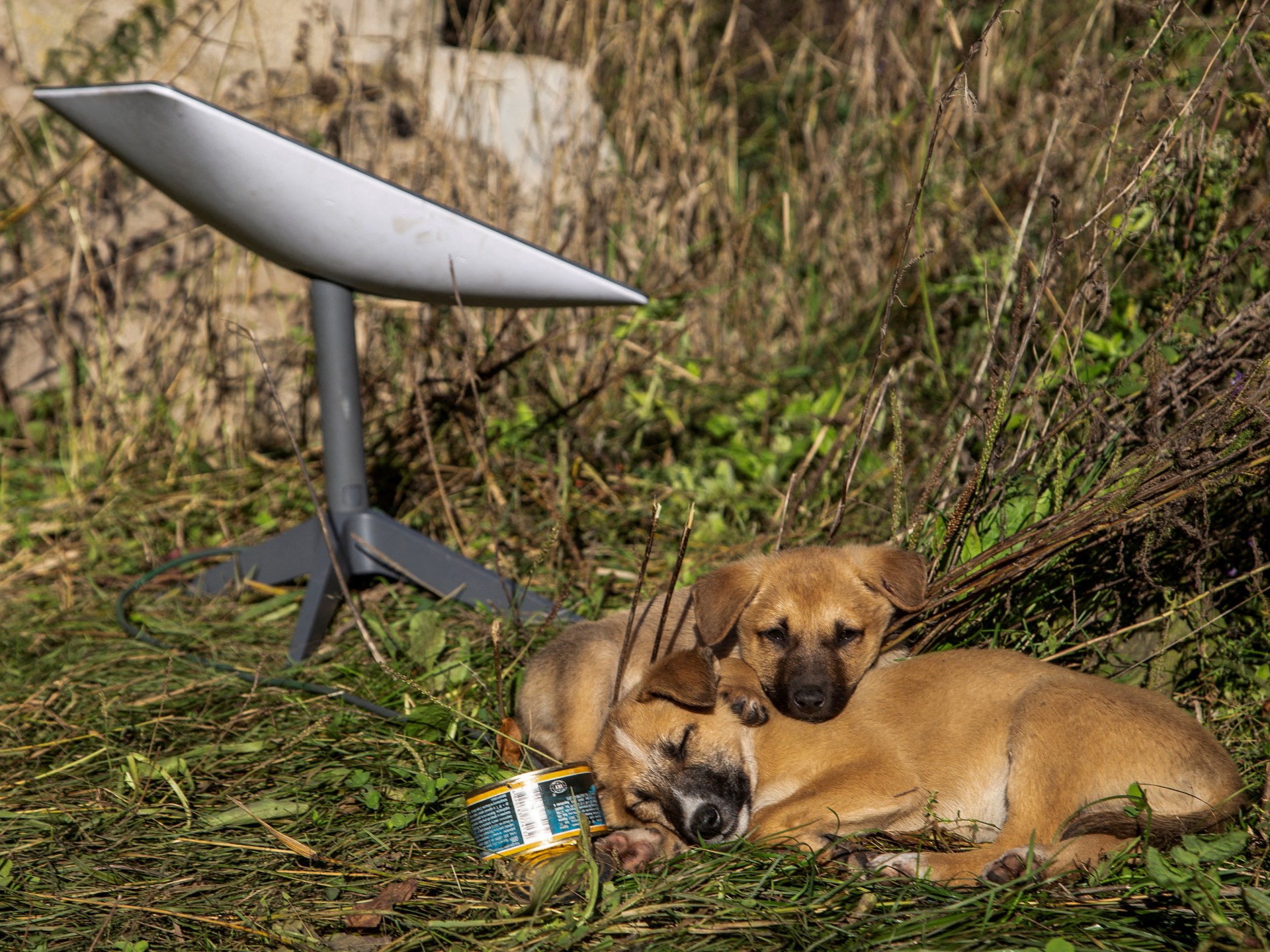
But the Geran kamikaze drones have undergone countless modifications, becoming faster and deadlier – and some were equipped with Starlink satellite internet terminals.
The terminals made them immune to Ukrainian jamming and even allowed their Russian operators to navigate their movement in real time.
Western sanctions prohibit the import of the notebook-sized terminals operated by Elon Musk’s SpaceX company to Russia.
But Moscow has allegedly smuggled thousands of them via ex-Soviet republics and the Middle East, notably Dubai, using falsified documents and activation in nations where the use of Starlink is legal, according to Russian war correspondents and media reports.
Russian forces were able to counter the use of Starlink by Ukrainian forces as the terminals linked to SpaceX’s satellite armada orbiting the Earth allowed faster communication and data exchange, as well as greater precision.
In early February, SpaceX blocked the use of every Starlink geolocated on Ukrainian territory, including the ones used by Ukrainian forces.
Advertisement
Only after a verification and inclusion into “white lists” that are updated every 24 hours can they be back online.
But any terminal will be shut down if moving faster than 90km/h (56mph) to prevent drone attacks.
“Looks like the steps we took to stop the unauthorized use of Starlink by Russia have worked,” Musk wrote on X on February 1.
The step is ascribed to Ukraine’s new defence minister, Mykhailo Fedorov, a 35-year-old who had served as the minister of digital transformation. He introduced dozens of innovations that simplified bureaucracy and business, according to a four-star general.
“Fedorov managed to sort it out with Musk – somehow, because we couldn’t do it earlier,” Lieutenant General Ihor Romanenko, a former deputy head of Ukrainian armed forces, told Al Jazeera.
He said the shut-off “significantly lowered” the effectiveness of Russia’s drone attacks and disrupted the communication of small groups of Russian soldiers trying to infiltrate Ukrainian positions.
The effect was so devastating that it made Russian forces “howl” with despair, said Andriy Pronin, one of the pioneers of military drone use in Ukraine.
“They’re like blind kittens now,” he told Al Jazeera.
Russian servicemen in places like the contested eastern town of Kupiansk are now “deprived of any way of getting in touch with mainland”, one of them complained on Telegram on February 4.
Other servicemen and war correspondents decried the shortsightedness of Russian generals who built communications around Starlink and did not create an alternative based on Russian technologies and devices.
However, the shutdown affected Ukrainian users of Starlink that were not supplied to the Defence Ministry but were procured by civilians and charities.
“The communications were down for two days until we figured out the white list procedure,” Kyrylo, a serviceman in the northern Kharkiv region, told Al Jazeera. He withheld his last name in accordance with the wartime protocol.
The effect, however, is short-term and is unlikely to turn the tables in the conflict that is about to enter another year.
“It’s not a panacea, it’s not like we’re winning the war,” Pronin said. “It will be hard [for Russians], but they will restore their communications.”
According to Romanenko, “it’ll take them several weeks to switch to older” communication devices such as radio, wi-fi, fibre optic or mobile phone internet.