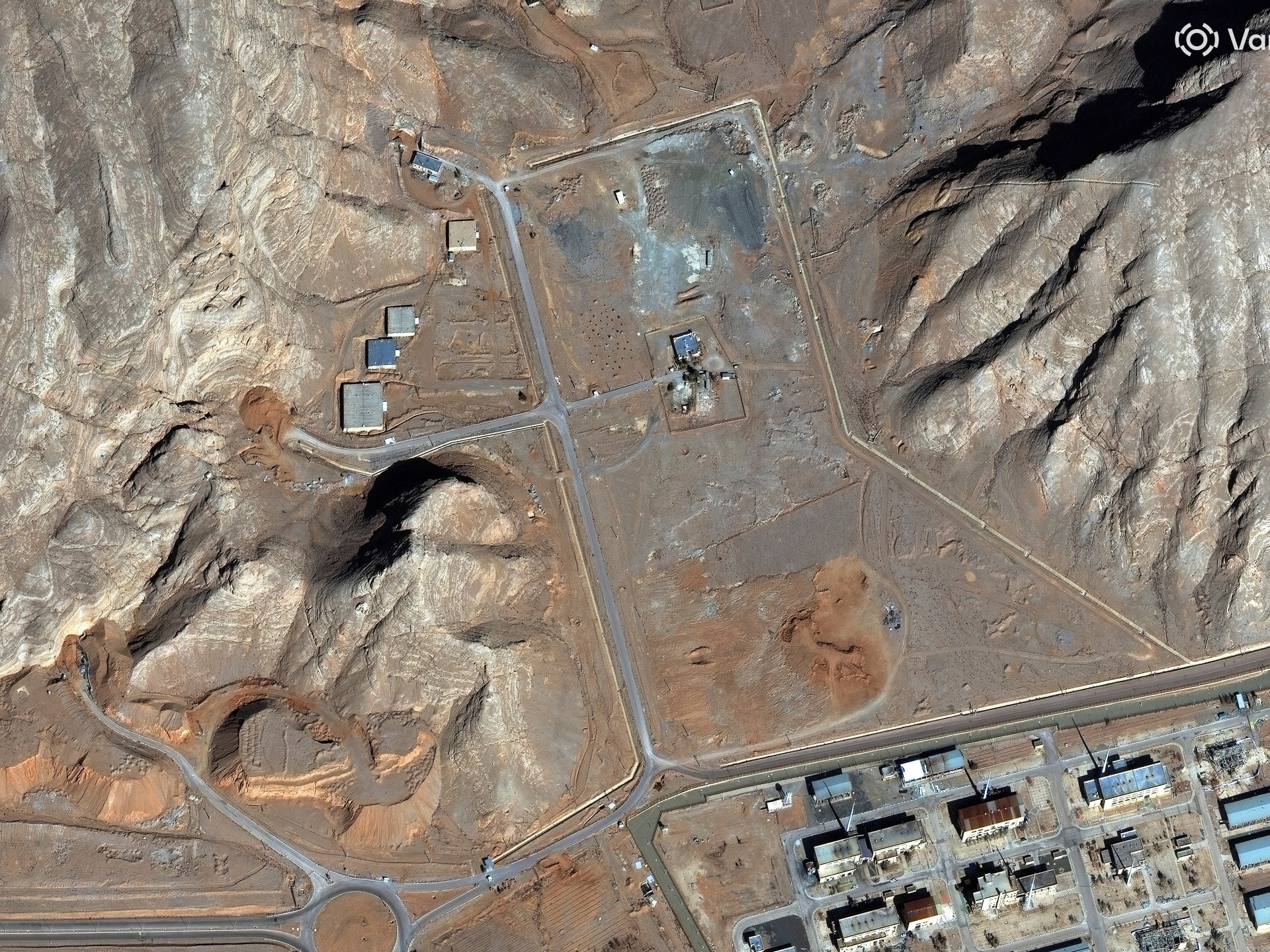

The United Nations nuclear watchdog has said in a report that Iran has stored most of its highly enriched uranium at an underground tunnel complex at its Isfahan facility, urging Tehran to allow inspections as it faces growing pressure from the United States over its nuclear programme.
The International Atomic Energy Agency (IAEA) report, which was circulated to members Friday, confirmed earlier findings that the country was enriching uranium up to 60 percent, which is a short step away weapons-grade purity, raising concerns over the IAEA’s lack of access to the Isfahan site, one of three facilities that the US claimed to have “obliterated” in last year’s 12-day war.
- list 1 of 3US-Iran talks conclude with claims of progress but few details
- list 2 of 3US re-asserts 2025 strikes ‘obliterated’ Iran’s nuclear programme
- list 3 of 3Iran hails ‘encouraging signals’ from US before nuclear talks on Thursday
end of list
The IAEA report also stated that its inspectors do not know the precise location of a fourth uranium enrichment facility that Iran said it was setting up in Isfahan prior to the 12-day war, adding that they were not aware of its operational status or whether it currently contains nuclear material.
The IAEA said it had observed in satellite imagery “regular vehicular activity around the entrance to the tunnel complex at Isfahan in which (uranium) enriched up to 20% and 60% U-235 … was stored”, stressing the importance of being able to carry out inspections in Iran without further delay.
There was no immediate comment from Iran.
The report comes a day after US and Iranian negotiators held a third round of indirect talks mediated by Oman in Geneva that yielded no breakthrough.
It will be discussed at a quarterly meeting of the IAEA’s 35-country board commencing on Monday next week in Vienna, coinciding with further Oman-mediated meetings between technical teams in the same city.
Advertisement
There is uncertainty over the fate of Iran’s stockpile of more than 400kg (882 pounds) of 60 percent enriched uranium that was last seen by nuclear watchdog inspectors last June 10.
Israel launched strikes on Iran later that month, beginning a 12-day war that the US briefly joined to bomb Iranian nuclear sites.
Tehran suspended some cooperation with the IAEA and restricted the watchdog’s inspectors from accessing sites bombed by Israel and the United States, accusing the UN body of bias and of failing to condemn the strikes.
Al Jazeera correspondent Ali Hashem said the technical points up for discussion in the Oman-mediated talks on Monday would, he said, be “related” to extracting the 440.9kg (972 pounds) of uranium enriched to up to 60 percent that the IAEA had reported prior to the 12-day war, in case there was “any tendency to go towards weaponisation of the programme”.
However, Hashem added, the IAEA is aware that “even the Iranians aren’t able to get into those facilities.” “So there’s been a lot of work around the facilities, at least this is what was shown in satellite imagery, but it doesn’t seem that the Iranians were able to get in,” he said.
Reporting from Tehran, Al Jazeera’s Tohid Asadi said the stockpile of enriched uranium and the inspections were the main “sticking point” in US-Iran discussions.
After yesterday’s talks, Iranian Foreign Minister Abbas Araghchi said the US should stop its “excessive demands”. He did not specify what those demands were, but the US has said it wants Iran to dismantle its nuclear infrastructure entirely, limit its arsenal of ballistic missiles and stop supporting regional allies.
Related News
Israel’s opposition leader voices support for ‘broad’ Middle East expansion
Trump says planning to ‘make visit’ to Venezuela following Maduro abduction

UN staffers back Francesca Albanese, condemn European ministers for attacks