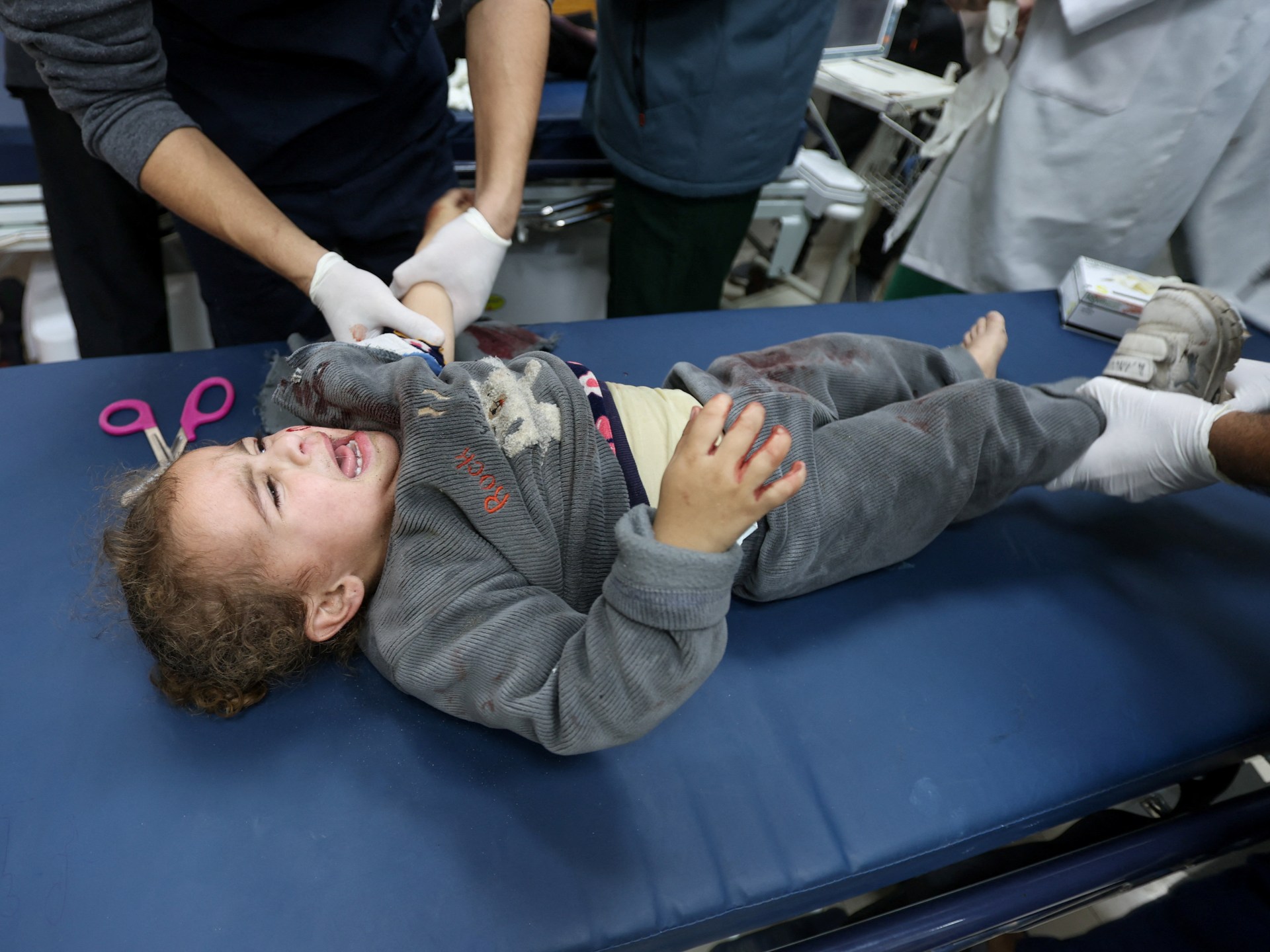

Israel has launched intense artillery and helicopter attacks on southern Gaza despite a United States-brokered ceasefire, bombing a tent housing displaced Palestinians and killing a five-year-old girl and her uncle, according to officials.
The killings on Monday brought the number of Palestinians killed by Israeli forces since the truce came into effect in October to at least 422, according to Gaza health authorities.
- list 1 of 4Egypt says it shares ‘identical’ views with Saudi Arabia on Yemen, Sudan
- list 2 of 4Five-storey building damaged during war collapses in central Gaza
- list 3 of 4Gaza PhD scholar is now baker to feed family, others amid Israel’s war
- list 4 of 4Israel extends Gaza occupation beyond ‘yellow line’ in north, bombs south
end of list
The Nasser Medical Complex in southern Khan Younis said the deadly Israeli strike hit a tent in the coastal al-Mawasi area, and that four others, including children, were also wounded.
Israel’s military said it struck a Hamas fighter who was planning to attack Israeli forces “in the immediate timeframe”. But the military did not provide evidence for the claim, and it was not clear if its statement referred to the tent attack.
Despite the ceasefire, Israeli forces have continued near-daily attacks on Gaza and have maintained restrictions on the entry of humanitarian aid. Much of the enclave has been devastated by Israel’s genocidal war, with roughly 88 percent of buildings damaged or destroyed, Palestinian officials say.
Most of Gaza’s two million people are now living in tents, makeshift shelters or damaged buildings in areas vacated by Israeli troops.
The Palestinian Civil Defence said on Monday that another Palestinian home damaged in earlier Israeli strikes collapsed in the central Maghazi camp, killing a 29-year-old father and his eight-year-old son.
But the rescue service said in a subsequent statement that it was unable to respond to requests to remove hazards caused by damaged buildings because of a lack of equipment and continuing fuel shortages.
The Gaza ceasefire, agreed upon after more than two years of Israeli attacks that killed more than 71,000 people, is being implemented in phases. The first stage includes exchanges of captives and prisoners, increased humanitarian aid and the reopening of Gaza’s Rafah border crossing with Egypt.
Advertisement
Hamas has freed all remaining living captives and returned dozens of bodies, except for one, while Israel has released nearly 2,000 Palestinian detainees and prisoners, including some serving life sentences.
However, humanitarian groups say that Israeli restrictions continue to hamper aid deliveries, while Gaza’s Rafah crossing with Egypt remains closed. The crossing had long been Gaza’s only connection to the outside world until the Israeli military occupied the Palestinian side in May 2024.
Israel’s Kan broadcaster reported on January 1 that Israeli authorities are preparing to reopen the crossing in “both directions” following pressure from US President Donald Trump.
If confirmed, it would mark a shift from an earlier Israeli policy that stated the crossing would only open “exclusively for the exit of residents from the Gaza Strip to Egypt”. The policy drew condemnation from regional governments, including Egypt and Qatar, with officials warning against the ethnic cleansing of Gaza.
The latest Israeli report has left many Palestinians hopeful.
Tasnim Jaras, a student in Gaza City, told Al Jazeera that it was her “dream that the crossing opens so we can continue our education”.
Moaeen al-Jarousha, who was wounded in the war, said he needed to leave Gaza to receive medical treatment abroad. “I need immediate medical intervention. I live in very difficult conditions,” he said.
Al Jazeera’s Hani Mahmoud, reporting from Gaza City, said Palestinians in Gaza have been waiting for the crossing to open for a long time.
“For many, this isn’t about travel, it’s about survival. Parents are asking about medical access they haven’t been able to obtain over the past two years. Students think of this as an opportunity to continue their education,” he said.
“And for many families, this is an opportunity to reunite with family members who have been separated for too long. But hope here is never simple. People here have heard about these announcements numerous times, and many recall how quickly it shut again,” he added.
Israel, meanwhile, continues to retain control of 53 percent of Gaza, and witnesses on Monday reported continued demolitions of residential homes in the eastern Zeitoun neighbourhood of Gaza City.
The Israeli military also said it attacked a Palestinian who had crossed the so-called “yellow line” – an unmarked boundary where the Israeli military repositioned itself when the truce came into effect – in southern Gaza on Monday with the aim of “removing the threat”. It did not provide evidence for the claim.
Advertisement
Israel also said it had carried out strikes against Hezbollah and Hamas targets in southern and eastern Lebanon.
Related News
How Pakistan’s Asim Munir became Trump’s ‘favourite field marshal’
Yemen’s presidential council cancels UAE defence deal

Several killed in explosion at Swiss ski resort town: Police