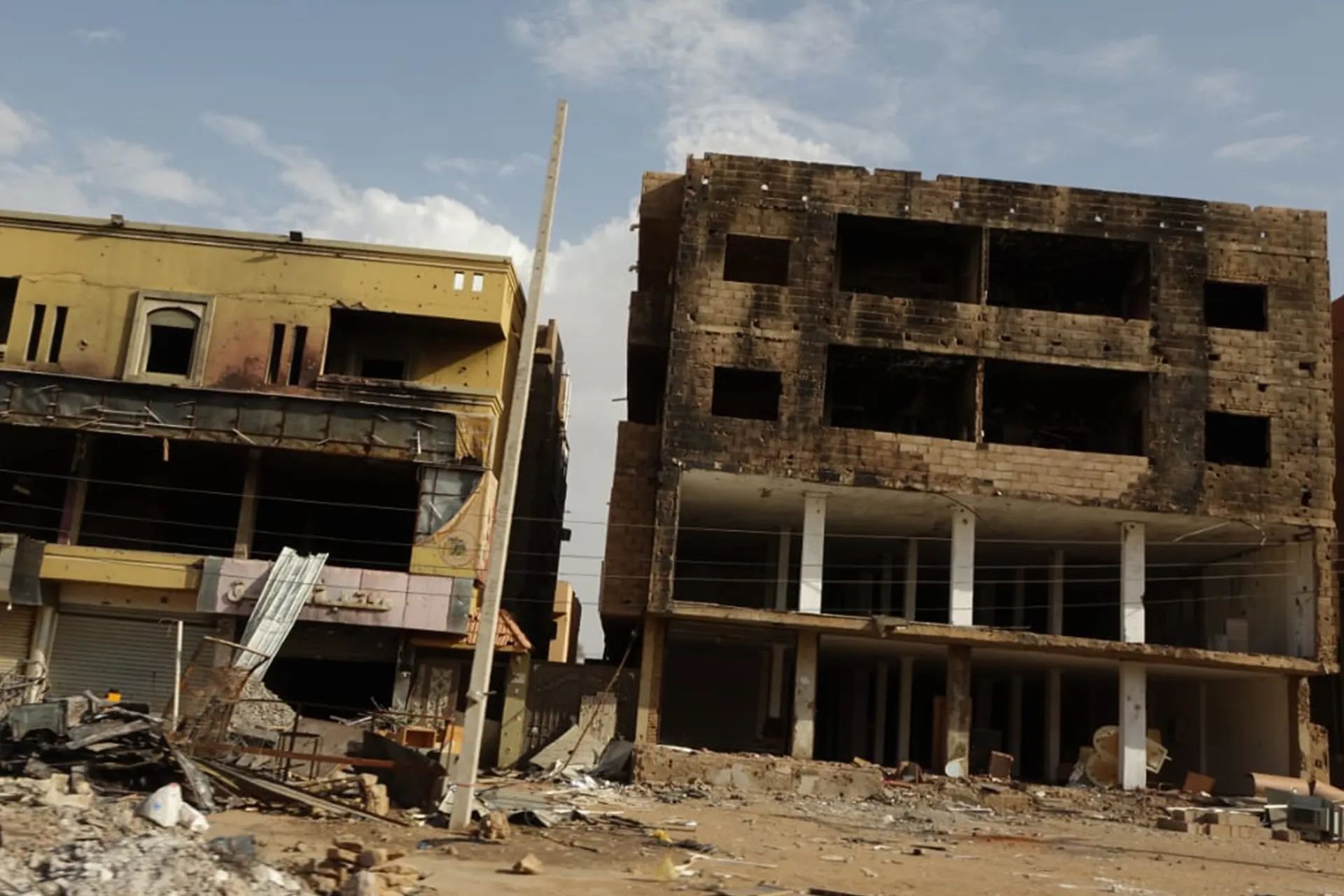

Khartoum, Sudan – Night often hides imperfections, but in Sudan’s capital, the scars of war are laid bare in daylight. Neighbourhoods and homes lie in ruins, yet signs of recovery are visible along the city’s roads, with rubble cleared and traffic slowly returning. Despite these signs of normality, refugees and displaced residents, many of whom fled more than three years ago, are returning cautiously, as official statements about life returning to normal often clash with the realities on the ground.
Al Jazeera’s observations during a tour of Khartoum reveal stark differences across the city. Wealthy districts, particularly in the east, remain largely deserted. This includes neighbourhoods from Garden City in the north, stretching through Manshiya, Riyadh, Taif, Maamoura, Arkawit, Mujahideen and other affluent districts in the south.
A damaged centre
In central Khartoum, silence hangs over the ruined Arab Market and city centre. The area was once home to most ministries, institutions, banks and the central gold market. Signs of life are scarce, except along Freedom Street, known for electrical appliances and equipment, where shops have reopened and shoppers have begun to return.
Neighbourhoods such as Khartoum 1, 2, and 3, al-Amarat, al-Sahafa, and Yathrib remain largely empty, with only a limited number of residents back.
![Restaurants and shops are slowly recovering and reopening [Al Jazeera]](https://www.aljazeera.com/wp-content/uploads/2026/05/5ybsshth-1779026462-1779167940.webp?w=770&resize=770%2C513&quality=80)
At night, these neighbourhoods fall into darkness due to the lack of electricity, while during the day, the heavy traffic along Sixty Street stands out. One of the largest roads in eastern Khartoum, it links the city’s north with its south. Along the street, banks, pharmacies, shops, restaurants, including those serving Syrian cuisine, and fuel stations have reopened, yet the residential areas behind it remain quiet by day and shrouded in darkness at night.
Advertisement
A cautious return
Families in these neighbourhoods are approaching the decision to return carefully, while others are postponing it until services improve and life becomes closer to normal. Many homeowners are not under severe economic pressure, and some have already established themselves abroad. Those who have returned report that some neighbours still living overseas have found work or businesses that provide income and relative stability. After more than two years away, many fear they may not find similar conditions if they come back, particularly given the fragile economy and difficult living circumstances.
The decision to return is influenced by several factors, including income, children’s education, healthcare services, and confidence in ongoing security and stability. In northern Omdurman, Karari locality has seen both economic and population growth. The Rapid Support Forces (RSF), a Sudanese paramilitary group currently fighting the army, were not present during the war. Karari has benefitted from inheriting Khartoum’s role, with commercial activity, property businesses, and government institutions relocating there, leaving it better off than before the conflict.
Life is also coming back to parts of Omdurman and Umm Badda. East Nile has seen increasing numbers of residents returning, as have Khartoum North neighbourhoods, though central areas still struggle under the rubble left by the war. Social experts note that hesitation to return stems not only from economic conditions and services, but also from the psychological effects of the war. Some families suffered trauma through the loss of relatives, the destruction of homes, looting, or long periods in conflict zones, creating lasting fear associated with the area itself.
The instability in the capital during the war also prompted some residents to sell their homes. A Khartoum estate agent told Al Jazeera that there is a growing supply of homes for sale, with eastern districts attracting the highest demand from buyers.
![Life is beginning to return to parts of Khartoum, despite the deteriorating economic and living situation [Al Jazeera]](https://www.aljazeera.com/wp-content/uploads/2026/05/56qfb-1779026472-1779167942.webp?w=770&resize=770%2C513&quality=80)
Most buyers are traders and businesspeople looking to take advantage of property prices that have fallen by 30 to 40 percent, depending on the location and condition of the building, hoping that prices will return to pre-war levels within a year or less.
He added that buyers prefer ready-built properties due to high construction costs, noting that rents for flats and houses vary depending on whether the building has a private electricity generator, amid an unstable power supply.
Advertisement
A journey of hardship
Daily shopping for Sudanese families is no longer a simple routine. In recent weeks, it has become a struggle, as prices shift rapidly amid a severe economic crisis and the ongoing war.
In markets across Khartoum state, scenes of residents moving between shops in search of small price differences have become a daily routine, with many buying only part of their needs or skipping basic goods that were once taken for granted. Even bread has become a burden for low-income families and those who lost their income, after its price rose to five times its pre-war level.
The phrase “every day brings a new increase” has become common among shoppers, as rising prices force thousands of families to change their lifestyle, reduce food consumption, and rely on debt or money transfers from relatives abroad to meet basic living needs.
A tour of shops and grocery stores shows that most goods are imported from Egypt by land and from Saudi Arabia by sea, while some Sudanese industries — particularly dairy products, mineral water and processed meat — have resumed production.
The same applies to medicines. When Al Jazeera asked for aspirin at a pharmacy on Sixty Street, the pharmacist replied: “We have Korean, Cypriot, Pakistani and Bangladeshi options.” A Sudanese pharmaceutical factory, known for the quality of its products, has also resumed supplying the market.
Transport costs between the main urban centres of Greater Khartoum have risen, adding to the burden on residents. Most buses appear old and worn, showing visible signs of damage from the war. On nearly every journey, there are two to four passengers who cannot afford the full fare or can only pay part of it.
Most payments are now made through banking applications, which have become common even among roadside car washers and tea sellers.
Despite the hardships, difficult living conditions and poor services, the determination to continue and overcome challenges remains a defining characteristic of residents striving to restore their previous way of life, return to their former activities, or begin new ventures.