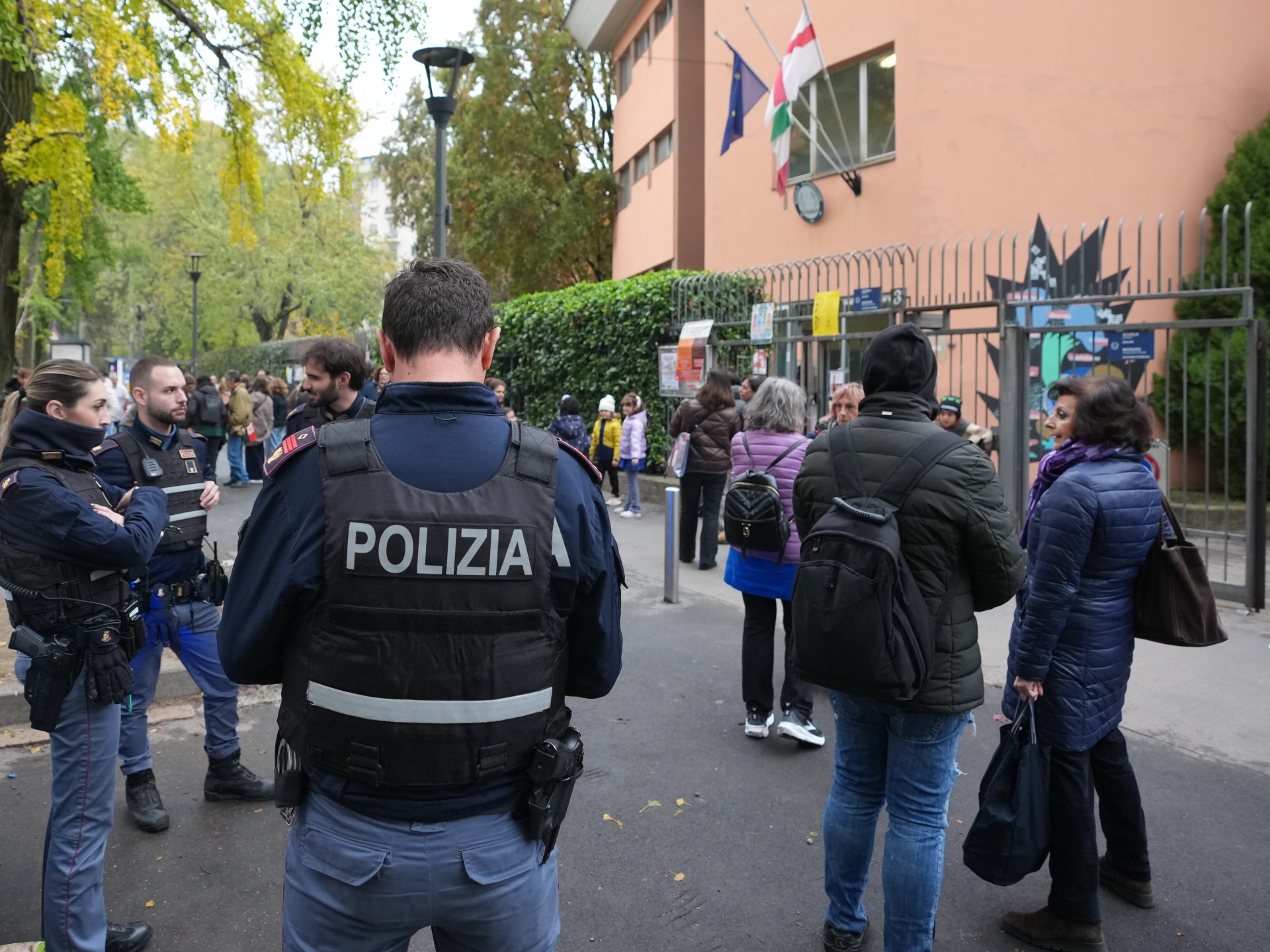

More than 1,800 schools in Italy were sent emails containing bomb threats on Thursday, the government said, a day after some 6,300 schools received similar alerts.
Many schools closed immediately after receiving the latest warnings, causing widespread disruption as parents rushed to collect their children.
- list 1 of 3Pro-Russian hackers leak Italian foreign minister’s data on dark web
- list 2 of 3Who is behind Europe’s suspected hybrid attacks?
- list 3 of 3If hackers can take over a supermarket fridge, what else is at risk?
end of list
Police in Rome said “there was nothing to substantiate” the threats.
Like Wednesday’s emails, the messages were reportedly signed by “Mikhail Andropov”, who presented himself as the “leader of the Vilayat of Misoginistan”, according to Italy’s Ansa news agency.
The same purported author claimed responsibility for email bomb threats sent last week to newsrooms in Ireland and Bulgaria.
Prime Minister Giorgia Meloni summoned opposition leaders for talks on how to deal with similar incidents.
Meloni’s office said “buildings should not be evacuated in the absence of concrete elements beyond the mere receipt of a mass email that would suggest a genuine danger exists”, adding that it would instruct schools to act accordingly.
Authorities in Scotland, Northern Ireland and the Republic of Ireland said many schools had received similar threatening emails from abroad on Wednesday, but classified them as hoaxes and allowed classes to continue.
Opposition parties have accused Meloni of prioritising spending on conventional military equipment while neglecting what they say are more pressing cyberthreats.
“We need stronger coordination among the bodies responsible for cybersecurity, and we have proposed shifting part of the available resources towards cyberdefences,” said Elly Schlein, the leader of the main opposition Democratic Party.
Advertisement
The latest security alert came amid rising concerns in Europe about hybrid warfare threats, which have targeted supermarkets, blood banks, air traffic and TV broadcasters.
On Tuesday, France summoned Iran’s ambassador after accusing Tehran of a cyberattack that disabled refrigerators in hundreds of supermarkets. Tehran rejected the French accusations as “baseless” and “hostile”.
Some European officials suspect Russia of orchestrating the campaign in countries supporting Ukraine after Moscow’s full-scale invasion. Russia denies the accusation and describes it as a smear campaign.
Related News
Saudi Arabia intercepts missiles and drones as fighting with Houthis rages
Israeli strikes hit Gaza as Health Ministry urges Rafah opening
Ukraine invests in firepower as it inflicts a new Russian casualty record