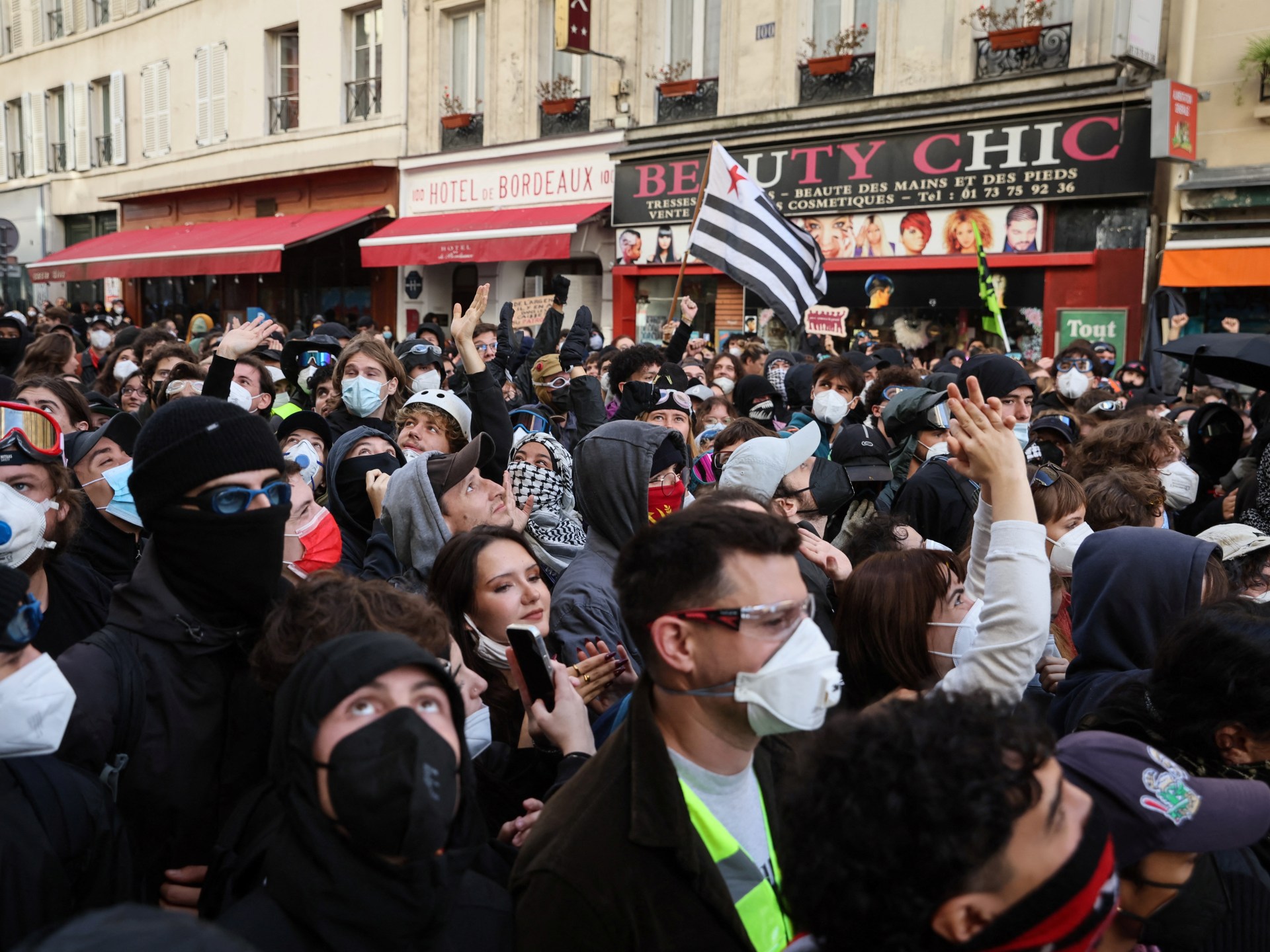

Paris, France – Saturday is a day of many unknowns. That was how the French newspaper Le Monde described it as France braced for possible nationwide demonstrations bringing together high school students, trade unions and “yellow vest” activists.
The protests began in mid-September at a high school in the Paris suburb of Creteil, where students took to the streets over dilapidated buildings, overcrowded classrooms, teacher shortages and what they see as a deeply unequal education system.
- list 1 of 3Presidential hopeful Melenchon joins France school protest march
- list 2 of 3France’s mounting debt: Is Europe next?
- list 3 of 3‘Boiling point’: Why students are protesting against Albania’s Edi Rama
end of list
Since then, the mobilisation has spread to thousands of “lycees”, or upper secondary schools, across the country. It is now beginning to reflect broader anxieties in a country grappling with a combination of fiscal pressures, economic stagnation and mounting social discontent.
Teachers, trade unions and university students have joined the movement.
On Saturday, some “yellow vest” activists – remnants of the participants in the grassroots cost-of-living protests that shook President Emmanuel Macron’s first term in 2018 – have also called on supporters to join the students.
“High school students are fighting for their future. Workers are fighting to earn a living from their labour. Retirees are fighting to preserve their dignity. Our paths may differ, but our concerns can converge,” Jerome Rodrigues, a prominent “yellow vest” activist, said in a video message released last week that called on people to join Saturday’s demonstrations.
Now France is waiting to see whether those calls will translate into a large, coordinated mobilisation.
Advertisement
Warlike injuries
Authorities have described the unrest as among the most violent in decades, saying more than 900 police have been injured since the start of the protests. But critics argued that although some demonstrators have engaged in violence, they represent a minority and the actions of a few risk overshadowing the grievances of the wider movement.
The government has also faced criticism over its response to the protests, including the detention of thousands of minors and the use of force against young demonstrators.
More than 6,700 children had been taken into police custody since mid-September, according to reports published this week.

Human rights lawyers said several teenage students have suffered warlike injuries.
Two cases have drawn particular attention: A 15-year-old lost his hand in the explosion of a stun grenade outside a school in the northern city of Lens, and a 16-year-old in western Tours lost his sight due to an injury caused by a rubber bullet.
There are fears of further clashes on Saturday.
“This is a moment of fatigue in the country,” Prime Minister Sebastian Lecornu said on Thursday. “We are in an atmosphere of perma-crisis: wars, inflation and issues surrounding purchasing power.”
The government has accused the far-left France Unbowed (LFI) party of inflaming the protests. The party has rejected the accusation.
While France suspended the use of stun grenades for the student demonstrations, Interior Minister Laurent Nunez said on Friday that he authorised police to use them in the event of what he called “urban violence”.
Nunez also said he is expecting a “fairly significant” turnout on Saturday.
Hundreds of protest sites
Calls on social media for members of past protest movements to join the current one have been made for weeks. The website 17octobregiletjaune.net, which tracks “yellow vest” actions, listed more than 1,750 planned protest locations across the country.
The government has tried to quell student anger by scrapping plans to increase some higher education registration fees and promising to deploy 3,000 substitute teachers to high schools. This week, it set up a national online survey for pupils to hear their concerns.
But Mathieu Roger-Lacan, a French literature teacher in a disadvantaged area and author of A Language of One’s Own, a book about the growing language gap, argued that these measures fail to address the deeper problem: an education system that struggles to provide equal opportunities.
Advertisement
“If you have a pool that is leaking, the answer should not be to put more water into it but to work on its structure – and that costs money too,” he said.
For Roger-Lacan, the problem is not simply how much France spends on education but how it distributes those resources.
A government report published this week said that 32 percent of the French education ministry’s budget for next year will go towards funding the pensions of retired civil servants.
Students are not only complaining about deteriorating school buildings and overcrowded classrooms but also expressing a deeper anxiety about their future.
For many, a diploma no longer feels like a guarantee of stable employment or social mobility. That concern is compounded by questions about the quality of education itself amid evidence of persistent weaknesses in French students’ academic performance.
In September, the Organisation for Economic Co-operation and Development (OECD) said that French 15-year-olds’ results in mathematics and reading had fallen to among their lowest levels on record.
“There is a gap between the diploma we give at the end of school, which is given to a huge part of the population, and the reality around us, which is that many of these young students have great difficulties even in writing French,” Roger-Lacan said.
Competing demands
The protests come at a very difficult time for the government, which is caught between demands for better-funded public services and the need to rein in France’s debt.
The government recorded a deficit of 152.5 billion euros ($171.3bn) last year, equivalent to 5.1 percent of France’s gross domestic product (GDP). By contrast, the European Union average is 3.1 percent.
Meanwhile, public debt ballooned to 115.6 percent of GDP, the third highest in the EU after Greece and Italy.
Lecornu’s proposed 2027 budget seeks to reduce the deficit through spending restraint and tax measures, including a freeze on public sector pay and limits on pension increases.
Whether the government can make those savings without deepening public anger is another question.
The debate touches a nerve in France, where the welfare state and access to public services remain central political issues.
Macron’s decision to raise the retirement age from 62 to 64 triggered months of mass demonstrations in 2023, exposing deep opposition to reforms that many saw as unfairly burdening workers.
Now as the government prepares its next budget, it faces the challenge of persuading the public that spending cuts and other savings are necessary without further eroding confidence in public institutions.
The political stakes are high. The budget bill will be debated in a deeply divided parliament as parties position themselves before the 2027 presidential election, which will mark the end of Macron’s presidency.
Related News
Deadly air strike kills dozens at Sudan gold mine near Egypt border
Photos: Nepal flood survivors find little trace of former lives

‘Truly historic’: Morocco’s king appoints first woman prime minister