Niger military accuses France of orchestrating failed mutiny: What to know
 06 September 2026
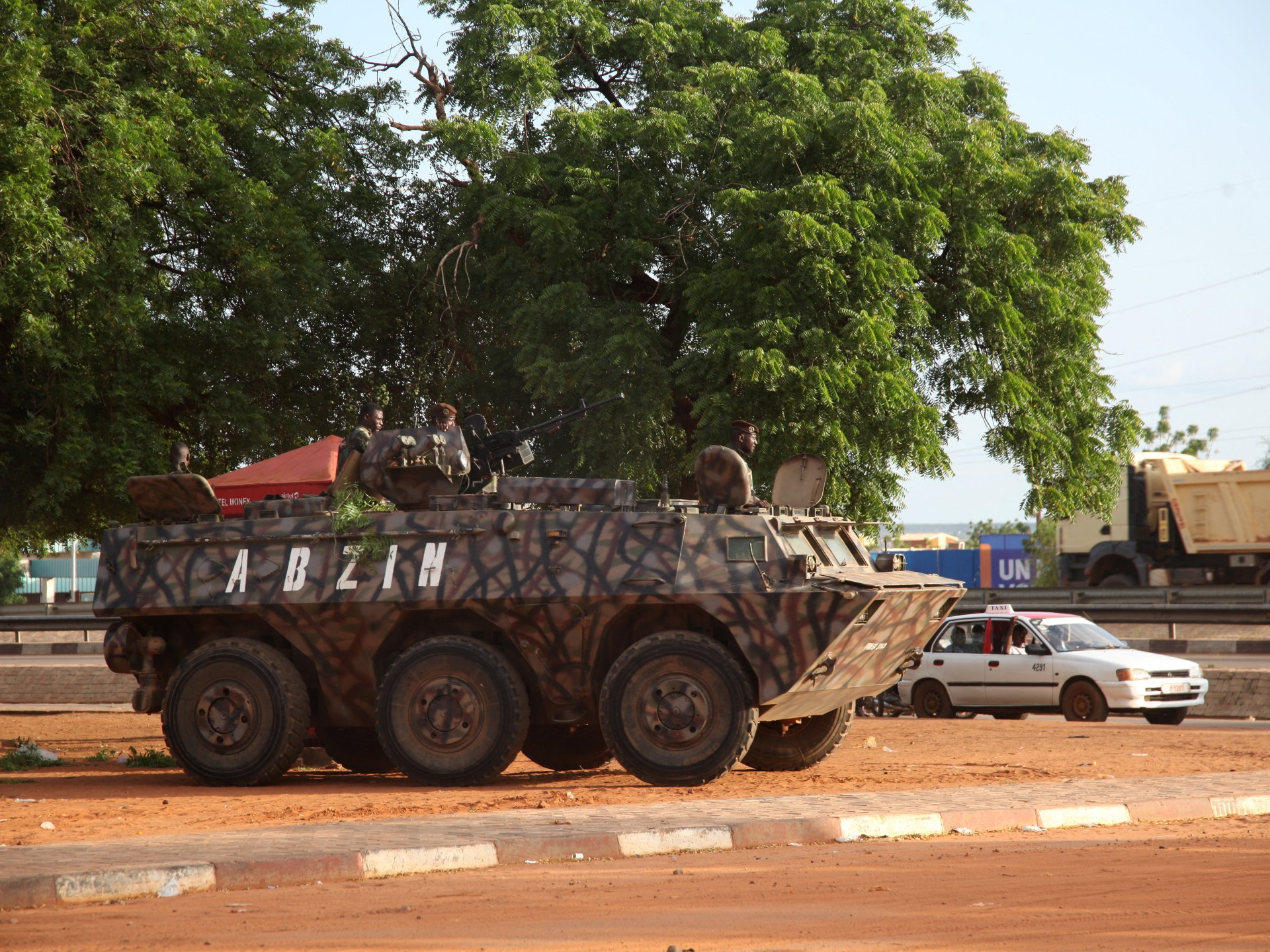

Niger’s military government has accused France of orchestrating a failed mutiny that rocked the capital, Niamey, last week.
France denied any involvement in the events in its former colony, but the accusation indicates that tensions between them remain high.
- list 1 of 3Niger displays arsenal seized after failed military mutiny
- list 2 of 3Niger accuses France of orchestrating failed military mutiny
- list 3 of 3France denies Niger’s accusation it orchestrated failed military mutiny
end of list
Here’s what you should know:
What happened last week?
Shortly after midnight on August 29, renegade soldiers targeted Base 101, a major military facility inside Niamey’s international airport complex.
Authorities said the mutineers detained some of their comrades and opened fire at “certain sensitive sites” in the capital.
Fighting spread to the presidential palace and temporarily knocked the state broadcaster off air, with explosions and gunfire echoing around Niamey for hours until Niger’s army, helped by Russian paramilitary fighters known as the Africa Corps, contained the mutiny.
State media said hundreds of soldiers took part, with dozens killed or arrested.
The mutiny happened three years after Abdourahamane Tchiani seized power in a coup that overthrew President Mohamed Bazoum, saying the elected government had failed to contain armed groups. However, violent unrest has persisted, while governance grievances and economic challenges remain.
What has Niger’s military government said?
As with previous rounds of unrest, Niger’s military authorities blamed France and other West African countries.
“This operation, with its international ramifications, was instigated and sustained by a vast network of collusion headed by the French regime of Mr [Emmanuel] Macron,” said Soumana Boubacar, Niger’s government spokesperson, in a statement read out on TV on Friday.
Advertisement
“Traitorous and renegade elements, to whom promises of great things were made, were tasked with carrying out unfulfilled ambitions of Macron and his cronies in our country,” he said, adding that such “undermining manoeuvres will always fail”.
The Niger Council of Ministers, which functions as the cabinet since the 2023 coup, said a “substantial body of evidence has been compiled regarding this attack and Niger reserves the right to bring the matter before international courts”. Details were not provided.
Niger also accused a number of regional countries of being involved, including the regional economic bloc ECOWAS. Benin’s government, one of the countries accused, rejected the accusations.
In contrast, Niger thanked Russia, Algeria and allies in the Sahel region – Burkina Faso and Mali – for their support.
What has been the French response?
France dismissed the allegations as “pure fantasy”.
“There never was any intention, nor means that France would have mobilised,” French Foreign Minister, Jean-Noel Barrot, told the French radio station, RFI.
“All of this is, as usual, a way of wrongly blaming France for something it is simply not responsible for.”
Tensions between the two countries have increased following the 2023 coup.
Niger has since ordered the withdrawal of about 1,500 French troops, expelled the French ambassador, revoked a number of bilateral military agreements and suspended French state-funded stations, such as France 24 and RFI, from broadcasting there.
Is Niger’s security situation worsening?
Henri Nsaibia, West Africa senior analyst at Armed Conflict Location & Event Data (ACLED), said the Nigerien armed forces’ fight against armed groups linked to ISIL and al-Qaeda could be weakened following the mutiny.
“The regime will likely divert resources from fighting jihadist groups to monitor internal threats,” he said.
Niger’s security situation is facing several challenges.
Since the 2023 coup, nearly 6,000 people have been killed in more than 1,400 violent incidents, according to ACLED. The casualties represent a sharp increase compared to the three years before Tchiani was in power, when nearly 3,200 people were killed in more than 1,300 violent incidents.
“Niger still experiences less intense violence than neighbouring Mali and Burkina Faso, but faces a wider range of armed threats,” said Nsaibia.
What’s the history of French colonialism in Niger?
France’s influence has dropped dramatically throughout its former colonies in West Africa in recent years in the wake of failed military interventions and allegations of interference.
Advertisement
The rise in anti-French sentiment has helped coup leaders in a number of countries claim legitimacy, including in Niger, where France has a long history of brutality.
France’s 1899 military campaign in Niger is still remembered for its intense violence, mass executions and destruction of towns and villages.
Niger became part of France’s colonial empire the following year and gained independence in 1960, but Paris still meddled in its internal politics and economic policies.
In recent years, discussions about potential reparations as compensation for the looting and extraction of the country’s resources during and after French rule have intensified.
Related News
Egypt’s Sisi meets MBS, backs Saudi call for secure Red Sea navigation
Russia’s attacks on Ukraine kill six after Zelenskyy-Trump talks
Saudi Arabia allies line up support as Houthi attacks mount