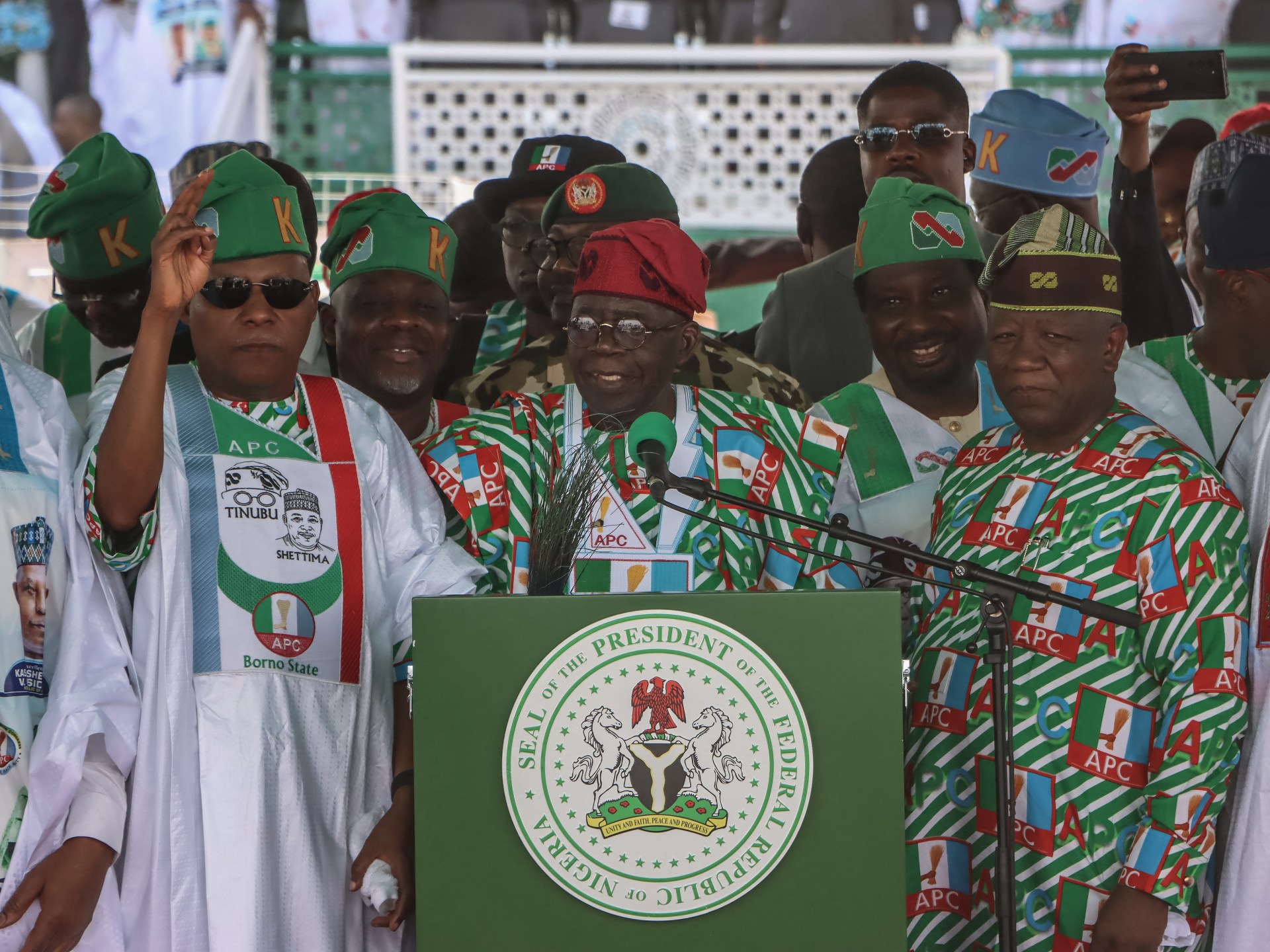

Nigerian President Bola Tinubu promised supporters in the northeastern city of Maiduguri he would restore peace to their rebellion-hit region, as an election looms in January.
Tinubu made the pledge at a rally in the city on Wednesday, as he seeks a second and final term in an election on January 16.
Recommended Stories
list of 4 items
- list 1 of 4How women scavenge scraps from lithium to earn a living in Nigeria
- list 2 of 4Borno school enrolment nearly doubles after years of conflict
- list 3 of 4Dozens drown as boat capsizes in Nigeria en route to funeral
- list 4 of 4The cost of Nigeria’s power failures for one small business
end of list
Maiduguri is the capital of Borno State, the heartland of the rebellion led by Boko Haram and ISIL West Africa Province (ISWAP).
Tinubu is under pressure to convince voters that intensified military operations in Borno and the northwest, where kidnapping for ransom remains rife, will deliver lasting security gains for communities scarred by conflict.
“We will achieve that peace; the terrorism will go; they [rebel fighters] have the opportunity now to lay down their arms, to lay down all arms and surrender all weapons, change from the character of terrorism and banditry,” Tinubu said.
Holding the rally in Maiduguri sent a “simple statement saying there’s an improvement in the security situation”, Kabir Adamu, the managing director at Beacon Security and Innovations Limited, told Al Jazeera.
It also showed “an improvement … in the economic circumstances within the state”, Adamu said, speaking from Nigeria’s capital of Abuja.
Tinubu’s main rivals are former Vice President Atiku Abubakar and Peter Obi, a former Anambra State governor who won more than 6 million votes in the last election.
Insecurity remains despite some progress
Ending insecurity in the north was one of Tinubu’s promises when campaigning for the presidency in 2023, but analysts and his opponents say that, like his predecessors, he has fallen short.
Advertisement
More than 50 percent of respondents disapprove of the president’s performance and more than 70 percent rate the economy “poor or very poor”, according to a YIAGA Africa poll released in October.
But Adamu said, “significant progress” has been made within Borno State.
“There was a time when about 24 local governments were more or less being contested, in terms of their control by the state or non-state actors,” he explained.
“Now, reasonably, almost all the local governments are accessible, even though there are challenges outside the immediate city centres.”
Nigeria’s defence minister said this month that the military was receiving real-time US intelligence and satellite support to target armed group leaders and degrade rebel networks.
In May, US and Nigerian forces led a mission that killed Abu-Bilal al-Minuki, ISIL’s global second-in-command.
Security analysts say Nigerian forces have driven rebels from most of the territory they once held, but the fighters still stage deadly raids, ambushes and bombings.
The armed groups have also been increasing their activities in the northwest, where kidnapping gangs mostly operate.
Crisis monitoring group ACLED said earlier this year that fighters linked to al-Qaeda and ISIL (ISIS) were rapidly increasing their attacks on the borderlands between Niger, Benin and Nigeria, turning remote transit corridors into active conflict zones.
Tinubu said security forces were working to rescue more than 70 schoolchildren who remain in captivity after being abducted in two separate attacks in May and June in Borno.
Another key issue in the run-up to the elections is economic reform, as poverty has increased and access to basic commodities is increasingly difficult, said Adamu.
Related News
Ukraine strikes Kerch Bridge as Putin ally declares ‘no one needs Europe’
Russian strikes on Ukraine leave hundreds of thousands without electricity
WHO chief calls for peace amid heavy fighting in Ebola-hit DR Congo region