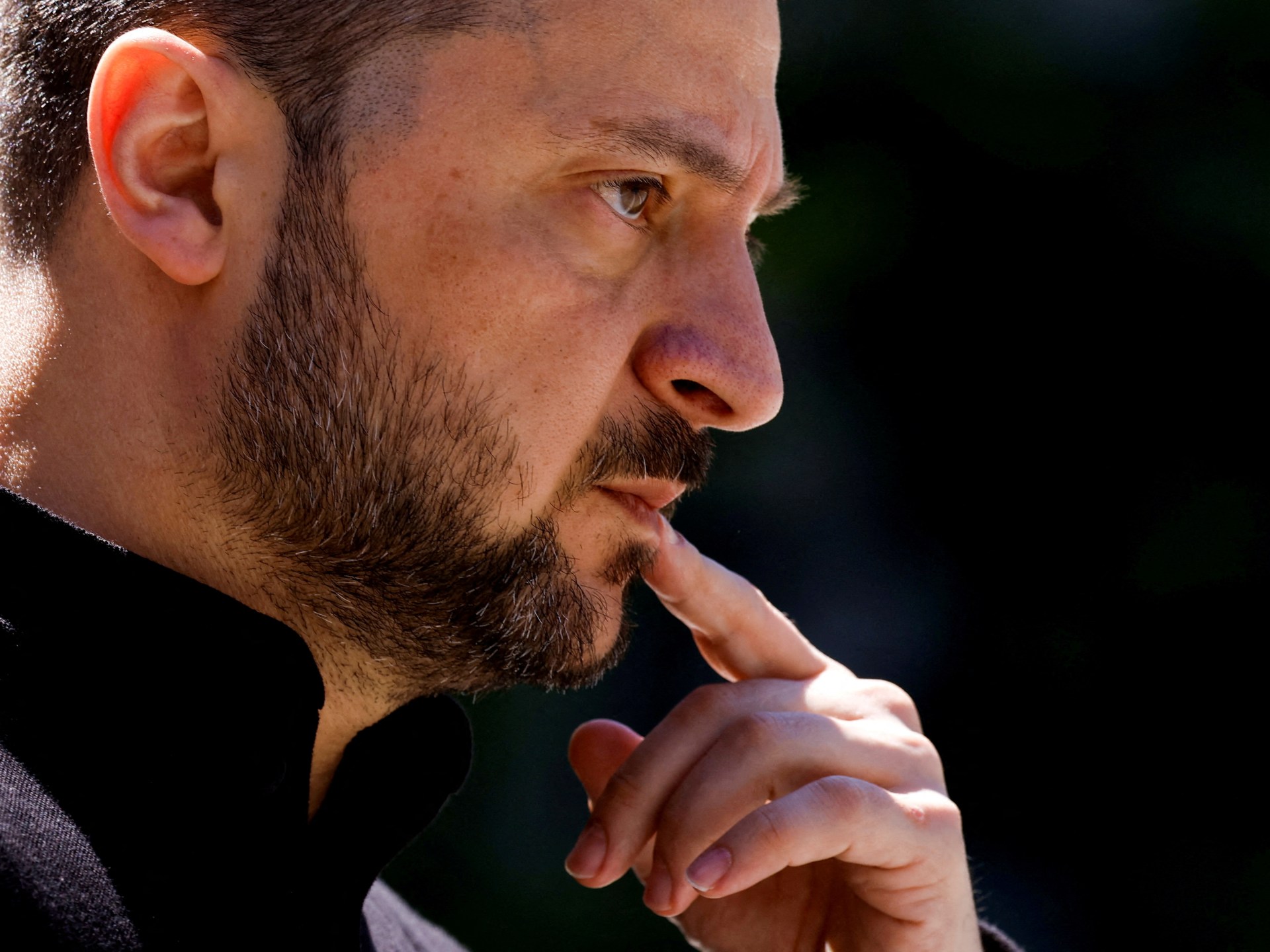

Kyiv, Ukraine – Volodymyr Zelenskyy’s fortunes have shifted since he was elected as an anticorruption outsider in 2019.
In the first months of Russia’s full-scale invasion, his defiance and everyman image won him global acclaim and overwhelming support at home.
- list 1 of 4In Ukraine’s west, Hungarian minority rights collide with wartime politics
- list 2 of 4Zelenskyy reveals 55,000 Ukrainian soldiers killed fighting against Russia
- list 3 of 4Zelenskyy says ‘no rules broken’ after Olympics bans Ukraine racer
- list 4 of 4Russia suffers ‘32,000’ monthly Ukraine casualties, broken communications
end of list
But that unity, exhausted by four years of full-scale war, has given way to a more complex mood.
Now, while many Ukrainians still back him as an international figurehead, concerns about governance and corruption are reshaping his standing domestically.

From Messiah to pariah
In 2019, when Zelenskyy ran for president, he was a well-known comic actor, best known for playing a schoolteacher who wakes up to find he has been elected head of state after a video of him ranting against corruption, secretly recorded by his pupils, goes viral.
His campaign used much of the same anticorruption rhetoric as his on-screen character, positioning himself as an outsider to the entrenched oligarchic networks that dominated Ukrainian politics.
This was something that appealed to voters disillusioned by the status quo, and he stormed to a landslide victory, winning 73 percent of the vote.
After Zelenskyy came to power, the realities of governing began to erode his everyman image as he first dealt with an energy crisis and then, the impact of the global COVID pandemic.
Advertisement
In December 2021, two months before the war began, his popularity stood at just 31 percent, according to the Kyiv International Institute of Sociology.
It is a cycle that Peter Dickinson, the British publisher of Business Ukraine magazine and editor of the Atlantic Council’s UkraineAlert service, sees as common in Ukrainian politics.
Ukraine’s democracy is “very vibrant” and “very dynamic,” but also “very immature in a lot of ways”, often resembling a “high school popularity contest”. Politics revolves around individuals rather than institutions, he added.
Leaders are initially embraced as national saviours, only to be swiftly rejected when expectations of rapid change go unmet, something he called the “Messiah to pariah” effect.

On February 24, 2022, Russia invaded Ukraine, and overnight, Zelenskyy became a wartime president.
Donning a casual green military T-shirt, he addressed the nation in a series of self-shot videos published on social media.
His impassioned speeches urged Ukrainians to take up arms, and his refusal to leave Ukraine, despite warnings from the United States, won him praise at home and abroad.
His approval rating skyrocketed, hitting 91 percent in the first weeks of the invasion.
Several people Al Jazeera interviewed in the weeks before the full-scale invasion, who had been critical of the president, changed their minds in the first weeks.
Mykhail Hontarenko, from Odesa, told Al Jazeera at the time that he had warmed to Zelenskyy, who he saw as a seasoned entertainer suddenly thrust into an experience that made him display genuine emotion. “I don’t think he is acting now; he is scared,” he said.
Part of the establishment
However, since then, the Ukrainian president has spent less time on the street and more time at the Presidential Palace and on diplomatic trips as he seeks to rally international support.
In a December survey, the Kyiv International Institute of Sociology found that while 61 percent of Ukrainians trust Zelenskyy, 32 percent do not.
Some believe he would struggle to be re-elected in a post-war vote.
Dickinson said this is partly due to corruption scandals involving his associates and the perception that he is concentrating power and using wartime conditions to expand presidential authority.
Zelenskyy is facing growing pressure from Washington to organise national elections in 2026, but that would require legal and constitutional changes under the country’s wartime martial-law rules.
Advertisement
In recent days, Zelenskyy has stated that he is “ready” to hold an election – as long as Washington and, perhaps, Brussels could ensure its security.
In late 2025, Ukraine was shaken by a major corruption scandal, prompting searches and arrests involving senior figures and fuelling scrutiny of Zelenskyy’s inner circle, including longtime chief of staff Andriy Yermak, who resigned.

“Ukrainians are very, very cynical anyway when it comes to political corruption, so it was a disastrous optic for him to have personal friends of his who he’d appointed to senior roles to be implicated in a scandal,” Dickinson said.
He added that the latest scandal centred around the energy sector, which is particularly jarring for Ukrainians, considering that Russia’s attacks on infrastructure have left millions without electricity, water or heat in freezing conditions.
“The people [once] felt he was the everyman on the street, but now he’s part of the establishment”, Dickinson said.
Amina Ismailova, a manager at a textile company in Kharkiv, in Ukraine’s northeast, told Al Jazeera that she believes trust in Zelenskyy is lower than the polls suggest.
While many soldiers and veterans are not getting paid or receiving adequate healthcare, politicians are profiting from corruption schemes – something that is hard for people to accept, she said.
The problem, Ismailova said, echoing many people Al Jazeera spoke to, is the lack of a viable alternative.
Valerii Zaluzhnyi, Ukraine’s ambassador to the UK, was a name mentioned by a few, although the former head of Ukraine’s military has never announced political ambitions.
Zaluzhnyi, known as the “Iron General”, enjoys the image of a war hero and military mastermind, and Zelesnkyy’s decision in early 2024 to “renew the leadership” and send him to the UK raised suspicions that he saw him as a potential threat to his presidency.

The rally around the flag effect
But despite the current domestic mood, many Ukrainians still support Zelenskyy as a wartime leader.
Dickinson said Zelenskyy’s response to US President Donald Trump in their fractious Oval Office meeting in February 2025 – where the Ukrainian president was seen as being pressured or belittled by Trump – triggered a patriotic surge inside Ukraine.
Polls at the time showed an immediate rise in his approval ratings.
Many people felt that when Zelenskyy was attacked, Ukraine itself was being attacked, said Dickinson.
Related News
Iran arrests prominent reformists over deadly January unrest
Four Palestinians killed in Israeli air attack on Gaza residential building
Russian shelling kills seven in Ukrainian market, clouding Abu Dhabi talks