Russia deploys hypersonic Oreshnik missiles in Belarus amid Europe tensions
 31 December 2025
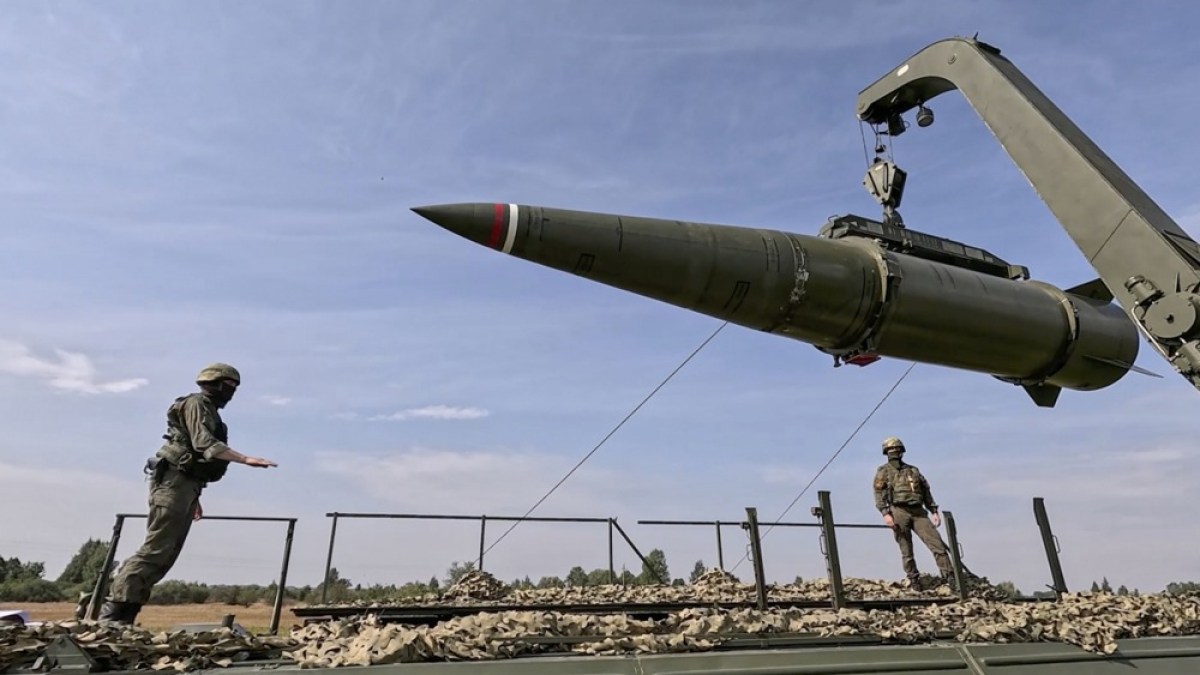

Russia has released footage showing the deployment of its Oreshnik hypersonic missile system in Belarus, a move that could strengthen Moscow’s ability to target Europe in a potential future conflict.
The Russian state news agency TASS reported on Tuesday that this marks the first public display of the mobile Oreshnik systems. President Vladimir Putin has described the missiles as impossible to intercept, citing speeds that are more than 10 times the speed of sound.
- list 1 of 4Saudi Arabia reveals details of Yemen bombing, as UAE set to withdraw
- list 2 of 4Disney to pay $10m over alleged breaches of US child privacy laws
- list 3 of 4Israel’s recognition of Somaliland ‘strange, unexpected’: Somali president
- list 4 of 4Thailand releases 18 Cambodian soldiers as ceasefire holds
end of list
Russian Ambassador to Belarus Boris Gryzlov used his New Year’s greeting to confirm the missile’s deployment.
“The Russian Oreshnik missile systems entered combat duty in [Belarus]. This step is a clear confirmation of the effectiveness of the bilateral interstate treaty on security guarantees within the Union State, which entered into force in March,” the greeting message said, according to TASS.
The deployment in a country bordering NATO members and Ukraine comes amid heightened tensions over Russia’s war in Ukraine.
On Monday, Russian Foreign Minister Sergey Lavrov alleged that Ukraine had launched an attack on Putin’s Valdai residence in the Novgorod region of northwestern Russia.
Russia has threatened to retaliate against Ukraine after alleging that nearly 100 drones had targeted the home. Ukrainian President Volodymyr Zelenskyy has rejected Russia’s claim.
Analysts note that stationing the Oreshnik missiles in Belarus could shorten the time for Russian nuclear weapons to reach European targets.

Nuclear deterrence strategy
Western analysts see the move as a signal of Moscow’s reliance on nuclear deterrence to discourage NATO support for Ukraine.
Advertisement
Two US researchers told the Reuters news agency that the video confirmed earlier satellite-based identification of the discussed Krichev-6 airbase as the missile’s likely location. Jeffrey Lewis of the Middlebury Institute and Decker Eveleth of CNA research and analysis organisation in Virginia said a building in the video matches an image captured by the Planet Labs commercial satellite company in November. They credited Russian military blogger Dmitry Kornev with first connecting the video to satellite imagery and posting the results on X.
Although the footage did not reveal the exact location, it showed mobile launchers navigating forest roads, crews camouflaging the systems, and a senior Russian officer declaring that the missiles were officially on combat duty. Training and reconnaissance routines were shown as light snow fell.
Moscow tested a conventionally armed Oreshnik – Russian for “hazel tree” – against a target in Ukraine in November 2024. Putin has stated that even with a conventional warhead, the missile’s destructive capacity rivals that of nuclear weapons. With a reported range of up to 5,500km (3,418 miles), the system could theoretically strike across Europe or the western United States.
Scepticism from the West
Some Western officials question the missile’s practical effect on the battlefield. A US source said in December 2024 that the Oreshnik is not considered a game-changer.
Belarusian President Alexander Lukashenko, a close ally of Putin who has engaged with US President Donald Trump’s administration, had previously confirmed the missile installation. He said no more than a dozen Oreshniks would be deployed, a move described by his defence minister as a response to what they called aggressive Western actions.
While Lukashenko allowed Russian forces to launch operations into Ukraine from Belarus in 2022, Belarusian troops have not been sent to fight alongside Russian units.
European response
German Chancellor Friedrich Merz addressed Moscow’s military posture in an annual New Year’s speech.
“We are seeing more and more clearly that Russia’s aggression was and is part of a plan targeted against the whole of Europe,” he said, noting daily threats of sabotage, espionage, and cyberattacks.
Merz also touched on Europe’s need to act independently amid a more uncertain US partnership under Trump.
“For us Europeans, this means that we must defend and assert our interests much more strongly by ourselves,” he said.
He added: “This can be a decisive year for our country and for Europe. It can be a year in which Germany and Europe, with new strength, reconnect with decades of peace, freedom and prosperity.”
Related News
‘War on terror’ defence of Trump boat strikes doesn’t hold water: Experts
Turkiye, Libya intensify probe into deadly plane crash near Ankara
Russia-Ukraine war: List of key events, day 1,406