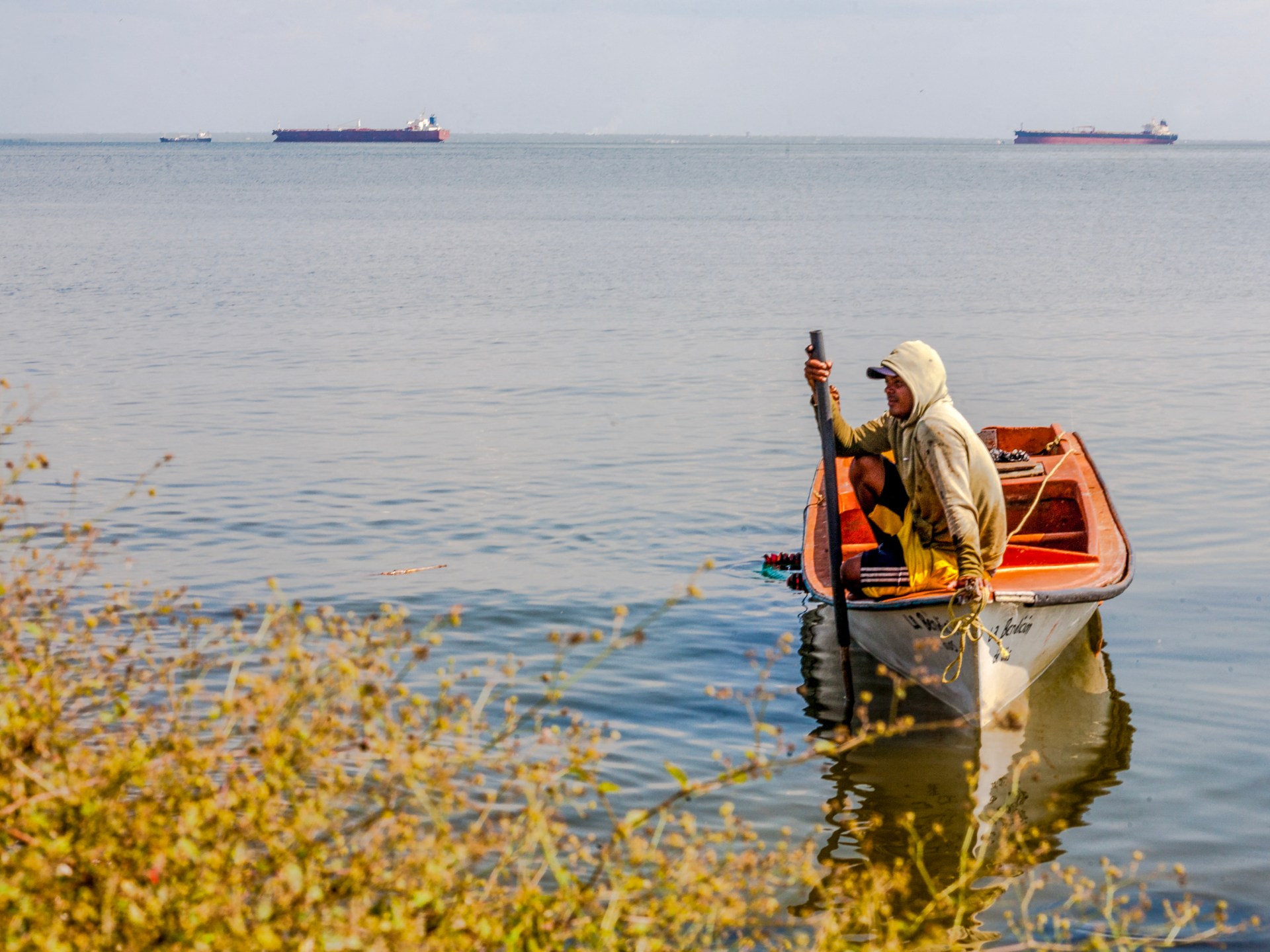

The United States Department of the Treasury has issued a new round of sanctions aimed at isolating Venezuela’s oil industry, as part of President Donald Trump’s pressure campaign against the South American country.
The sanctions announced on Wednesday target four companies and their associated oil tankers, which are allegedly involved in transporting Venezuelan oil.
- list 1 of 3US pursues third oil tanker off the coast of Venezuela
- list 2 of 3US issues Iran-Venezuela sanctions over alleged drone trade
- list 3 of 3How many countries has Trump bombed in 2025?
end of list
Trump has claimed that Venezuelan leader Nicolas Maduro leads a so-called “narco-terrorist” government that seeks to destabilise the US, a charge repeated in the latest sanctions announcements.
“Maduro’s regime increasingly depends on a shadow fleet of worldwide vessels to facilitate sanctionable activity, including sanctions evasion, and to generate revenue for its destabilizing operations,” the Treasury said on Wednesday.
Petroleum is Venezuela’s primary export, but the Trump administration has sought to cut the country off from its international markets.
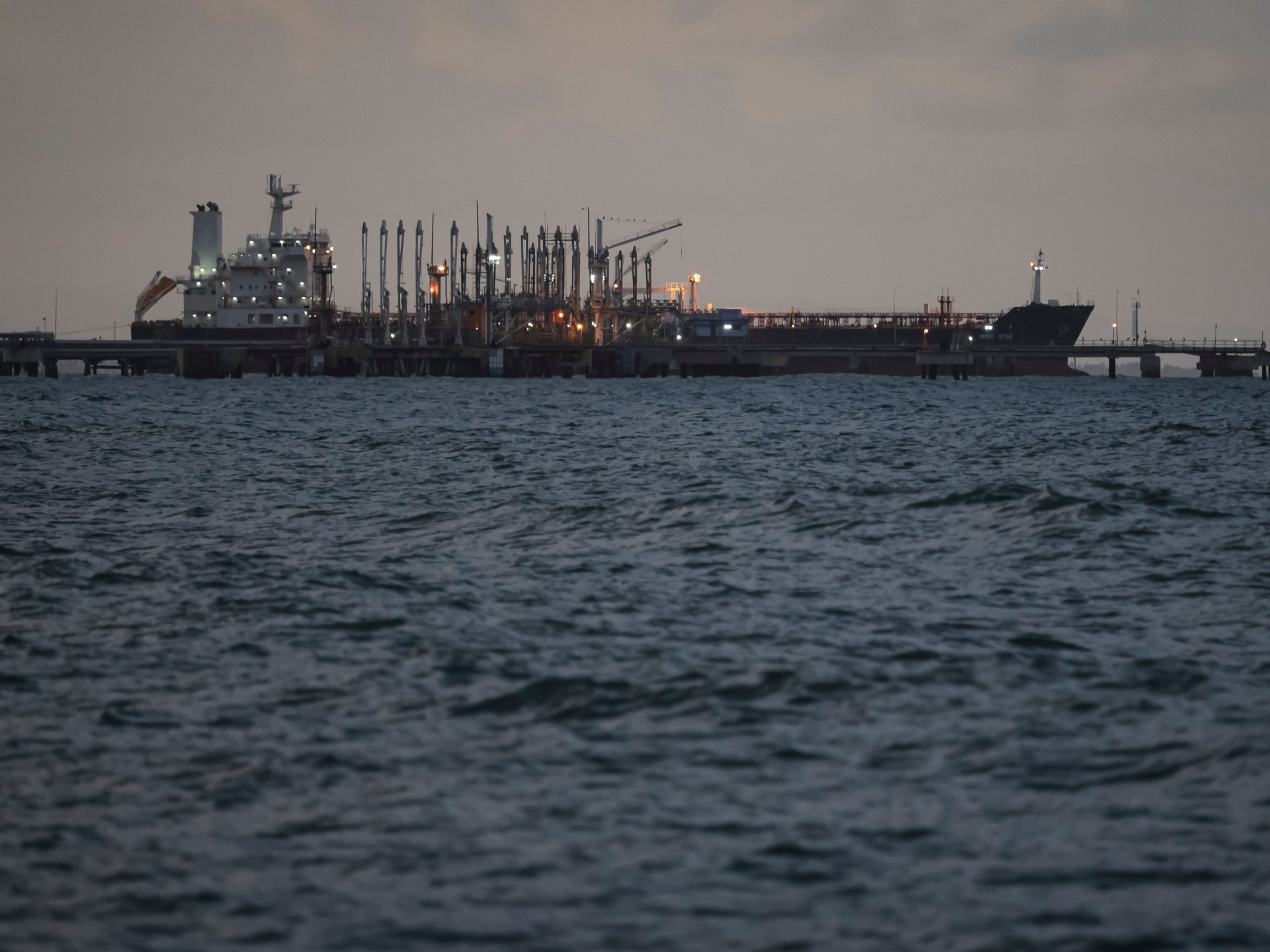
Wednesday’s notice accuses four tankers – the Nord Star, the Rosalind, the Valiant and the Della – of helping Venezuela’s oil sector to circumvent existing sanctions, thereby providing the “financial resources that fuel Maduro’s illegitimate narco-terrorist regime”.
“President Trump has been clear: We will not allow the illegitimate Maduro regime to profit from exporting oil while it floods the United States with deadly drugs,” said Treasury Secretary Scott Bessent.
“The Treasury Department will continue to implement President Trump’s campaign of pressure on Maduro’s regime.”
Claims on Venezuelan oil
The sanctions come a day after Washington imposed sanctions on a separate Venezuelan company it says assembled drones designed by Iran.
Advertisement
In recent months, the Trump administration has cited several motives for ratcheting up pressure against Venezuela, ranging from immigration to Maduro’s contested election in 2024.
Trump, for instance, has framed the pressure campaign as a means of stemming the trade of illegal drugs, despite Venezuela exporting virtually none of the administration’s main target, fentanyl.
Critics have also accused Washington of seeking to topple Maduro’s government to take control of the country’s vast oil reserves.
Trump officials have fuelled those suspicions with remarks seeming to assert ownership over Venezuela’s oil.
On December 17, a day after Trump announced a “total and complete blockade” of sanctioned oil tankers entering and leaving Venezuela, his top adviser, Stephen Miller, claimed that the US “created the oil industry in Venezuela”.
He suggested that the oil was stolen from the US when Venezuela nationalised its petroleum industry, starting in 1976.
That process accelerated after the 1998 election of socialist President Hugo Chavez, who reasserted state control over Venezuela’s oil sector, ultimately leading to the seizure of foreign assets in 2007.
That “tyrannical expropriation” scheme, Miller alleged, “was the largest recorded theft of American wealth and property”.
Still, one major US oil company, Chevron, continues to operate in the country.
Trump has echoed Miller’s claims, writing online that the US “will not allow a Hostile Regime to take our Oil, Land, or any other Assets”.
He added that all of those assets “must be returned to the United States, IMMEDIATELY”.
Military build-up in the Caribbean
In recent months, the Trump administration has tightened its focus on Venezuela’s oil industry, taking a series of military actions against tankers.
On December 10, the administration seized its first tanker, the Skipper, followed by a second seizure 10 days later.
The US military has reportedly been pursuing a third tanker as it crosses the Atlantic Ocean.
The attacks on the oil tankers come several months after the US began surging aircraft, warships and other military assets to the Caribbean region along Venezuela’s coast.
Since September 2, the US military has conducted dozens of bombing campaigns against alleged drug-smuggling boats in international waters in the Caribbean Sea and eastern Pacific, in what rights groups call extrajudicial killings.
More than 100 people have been killed, and the administration has offered scant legal justification for the attacks.
Advertisement
On Monday, Trump told reporters that the US had struck a “dock area” in Venezuela he claimed was used to load the alleged drug boats.
The dock bombing is believed to be the first of its kind on Venezuelan soil, though Trump has long threatened to begin attacking land-based targets.
While the administration has not officially revealed which agency was behind the dock strike, US media has widely reported it was conducted by the Central Intelligence Agency (CIA).
Related News
Displacement camps swell with people fleeing Sudan’s war-ravaged el-Fasher
Arab League welcomes Sudanese gov’t peace plan presented at UN
Saudi-led coalition strikes Yemeni port over unauthorised weapons shipment