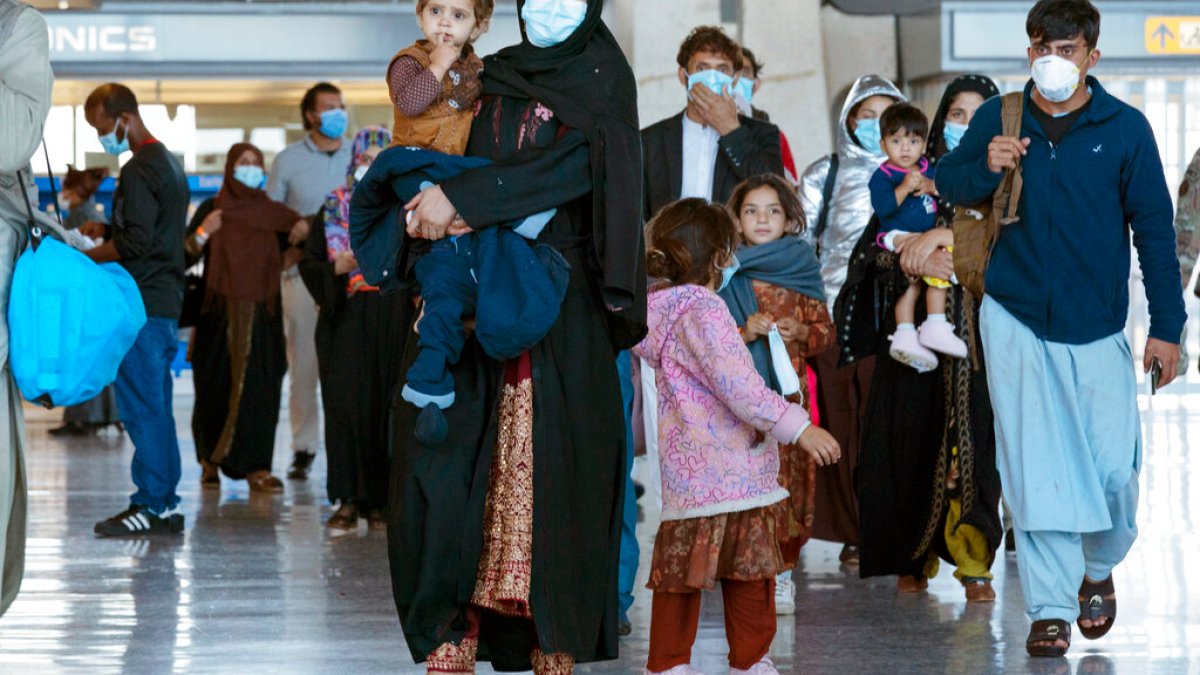

A group of 66 lawmakers in the United States has written to the administration of President Donald Trump asking it to halt a planned mass deportation of Afghans, including some who worked alongside coalition forces in Afghanistan before the military withdrawal in 2021.
In Monday’s letter, the lawmakers cited advocacy group reports that at least 150 Afghans were scheduled to be deported from Tuesday – flown from detention facilities in Louisiana to Pakistan.
- list 1 of 3Outrage as Afghan asylum seeker who fought alongside US dies in ICE custody
- list 2 of 3Biden administration shields Afghans in US from deportation
- list 3 of 3Afghan Adjustment Act: What does it mean for refugees in US?
end of list
The Associated Press news agency also reported that Department of Homeland Security (DHS) officials had said in court filings that they eventually planned on returning some of the Afghans to their home country.
The US does not have diplomatic relations with Afghanistan, which has been governed by the Taliban since US troops withdrew in August 2021.
“Sending dozens of people back to one of the most dangerous countries on earth, and where they are likely to be targeted for their or their family’s suspected support of the US government or criticism of the Taliban, is a death sentence,” the lawmakers wrote in the letter addressed to Secretary of State Marco Rubio and Secretary of Homeland Security Markwayne Mullin.
“Our country made a promise never to abandon the Afghans who sacrificed their own and their family’s safety to stand with American service members.”
Third-country deportations
As part of its crackdown on immigration, the Trump administration has made agreements with at least 35 countries to take in third-country nationals, in many cases because it cannot send them back to their home countries for fear they would be tortured, killed, or otherwise persecuted.
Advertisement
Critics of the practice have said it undermines decades of global humanitarian norms around asylum seeker and refugee protection. They say deportees often end up in countries with a record of human rights abuses, or places that are so dangerous the US tells its own citizens not to travel there.
The Trump administration has forcibly sent at least 25,000 people to third countries, according to a tally by nonprofits Refugees International and Human Rights First.
Human Rights First said it has confirmed that a flight carrying some of the Afghans from Alexandria, Louisiana, to Pakistan is scheduled for Tuesday.
Rights advocates say the batch of deportations to Pakistan may also include Iranians, small numbers of whom the Trump administration has previously sent to third countries to eventually be returned to Iran, despite the ongoing war the US is waging on the country.
Pakistan has deported millions of Afghans to Afghanistan in recent years, as relations with the Taliban have deteriorated.
Afghans in US left in limbo
Most of the Afghans scheduled for deportation did not have the opportunity to properly fight their removal in court, Shawn VanDiver, founder and president of the AfghanEvac advocacy group, said.
“They were placed into removal proceedings because they didn’t have attorneys to fight,” he said.
VanDiver said he spoke to one man on Monday, a former police officer in the Afghan government toppled by the Taliban, who expected to be deported and feared for his life if he ended up back in Afghanistan. Others, VanDiver said, had also either worked in the Afghan government or with the US, or had family that did so, and would be in danger in Afghanistan.
Since taking office, Trump has attempted to put an end to resettlement programmes for Afghans started by former President Joe Biden. More than 120,000 Afghans were evacuated from Afghanistan in 2021 after the chaotic withdrawal of US forces.
Some ended up in facilities abroad, like in Qatar. This September, the US granted a nine-month extension for Camp As Sayliyah, a facility in Qatar housing more than 1,000 Afghans who assisted US forces in Afghanistan.
Afghans evacuated to the US were initially granted humanitarian parole, allowing them to stay in the country. In 2022, the Biden administration granted them Temporary Protected Status for 18 months, allowing them to live and work legally in the US after their parole period expired, and while their immigration status was resolved.
But since then, few Afghans in the US have been able to move their applications for asylum, or other special protected status relating to their work with coalition forces, through the severely backlogged immigration system.
Advertisement
“These people are in dire straits; they have been stuck in this limbo for five years, waiting for permanency, waiting for green cards, waiting to hear about their status,” VanDiver said.
The Trump administration has instituted record-low quotas for asylum applications globally. However, he made an exception for white Afrikaners from South Africa, giving them sanctuary after alleging they had faced racial discrimination against white people.
Trump ordered a halt to processing applications from Afghans after a man from Afghanistan allegedly shot two National Guardsmen in Washington, DC, in November 2025. The Trump administration also included Afghan nationals in a blanket visa ban earlier this year, saying it would review immigration applications filed by anyone from the country. Both policies were challenged in court.
VanDiver said he and other advocates have been pushing for new legislation that would provide Afghans protection in the US, including a bill – co-sponsored by both Republican and Democratic lawmakers – that would grant many Temporary Protected Status after the Trump administration withdrew it.
Related News

Why Paramount-Warner merger has sparked fears about press freedom
As Islamophobia ramps up in US midterms, Texas Muslims eye local stakes
Iran war live: Trump claims US Navy blockade stops Iranian ships in Hormuz