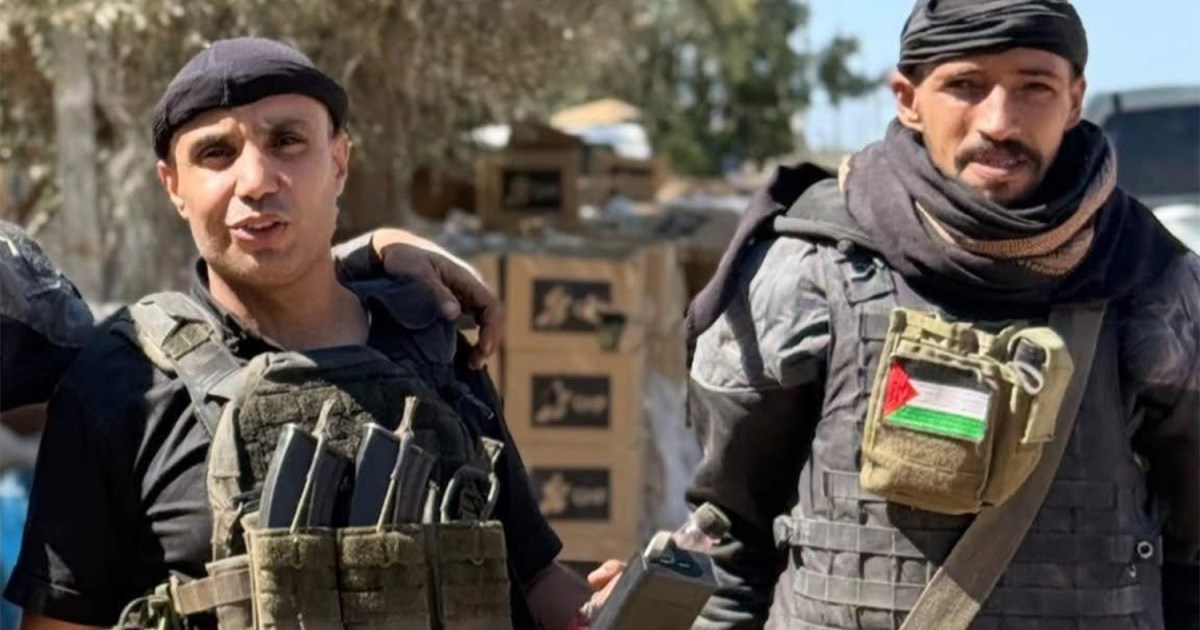

As the chapter closes on Yasser Abu Shabab, 32, the “Popular Forces” militia leader who appeared in Rafah during the war and was widely viewed as a collaborator with Israel, Ghassan al-Duhaini has been named his successor.
Soon after Abu Shabab was killed last Thursday, reportedly during a family dispute mediation, al-Duhaini, who was said to be injured in the same altercation, appeared in a video online dressed in military fatigues and walking among masked fighters under his command.
But who is Ghassan al-Duhaini? Has he just appeared, or was he there all along? Here’s what we know:
Who is Ghassan al-Duhaini?
Palestinian media sources say al-Duhaini, 39, has long been the group’s de facto leader, despite being officially the second-in-command.
They argue that his experience and age made him the operational head, while Abu Shabab, the figure publicly recruited by Israel, served as the face of the militia.
Al-Duhaini was born on October 3, 1987, in Rafah, southern Gaza. He belongs to the Tarabin Bedouin tribe, one of the largest Palestinian tribes that extends regionally and to which Abu Shabab belonged.
He was a former officer in the Palestinian Authority security forces, where he held the rank of first lieutenant.
Then he later joined Jaysh al-Islam, a Gaza-based armed faction with ideological ties to ISIL (ISIS).
Did he really take over after Abu Shabab?
The militia announced al-Duhaini as its new commander on its official Facebook page on Friday.
Al-Duhaini pledged to continue the group’s operations against Hamas.
Advertisement
In an interview with Israel’s Channel 12, comments later reported by The Times of Israel on Saturday, al-Duhaini insisted he had no fear of Hamas.
“Why would I fear Hamas when I am fighting Hamas? I fight them, arrest their people, seize their equipment … in the name of the people and the free,” he said.
On Friday, the militia published a promotional video on an affiliated Facebook page showing al-Duhaini inspecting a formation of armed fighters.
He told Channel 12 that the footage was intended to demonstrate that the group “remains operational” despite the death of its leader.
“His absence is painful, but it will not stop the war on terrorism,” he declared.
Has he always been against Hamas?
Hamas lists al-Duhaini among its most wanted figures, accusing him of collaborating with Israel, looting aid, and gathering intelligence on tunnel routes and military sites.
Little information is available on why he left the security forces.
Al-Duhaini has been increasingly active on social media, recently appearing prominently in a video showing the militia capturing and interrogating several Hamas members from a tunnel in Rafah.
Abu Shabab’s group claimed the detentions were conducted “in accordance with the applicable security directive and in coordination with the international coalition”.
He also appeared in a social media post beside what appeared to be several bodies, the caption saying they were Hamas men who had been “eliminated” as part of the group’s “counterterrorism” operations.
Hamas has attempted to assassinate al-Duhaini twice, killing his brother in one operation and narrowly missing al-Duhaini in another, when a booby-trapped house east of Rafah was detonated.
A Hamas source said al-Duhaini survived the blast “by sheer luck”, while four members of the attacking unit were killed and others wounded.
What is the Popular Forces militia?
The Popular Forces militia first came to prominence in 2024 under the leadership of Abu Shabab. It has an estimated 100 to 300 fighters who operate only metres from Israeli military sites, moving with their weapons under direct Israeli oversight.
The militia is primarily based in eastern Rafah, near the Karem Abu Salem crossing, the only entry point through which Israel currently permits humanitarian aid into Gaza.
A second unit is in western Rafah, near the notorious US-Israeli GHF aid distribution point, where hundreds of Palestinians have been shot as they sought aid.
Security sources told Al Jazeera Arabic that the Israeli army oversaw the arming of Abu Shabab and that he leads “criminal gangs specialising in intercepting aid convoys coming from the [Karem Abu Salem] crossing in southern Gaza and firing on civilians”.
Advertisement
Israeli newspaper Maariv reported in June that Israel’s intelligence agency, Shin Bet, was behind the recruitment of Abu Shabab’s gang, its chief Ronen Bar advising Prime Minister Benjamin Netanyahu to enlist and arm the group.
The so-called “pilot project” involved supplying the militia a limited and monitored number of rifles and handguns, the paper said.
Shin Bet’s idea, Maariv continued, was to use the gang to test whether it could impose a form of “alternative governance” to Hamas in a small, contained area of Rafah.
Still, some Israeli security officials, it added, do not view the group as a credible replacement for Hamas.
Abu Shabab’s name later appeared in an internal United Nations memo in late 2024 that identified him as a central figure behind the systematic and large-scale looting of humanitarian aid entering Gaza.
Reports about the group’s finances and operations suggest a pattern of systematic profiteering from Gaza’s humanitarian crisis.
Related News
RSF kills dozens, mostly children, in war-torn Sudan’s Kalogi: SAF sources
What is driving US President’s Trump’s actions against Venezuela?
Netanyahu writes to Israeli president requesting pardon in corruption cases