
The toll from the Ebola outbreak in the Democratic Republic of the Congo (DRC) has risen to an estimated 131 deaths from 513 suspected cases, Health Minister Samuel Roger Kamba says.
Previous figures from the epidemic, which the World Health Organization (WHO) has declared an international health emergency, were 91 people dead out of 350 suspected cases.
- list 1 of 3WHO declares Ebola outbreak a global emergency: What to know
- list 2 of 3DRC faces deadly Ebola resurgence amid worsening humanitarian crisis
- list 3 of 3Ebola, hantavirus: Is the world prepared for the next pandemic?
end of list
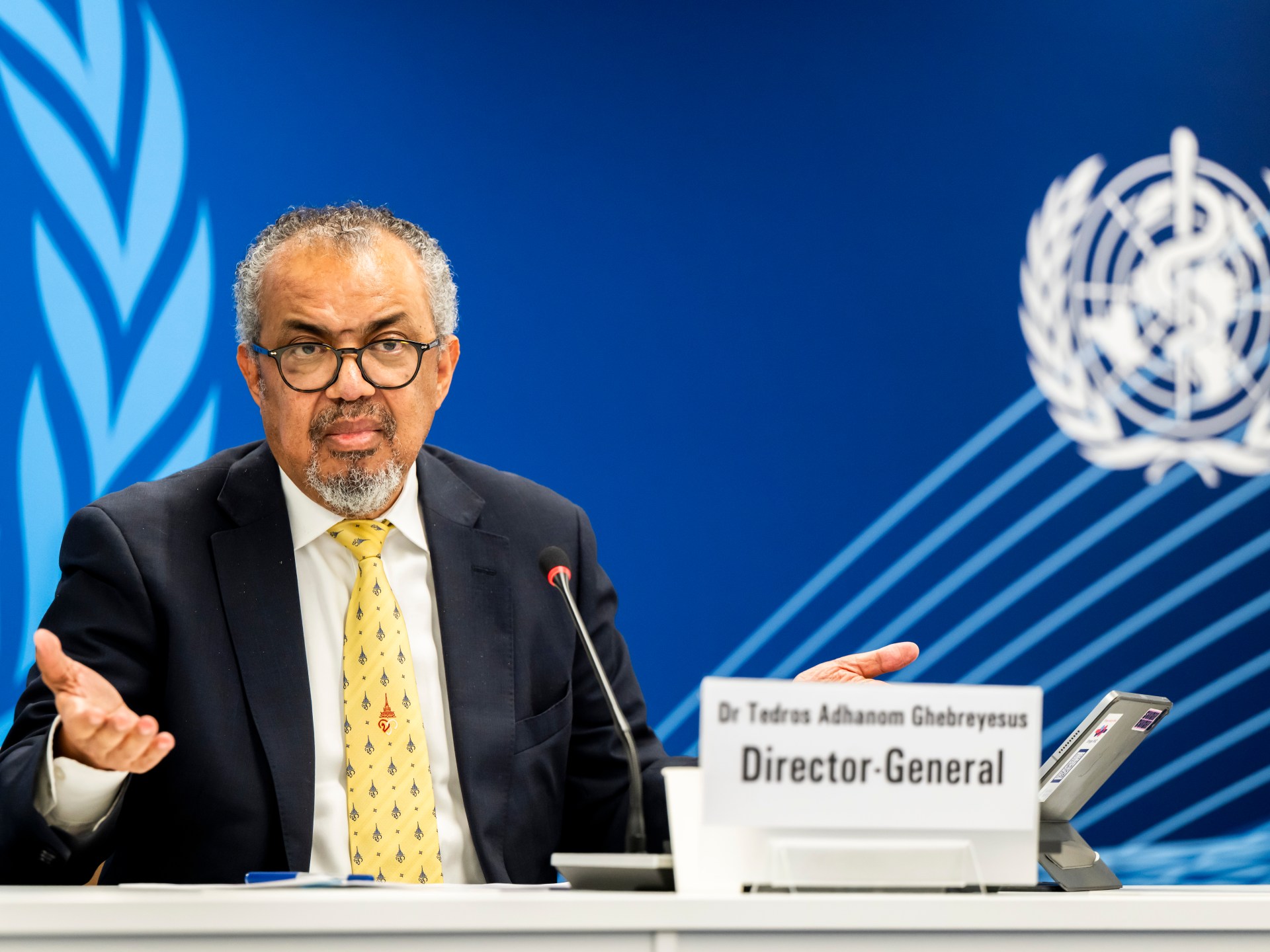
The WHO chief said on Tuesday that he was “deeply concerned about the scale and speed of the epidemic”, which has already started spreading into Uganda.
“Early on Sunday, I declared a public health emergency of international concern over an epidemic of Ebola disease in the Democratic Republic of the Congo and Uganda,” Director General Tedros Adhanom Ghebreyesus told the World Health Assembly in Geneva on Tuesday.
A meeting of the WHO’s Emergency Committee is scheduled for later on Tuesday to discuss the Ebola outbreak, Tedros said.
An emergency committee is made up of international experts who provide technical advice and recommendations to the WHO chief.
No vaccine or treatment exists for the Bundibugyo strain of Ebola, which is behind the latest outbreak of the disease, which has killed more than 15,000 people in Africa in the past half-century.
Kamba cautioned that the current death toll was an estimate and further research was needed to confirm whether all 131 suspected deaths were indeed caused by Ebola.

The outbreak’s epicentre is in the northeastern province of Ituri on the border with Uganda and South Sudan, whose status as a gold-mining hub leads to people regularly crisscrossing it.
Advertisement
The virus has already spread into neighbouring provinces, as far as 200km (125 miles) away from what has been identified as the epidemic’s ground zero and also beyond the DRC’s borders.
The Bundibugyo strain of Ebola has a fatality rate of up to 50 percent and no approved vaccine yet, but the panel of experts lmeeting on Tuesday will discuss vaccine options.
A vaccine named Ervebo, manufactured by Merck, is used for the Zaire strain of Ebola but has shown evidence of providing some protection against Bundibugyo in animal studies.
“When you have an outbreak with a strain that does not have countermeasures, we are going to advise on the best approach to take,” said Dr Mosoka Fallah, acting director of the science department at the Africa Centres for Disease Control and Prevention. “We will look at what evidence we have and make a decision.”
A World Health Organization official said that six tons of supplies to fight Ebola were set to arrive in the DRC on Tuesday, including personal protective equipment and other medical supplies.
“We have sent 12 tons of supply. An additional six are arriving today. These include personal protective equipment for frontline health workers (and) samples,” said Anne Ancia, WHO Representative in the Democratic Republic of the Congo’s Ituri province.
Meanwhile, Germany is preparing to admit and treat a United States citizen who contracted Ebola in the DRC, the German Ministry of Health told the AFP news agency.
“US authorities have requested assistance from the German government in treating a US citizen who contracted Ebola in Congo,” a ministry spokesperson said.
The US Centers for Disease Control and Prevention said Monday that the American had contracted the virus after exposure related “to their work” in the DRC and tested positive late on Sunday.