
Israelis head to the polls on October 27 in the first election since the genocide in Gaza and the wars on Lebanon and Iran, a vote widely seen as a referendum on Prime Minister Benjamin Netanyahu’s rule.
Since the start of the war on Gaza in October 2023, Israel’s parliament, known as the Knesset, has passed or advanced a wave of laws and motions affecting Palestinians, from rejecting their statehood and backing annexation of the occupied West Bank to cutting off the aid they receive.
Israel’s Jewish-led opposition casts itself as the alternative to Netanyahu’s right-wing government, but when it comes to Palestinians, the two often vote as one.
What do left and right mean in Israel?
Left and right are the most common way of mapping where parties stand on a political spectrum. The left generally favours more state spending and is more liberal on immigration and minority rights. The right generally favours lower taxes, tighter borders and a cohesive national identity.
In Israel, the labels work differently. They are defined less by economics than by the conflict with Palestinians. Broadly, the left has been associated with territorial compromise and negotiations, and the right with opposing a Palestinian state and supporting the growth of illegal settlements.
Israel’s political spectrum as a whole has shifted right, with once-fringe positions on Palestinians now very much the mainstream view. According to Palestinian political analyst Ehab Jabareen, much of Jewish Israeli politics now works from “assumptions that would have been treated as right-wing a generation ago”.
Advertisement
The chart below shows generally where each party sits on that spectrum today.

Israel’s parties and coalitions, explained
No party has ever won an outright majority in Israel’s Knesset.
To govern, a prime minister needs at least 61 of its 120 seats, which means building a coalition of smaller parties, often with competing demands. That gives small parties outsized leverage: if one walks out, the government can fall.

Netanyahu’s outgoing coalition
After the November 2022 election, Netanyahu’s right-wing Likud, the largest party with 32 seats, formed a 64-seat coalition. Its partners were two ultra-Orthodox parties, Shas and United Torah Judaism, and the far-right Religious Zionism alliance, a joint list of the Religious Zionism and Otzma Yehudit parties. It was Israel’s most right-wing government to date.

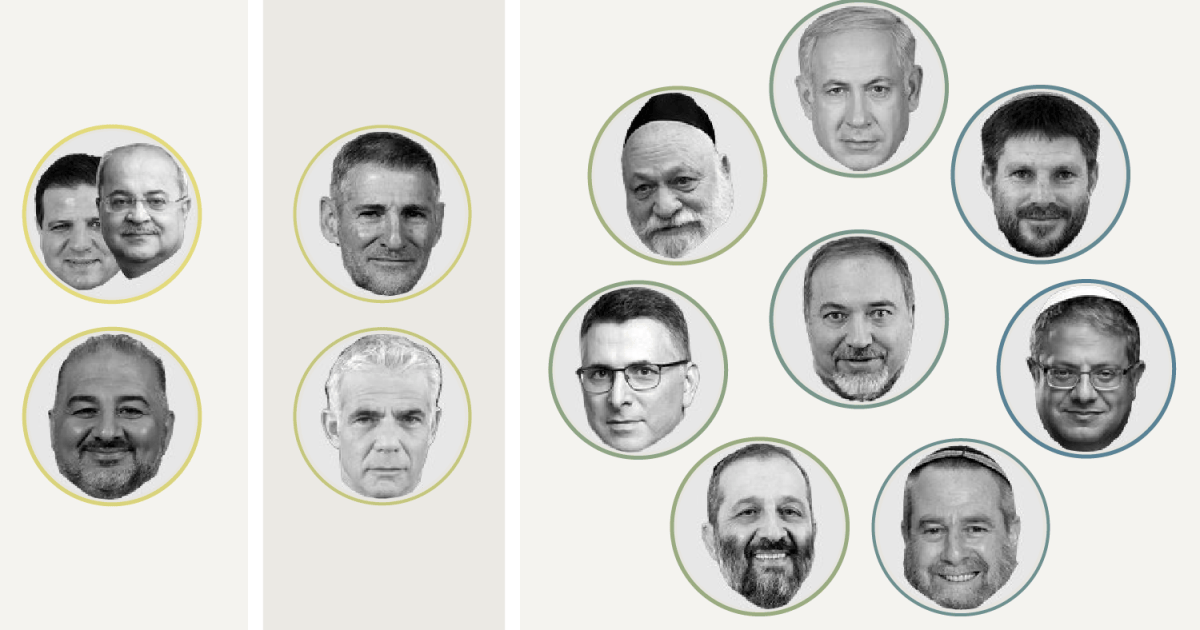
The far-right leaders are among the most powerful figures in government. Bezalel Smotrich, head of Religious Zionism, is finance minister and also holds authority over civilian affairs in the occupied West Bank, including settlement planning.

Itamar Ben-Gvir, head of Otzma Yehudit, is national security minister, in charge of the police. He and Smotrich have both pushed for annexation and settlement expansion, and both have used the threat of quitting to shape government policy.

The coalition has shifted repeatedly since. Benny Gantz’s National Unity alliance joined after the October 7, 2023 attacks by Hamas and left in June 2024, and Gideon Sa’ar’s New Hope joined that September. Ben-Gvir’s Otzma Yehudit quit over a “ceasefire” in Gaza in January 2025 and returned two months later. In July 2025, United Torah Judaism (UTJ) walked out over a stalled bill to exempt ultra-Orthodox men from military service. Shas, another party representing ultra-Orthodox voters, withdrew its ministers at the same time, but stayed in the coalition.
When parliament dissolved in July ahead of the October 27 election, the coalition held 60 seats: Likud (32), Shas (11), Otzma Yehudit (7), Religious Zionism (6) and New Hope (4).
Advertisement
The opposition
Opposition in Israel does not mean left. Yesh Atid, led by Yair Lapid, was the largest party in the outgoing Knesset, with 24 seats. Benny Gantz’s Blue and White was second. Both are centrist and have campaigned against a judicial overhaul proposed by Netanyahu and his coalition of religious and nationalist partners.
Yisrael Beiteinu, led by Avigdor Lieberman, is secular and right wing. Lieberman is a former Netanyahu ally who opposes draft exemptions for ultra-Orthodox men.
Labor, now part of the Democrats, is the only Jewish party in the outgoing Knesset that openly backs a two-state solution to the Israel-Palestine conflict.

The Arab-led parties, which represent Palestinian citizens of Israel, differ in ideology but share opposition to the occupation. Ra’am, led by Mansour Abbas, made history in 2021 as the first Arab party to enter an Israeli government. Hadash-Ta’al, led by Ayman Odeh and Ahmad Tibi, has never joined one. It is running in this election as part of the Joint List, alongside Balad.
How has each party voted?
Al Jazeera analysed the 10 most consequential Knesset votes affecting Palestinians between July 2024 and March 2026.
In Israel, a bill must pass three votes in the Knesset to become law. Most votes need only a simple majority of members present, and parties often stay away on purpose, either to deny a bill legitimacy or to avoid going on record. As a result, some votes in this analysis involve only a fraction of the 120-seat parliament. Some bills passed by wide margins, while others scraped through by a handful of votes.
What the data shows is that the left barely exists. The only consistent opposition came from the Arab-led parties and the four-seat Democrats, which together held 14 of the 120 seats in the last Knesset.
The results are shown in the graphic below, with a summary of the key votes beneath it.

‘No’ to Palestinian statehood
In February 2024, the Knesset backed a cabinet statement against unilateral recognition of a Palestinian state by 99 votes to 11.
The coalition, Yisrael Beiteinu and most members of Yesh Atid and National Unity – led by Gantz and comprising members of his Blue and White and Sa’ar’s New Hope party – voted in favour. Labor boycotted the vote, while only the Arab-led parties voted against.
The pattern repeated five months later. In July 2024, a resolution calling a Palestinian state an “existential danger” passed 68 to nine. National Unity, which by then had lost Sa’ar’s New Hope faction, joined the coalition and Yisrael Beiteinu in favour, Yesh Atid and Labor stayed away, and again only the Arab-led parties voted against.
Ahead of the election, the Jerusalem News Syndicate asked Israeli politicians from across the political spectrum, “Does your party support the establishment of a Palestinian state?” Every politician featured said “no”.
The Knesset’s votes reflect the public that elects it. Israelis’ view of Palestinian statehood had been declining for a decade, and it hardened sharply after October 7.
Advertisement
In spring 2023, 35 percent of Israelis told the Pew Research Center that Israel and a Palestinian state could coexist peacefully, down from 50 percent in 2013. By 2024, months after the attack, that had fallen to 26 percent. It reached 21 percent in 2025 and 17 percent in 2026, the first time a majority of Israelis have explicitly said coexistence is impossible.
On annexation of the occupied West Bank
In July 2025, a nonbinding declaration calling for the annexation of the occupied West Bank, including the Jordan Valley, passed 71 to 13. Yesh Atid and National Unity boycotted it. Labor joined the Arab-led parties in voting against the measure.
When annexation came to an actual bill, the lines blurred further. On October 22, 2025, during a United States vice-presidential visit, a bill that would apply Israeli law to the occupied West Bank passed in a preliminary reading by a single vote, 25 to 24:
- For: Religious Zionism, Otzma Yehudit and Yisrael Beiteinu
- Split: United Torah Judaism, 4 to 3
- Absent: Shas and New Hope
- Against: Yesh Atid, Labor and the Arab-led parties
Likud officially opposed the bill, with only lawmaker Yuli Edelstein voting for it. Had UTJ’s four votes in favour gone the other way, the bill would have failed.
UNRWA ban
The ban on UNRWA, the United Nations Relief and Works Agency for Palestine Refugees, drew the widest support of any binding law in the analysis.
Set up by the UN General Assembly in 1949 after the Nakba – or “catastrophe”, an Arabic word referring to the ethnic cleansing of Palestine in 1948 – UNRWA provides schools, healthcare, food aid and other basic services to nearly six million registered Palestinian refugees in Gaza, the occupied West Bank, including East Jerusalem, Jordan, Lebanon and Syria.
In October 2024, the first of two bills barring the agency from operating in territory Israel considers sovereign, including occupied East Jerusalem, passed 92 to 10. The second, cutting off all state contact with UNRWA, passed 87 to nine. Both laws took effect in January 2025, despite warnings from the UN and Western governments that they would cripple aid operations.
Netanyahu’s ruling coalition, Yisrael Beiteinu, Yesh Atid and National Unity all voted in favour, as did the Labor members of parliament who were present. The Arab-led parties were the only ones to vote against.
The election may change who governs Israel, but not necessarily how its parliament votes on Palestinians, especially as the electorate itself moves further right.
Related News
White House bars CNN from Air Force One for Trump’s upcoming trip

‘Still a lockdown’: Deadly floods hit Nepal tourism as peak season begins

Is Iran charging a toll to allow oil traffic through Hormuz?