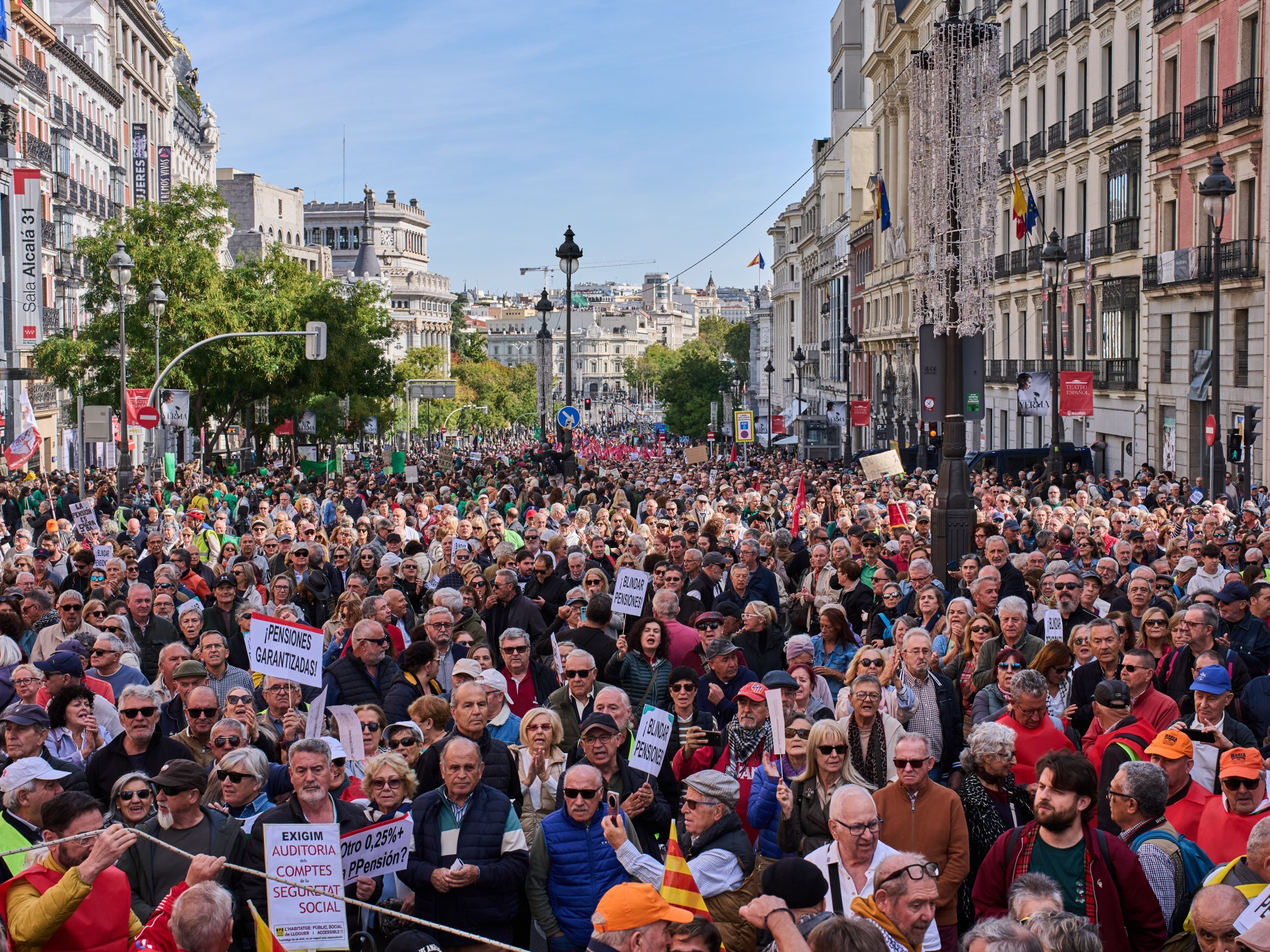

Approximately 25,000 people have gathered in the Spanish capital in support of the state pension scheme, as protests continue across Europe, prompted by a range of issues, including the cost of living, school conditions and alleged corruption.
Protesters from across the country marched through Madrid on Saturday before next month’s general election.
- list 1 of 3Can European leaders fix the cost-of-living crisis?
- list 2 of 3Why is Gen Z revolting?
- list 3 of 3Are parents in France and Italy liable for damage caused by student protesters?
end of list
The pressure on Spain’s state pension scheme is being driven by several factors, including an ageing population, a low birth rate and wage stagnation, as well as a declining ratio of workers to pensioners.
Demonstrators are concerned that the state pension scheme could be significantly weakened depending on who wins next month’s election. The country’s monthly pension bill hit a record high this year of almost 14.5 billion euros ($16.2bn).
Protesters marched from Atocha train station to the Gran Via, Madrid’s busiest and most famous street.
Several of the demonstrators carried banners reading “protect and guarantee our pensions”.
Emilio Delgado serves as the deputy spokesperson of the left-wing party Mas Madrid in the Assembly of Madrid. Posting on X, he said that “no pension should be below the minimum wage. A lifetime of work deserves a dignified retirement.”
Protesters want pensions to remain indexed to inflation and are calling for the gender pension gap to be eliminated.
Prime Minister Pedro Sanchez has accused the right-wing Popular Party (PP) of planning to weaken inflation-linked pension increases if it wins next month’s election.
Advertisement
However, leader Alberto Nunez Feijoo said on Monday that he would continue to raise pensions in line with inflation if his party wins the vote.
Sanchez has pledged to protect pensions if he remains in office and says the current pension system is affordable.
The system has gradually become more reliant on state funding because of a growing number of pensioners and increases in monthly payments.