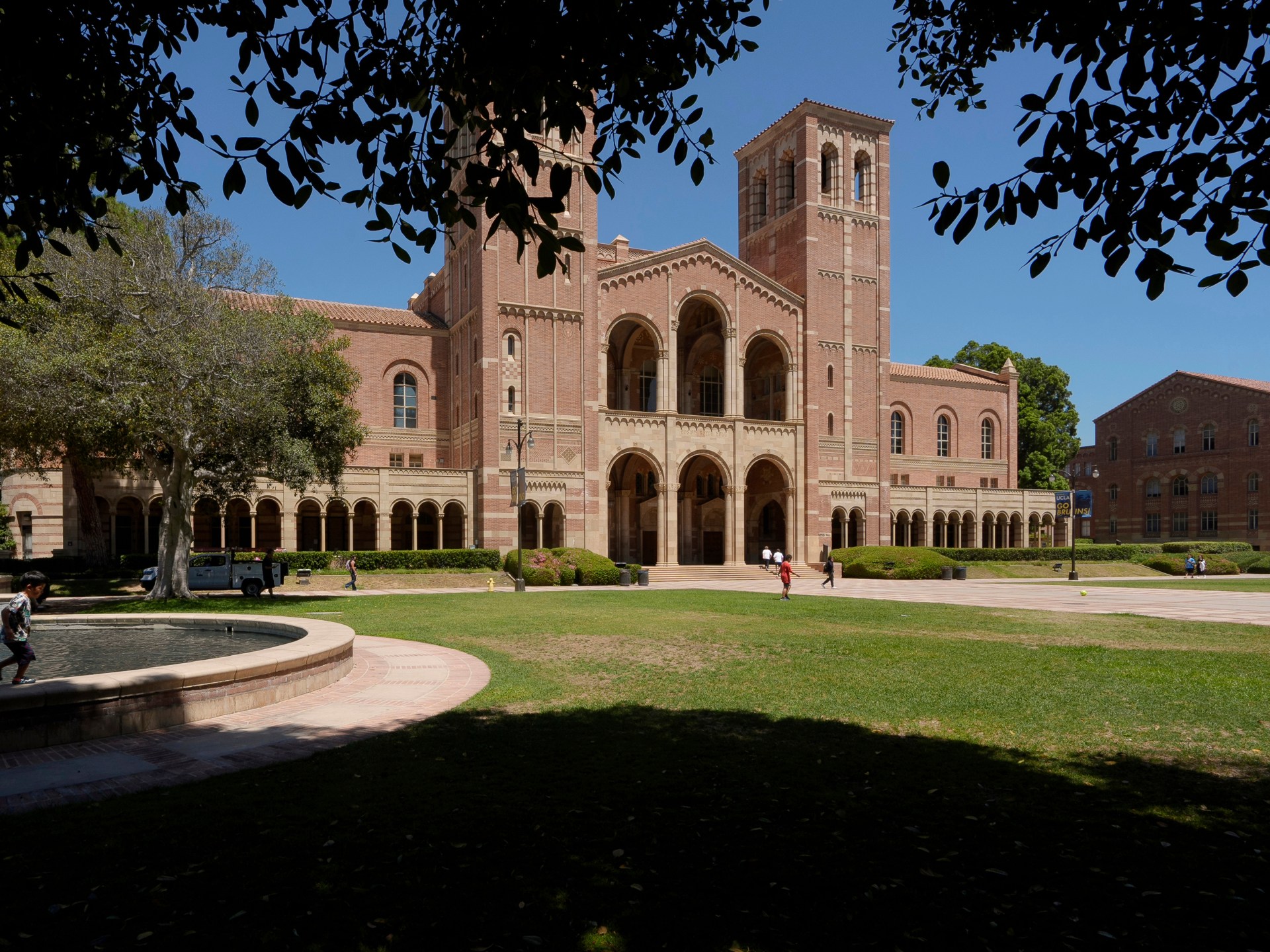

The United States Department of Justice has filed a lawsuit against the University of California at Los Angeles (UCLA), alleging that its “administration turned a blind eye to – and at times facilitated – grossly antisemitic acts”.
Tuesday’s lawsuit marks the latest example of a campaign under President Donald Trump to crack down on campuses that hosted large pro-Palestinian protests.
- list 1 of 3Trump offers UCLA $1bn settlement amid pro-Palestine protest standoff
- list 2 of 3Why is Columbia University expelling pro-Palestine students?
- list 3 of 3DOJ accuses George Washington University of indifference to anti-Semitism
end of list
Critics, however, have accused the Trump administration of seeking to dampen the free speech of activists it disagrees with.
In a statement, the Department of Justice said that the university had created a “hostile work environment” for Jewish and Israeli workers amid protests against Israel’s genocidal war on Gaza.
“According to today’s complaint, after the Hamas-led massacre in Israel on October 7, 2023, antisemitic acts pervaded UCLA,” the department wrote.
The lawsuit accuses UCLA of violating Title VII of the 1964 Civil Rights Act, which prohibits employment discrimination based on a number of factors, including religion.
The “general atmosphere of antisemitism” was “so severe and so pervasive” at UCLA that it constituted a “hostile work environment” under the law, according to the Justice Department’s complaint.
The lawsuit cites the Palestinian solidarity protests that unfolded on UCLA’s campus after the start of Israel’s war on Gaza.
“Based on our investigation, UCLA administrators allegedly allowed virulent anti-Semitism to flourish on campus, harming students and staff alike,” said Attorney General Pamela Bondi.
Advertisement
But critics consider the lawsuit the latest chapter in an ongoing pressure campaign to force top universities to align with the Trump administration’s priorities.
Inside the student protest movement
Israel’s war on Gaza has killed more than 75,000 people, according to Gaza’s Ministry of Health and other sources. Israel launched its genocidal military campaign against Gaza in 2023, after a Hamas-led attack left nearly 1,200 people dead in southern Israel.
Amid reports of widespread human rights abuses, including torture and starvation, student protesters held demonstrations on college campuses across the US in 2023 and 2024.
Trump campaigned for re-election in 2024, during the height of the movement to erect solidarity encampments on school grounds. His campaign platform called for dismantling the protests as one of 20 national goals.
“Deport pro-Hamas radicals and make our college campuses safe and patriotic again,” one of the platform’s bullet points reads.
Trump has long accused the pro-Palestinian movement of creating an unsafe learning environment.
But many protest organisers, some of whom were Jewish, have refuted allegations of anti-Semitism. Instead, they said their mission was to highlight the grave human rights abuses perpetuated by the Israeli government in Gaza.
Still, the student encampments faced crackdowns from university authorities and law enforcement. Thousands of students were taken into custody in 2024, though many were ultimately released without charge.
One encampment at UCLA that year was attacked by a group of right-wing supporters of Israel, wielding pipes and spraying mace at pro-Palestine protesters. Activists argued that the police allowed the violence to happen, before forcibly clearing the encampment the next day.
UCLA agreed to pay a $6m settlement to three Jewish students and a professor last year, after they alleged harms during the protest movement.
The school has maintained it has taken multiple measures to address anti-Semitism on campus.
Tensions with universities
Since taking office for a second term in January 2025, Trump has sought to punish certain schools where protests were prominent, including Columbia University in New York City.
In March, the Trump administration froze federal funding to Columbia, starting a wave of uncertainty in the education sector, as other schools also saw their contracts and grants suspended.
Trump also deployed Immigration and Customs Enforcement (ICE) to arrest Columbia student leader Mahmoud Khalil, a permanent US resident, on the basis that his protests threatened US foreign policy.
Advertisement
Khalil and other foreign-born student protesters continue to fight deportation in the US court system.
In July, the Trump administration arrived at a $220m settlement with Columbia, which saw the prestigious university accede to a list of demands in exchange for its federal funding being restored. Other schools, including Brown University and Cornell University, have likewise struck deals.
But schools, including Harvard, have so far refused to accept demands and costly settlements. They face ongoing investigations and penalties.
Last year, for instance, the Trump administration pressured UCLA, a public university, to pay more than $1bn in settlement fees in a letter that also demanded changes to its hiring and admissions processes.
At stake are more than $500m in frozen federal research grants to the school. The school has so far not agreed to pay the sum.
In July, the Justice Department also issued a notice of violation against UCLA, saying that its investigation had found violations of the Constitution’s Equal Protection Clause as well as the Civil Rights Act.
Advocates of the protests argue that the Trump administration’s efforts are a threat to the First Amendment of the Constitution, which protects free speech, the right to protest and academic freedom.
Related News
In Munich, Rubio urges transatlantic unity but lashes Europe on migration
Indian university faces backlash for presenting Chinese robot as its own
North Korea’s Kim Jong Un sets stage for daughter as his successor: Seoul