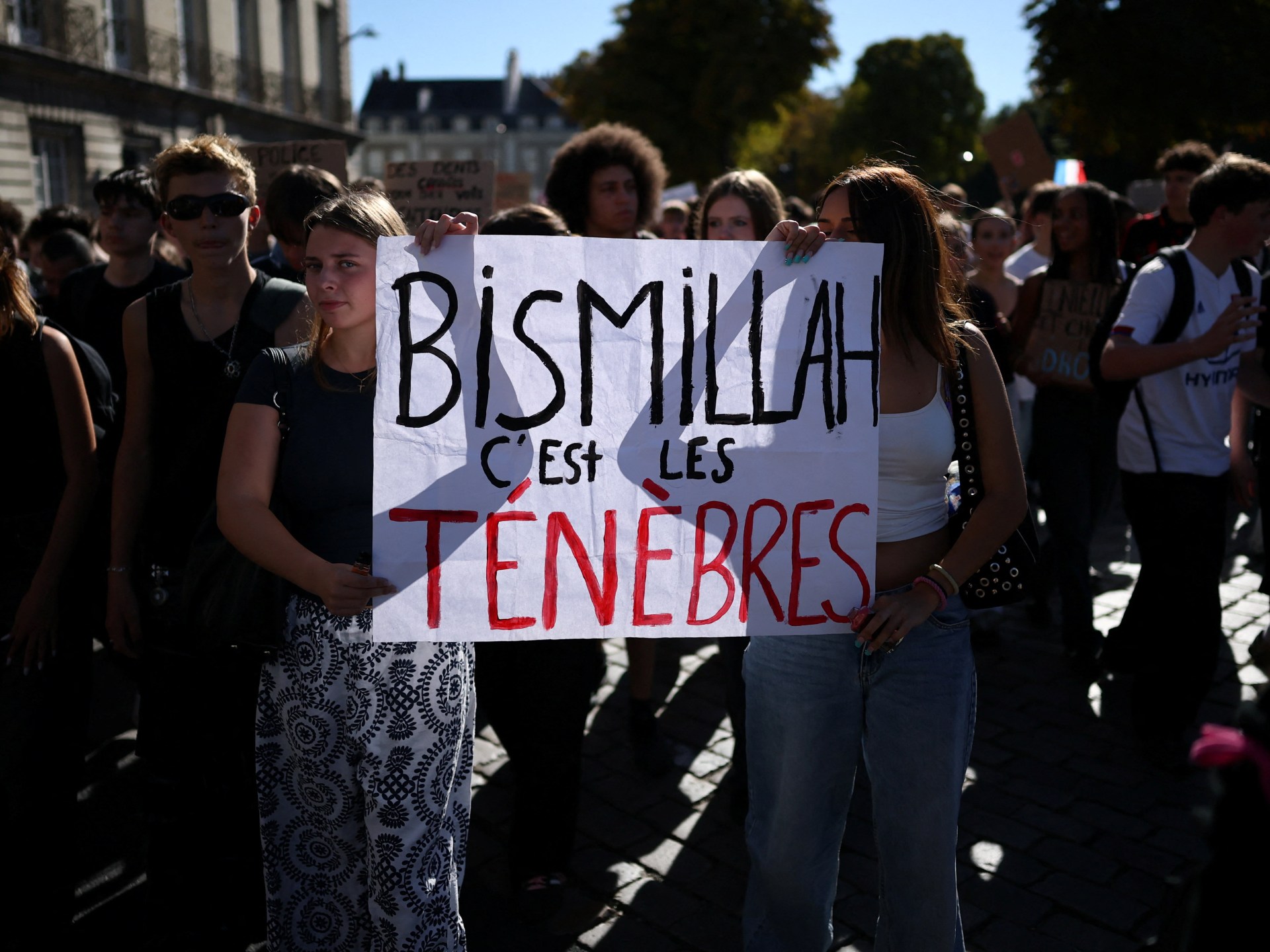

As violent protests roil France, bringing together students demanding better educational conditions and groups rejecting the high cost of living, one chant has become an improbable rallying cry: “Bismillah, c’est les ténèbres”.
The unofficial slogan does not mean much taken literally, but students have channelled a whole array of grievances that lie at the heart of the protest movement into this nonsensical expression. It is meant to mock racial stereotyping by the police.
- list 1 of 3Portugal cost-of-living protesters pour back into camps cleared by police
- list 2 of 3Italy approves sweeping security measures in response to protests
- list 3 of 3Ballon d’Or: Which countries and players have won the most awards?
end of list
Hundreds of thousands of people took to the streets nationwide over the weekend, in the largest mobilisation since protests over education reforms and rising prices began last month. The protest movement has been triggered by grievances ranging from overcrowded classrooms and teacher shortages to systemic inequality and lack of opportunity.
Police conduct has also come under scrutiny. France’s police inspectorate, the IGPN, has opened dozens of investigations into alleged police violence since protests began.
What does the slogan mean?
“Bismillah” is Arabic for “in the name of God”, an expression used by Muslims before beginning an activity. In French slang, it has lost some of its original meaning, becoming more akin to “let’s do it”.
“C’est les ténèbres” literally translates as “it’s the darkness”, which alludes to a situation that is bleak and hopeless.
The slogan therefore translates as “In the name of God, it’s the darkness”, which does not convey a clear message in and of itself.
Where did the slogan come from?
Students say the phrase is a mockery of the police force, which tried to infiltrate social media chats used by protesters to coordinate.
Advertisement
The screenshot of a Snapchat conversation featuring the expression began circulating in early October. In it, a user named Mamadou requests to be added to a group, saying: “Hi, in the name of God, it’s the darkness. When’s the blockade, wallah, bro?”
The message also featured emojis with Algerian flags.
Students say the message was sent by undercover police officers attempting to infiltrate their chats by using an unconvincing mix of Arabic and slang. The claim has not been verified and French authorities have not issued any statement.
Youssef El Chazli, associate professor in Arab and Mediterranean sociology at Paris 8 University Vincennes – Saint-Denis, said the phrase “reinforces an image of out-of-touch policemen filled with stereotypes”.
“Such stereotypes appear to disproportionately aim at youths from Arab and African descent,” El Chazli told Al Jazeera. “This appears as one more example of how out-of-touch state agencies seem to be with the current movement.”
The slogan has appeared on cardboard placards as a mockery of racial stereotypes and as a symbol of how authorities are out of touch with the realities of young people.
The slogan has spread as far as Italy and Belgium, where similar protests over the high cost of living and poor education also took place over the weekend.
El Chazli said satirical memes and internet trends have become tools to express political grievances during protests, which have traditionally been “inventive and creative”. “With youth mobilisations, protest creativity will draw heavily on youths’ subcultures,” he said.
Discussions around Islamophobia have also taken a front seat in public debate. French authorities have been reluctant to comment publicly on a significant spike in Islamophobic acts in France. One report cited by the Reuters news agency last year showed a 72 percent increase in such incidents during the January-March quarter of 2025 compared with the same period in 2024.
The French far right quickly resorted to racist language to blame Muslim youths for the violence, while United States President Donald Trump also chimed in, claiming that this is about “Islam wanting to take over”.
“What used to be a nonsubject 20 years ago is now a debated point,” El Chazli said. “For younger generations, Arab and African influences have been steadily mainstreaming in youth subcultures, owing to sports and arts figures, as well as new radio shows or social media content.”
Related News
UK PM adviser’s wife expresses ‘support’ for Palestine Action

White House bars CNN from Air Force One for Trump’s upcoming trip

Trump eases Russia oil sanctions, but is Europe still buying Moscow’s gas?